State 4-H Dog Skill-a-Thon Contest
Objectives
The primary objective of the Washington State 4-H Dog Skill-a-Thon Contest is to provide an opportunity for 4-H members to demonstrate knowledge and understanding of animal science and management related to dogs in a competitive setting. 4-H members are also given the opportunity to expand their knowledge about dogs and be recognized for their understanding of the many aspects of dog care and training, as well as the roles of dogs in society.
The Skill-a-Thon offers age-appropriate quizzes and stations that are designed to test 4-H members’ knowledge of dogs. Some stations may include visual diagrams or equipment or hands-on activities to demonstrate a dog-related task. The contest superintendent strives to provide an educational experience for participants and spectators.
Contest Rules
- Contestants must be 4-H members enrolled in the dog project and approved by the 4-H Extension Staff of their respective county.
- All participants must follow the Washington State 4-H Dog Program Policies Dress Code.
- This is a contest in which individuals compete. There will be no team entries.
- There is no limit to the number of individuals that each county may enter in this contest.
- Each participating county is requested to provide contest helpers as follows:
- an adult volunteer to help score the contest,
- an adult volunteer to serve as a station monitor or group leader.
- All challenges to the contest, including stations, official’s decisions or results, must be submitted in writing to the State Fair Manager at the Washington State 4-H Fair or the contest Superintendent at county fair within 24 hours of the contest.
- Contestants that do not comply with the rules will be disqualified.
- Coaches or spectators engaging in unsportsmanlike conduct or disruptive behavior will be asked to leave the contest area.
- All electronic devices, including but not limited to tablets, calculators, and cell phones, are prohibited unless being used as a medical device. If a contestant’s phone should ring, or if they are observed using electronic devices during the contest, the contestant will be disqualified.
If an individual has a disability and needs reasonable accommodations, see our Reasonable Accommodation Policy.
Judges
Official judges will work with the contest superintendent to place the stations. Judges are responsible for evaluating the individual contestants on the appropriate scorecards and submitting the scorecards to the superintendent at the conclusion of the contest.
Contest Phases
- The Quiz Phase of the contest will include questions from the Washington State 4-H Dog Showmanship Questions Study Guide.
- Juniors: 10 questions
- Intermediates: 20 questions
- Seniors: 30 questions
- The Station Phase of the contest will consist of a series of stations or tables where contestants will respond to the requirements of the station. Stations can be the same or different among age groups, i.e. Juniors can do some of the intermediate stations, etc., but age level should be taken into consideration.
- Juniors: three stations
- Intermediates: six stations
- Seniors: nine stations
- Examples of stations that may be used include, but are not limited to:
- Breed Identification: breeds must be recognized by AKC by January firstof the current year; miscellaneous and foundation stock are not to be included
- Care and Behavior
- Equipment Identification: includes care, grooming, training. handling, showing, and dog sports
- Nutrition and Feed Identification
- Health and Diseases
- Insects and Parasites
- Anatomy and Physiology: includes external parts, skeletal, internal organs, parts of the gastrointestinal tract, and reproductive organs
Scoring
- Each question in the quiz phase is to be worth two points.
- Each station in the station phase is to be worth 50 points.
- Ties in the overall contest will be broken in the following order:
- Highest score in the Quiz Phase; if still tied, then
- Highest total score in the Station Phase; if still tied, then
- The scores at each station, in order, may be used.
- Ties within any phase of the contest are to be broken using the overall score first and then the same sequence as above.
- Contest stations will be available for viewing for a limited time following the contest, and official keys will be displayed at each station.
General Guidelines
Below are some suggested topics used for Skill-a-Thon stations. The format of questions can be matching games, multiple choice, short answers, or a demonstration of a skill, etc. Questions can be asked with visual aids such as models, microscopic slides, pictures, or computer screens. Each station should take less than four minutes to complete. Adult volunteers at each station are helpful to keep things moving smoothly and keep score.
Sources
- 4-H Dog Project Manual by AKC or American Kennel Club
- Washington State 4-H Dog Showmanship Questions Study Guide
- Washington State 4-H Guide to Dog Showmanship
- Washington State 4-H Guide to Dog Obedience
- Washington State 4-H Dog Program Policies
- Welcome to 4-H
- Baker Institute for Animal Health CPR for Your Dog or Cat
- The Complete AKC Dog Book, 20th Edition; page 765 for anatomy diagrams, pages 803-852 for further diagrams and anatomy definitions
- AKC.org: breed information
Skill-a-thon Scorecard
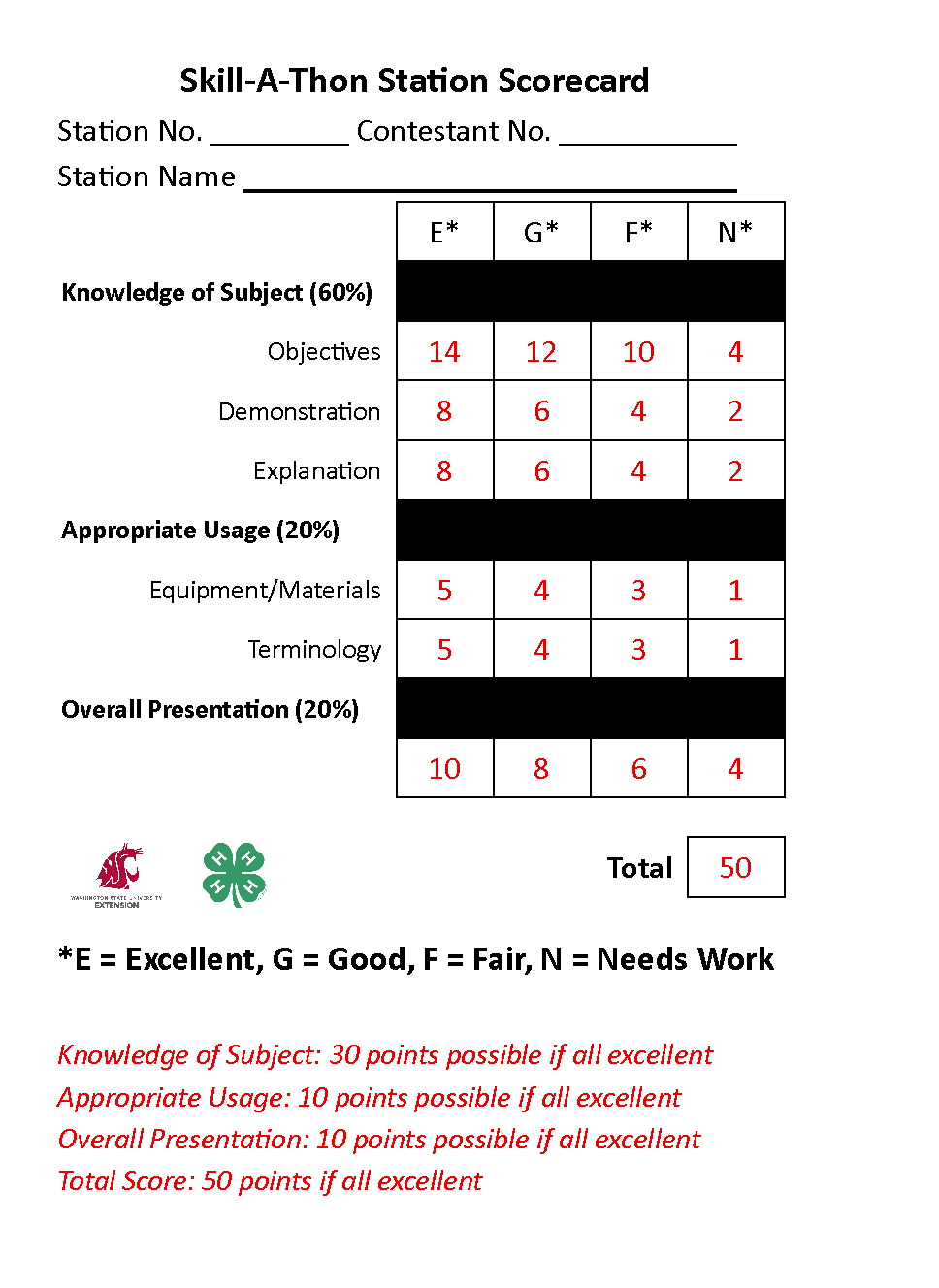
Scorecard Information
Information Reported:
- Station Number
- Station Name
- Contestant Number
Scoring
Members are scored on the following scale:
- E: Excellent
- G: Good
- F: Fair
- N: Needs Work
Areas scored are as follows:
- Knowledge of Subject: 60%, 30 points possible if all “Excellent”
- Appropriate Usage: 20%, 10 points possible if all “Excellent”
- Overall Presentation: 20%, 10 points possible if all “Excellent”
- Total Score: 50 points if all “Excellent”
Printable Scorecards
Select the image and use your browser’s Print Function to print a copy of each page. You can also use your Print Function to save the image as a PDF.
- For a Windows PC or Linux, use CTRL+P
- For a Mac, use command+P
You may need to adjust your print settings (such as margins, scale, orientation, etc.) to print cleanly. If you notice any unexpected borders, deselecting “Background Graphics” from the print settings can help.
Scorecards
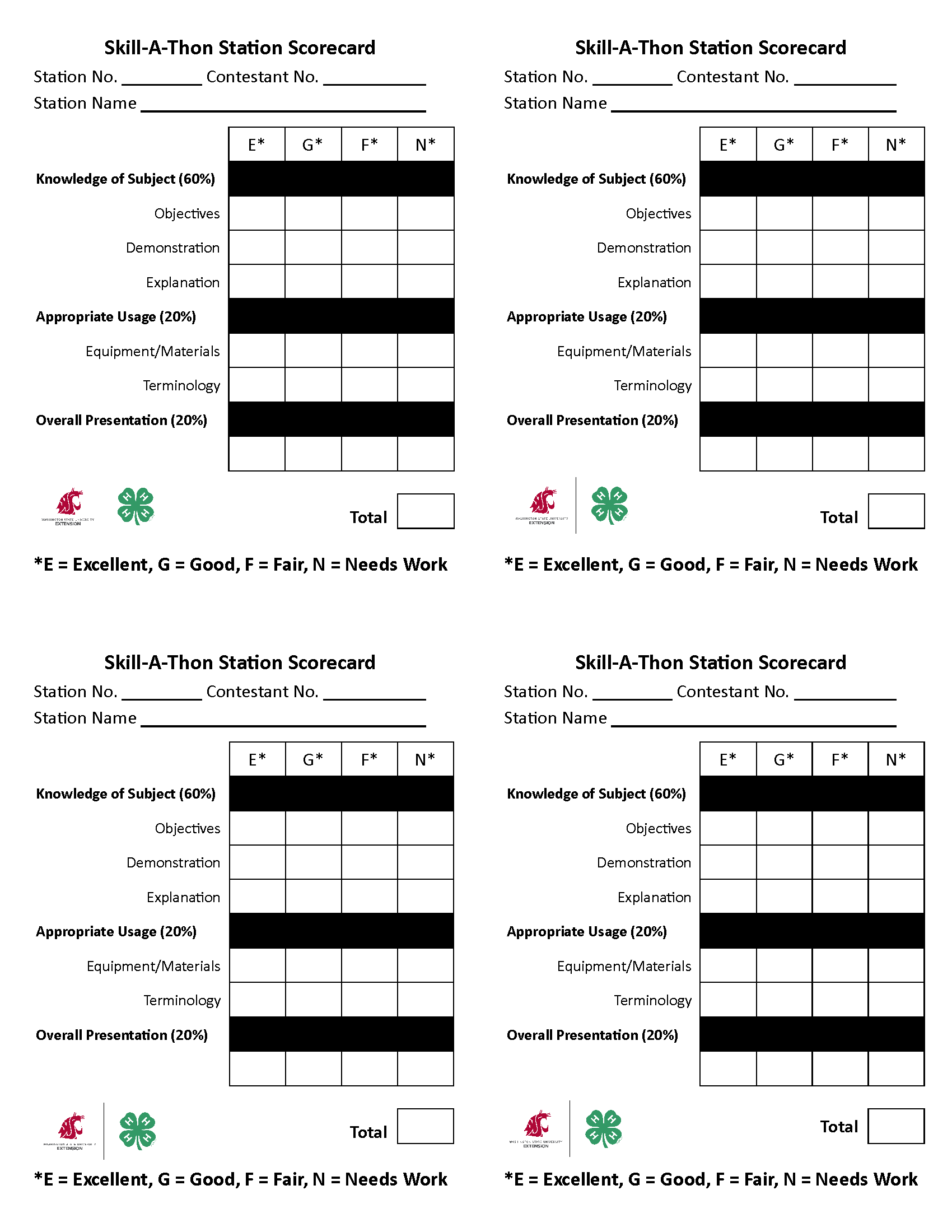
Scorecard Example