
Continuing Education

Template Tip: Coordinators receive frequent questions regarding ‘CE’. This would be your one stop shop for all that is ‘CE’. Note below that we have sorted the opportunities by program priority. As always, edit to your county’s requirements. Stay on top of your annual Continuing Education (‘CE’) Requirements:
- This is a tool to assist you in achieving your annual ‘CE’ requirement.
- It provides you a listing of pre-approved CE sorted by Program Priority
- With a list of Frequently Asked Questions.
More Information
What is Continuing Education ‘CE’?:
Education designed to improve a volunteer’s knowledge and skill base for performing work as a horticulture adviser and serving as a resource on issues of sustainable gardening. Volunteers must earn a certain number of hours (10 hours for certified MGs and 5 hours for emeritus MGs) of continuing education per year to be considered for reapplication. CE must be reported in GivePulse when earned.
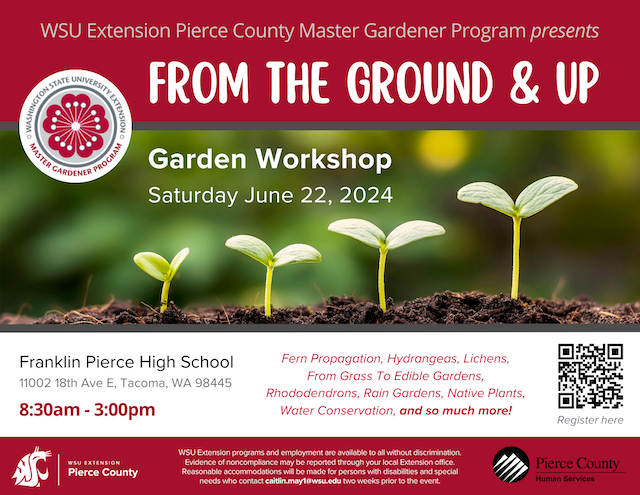
From the Ground & Up
Approved CE Catalog:
CE not specifically linked to a Program Priority:
- Urban and Community Tree Stewardship Training
- Use code: WSUMG100 to receive $100 off registration. MG cost is only $50.
- MG Role in ID’ing Invasives (video)
- 2024 MG Basic Training Lecture: Botany

Climate Change CE Resources
- Advanced Education Conference: Gardening in a Changing Climate
- 2024 MG Basic Training Lecture: Climate Change & Lawn Alternatives
Water Conservation CE Resources
- Waterwise Garden (video)
Local Food CE Resources
- Harvest Pierce County Edible Garden Series: Aug 24th, Harvesting and Storing Crops
- Harvest Pierce County Edible Garden Series: Sept 28th, Seed Saving
- Growing Groceries Classes (King County)
- Growing Groceries Education Series Registration (Snohomish County)
Soil Health CE Resources
- Harvest Pierce County Edible Garden Series: Sept 14th, Composting Basics
- Harvest Pierce County Edible Garden Series: Oct 5th, Putting the Garden to Bed
- 2024 MG Basic Training Lecture: Soil Science & Composting
Pollinators CE Resources
- 2024 MG Basic Training Lecture: Entomology & Pollinators
Plant Biodiversity CE Resources
- Seed Saving Mini Course: Floret Online Workshop – Floret Flowers

Clean Water CE Resources

Wildfire Preparedness CE Resources
Nearby Nature CE Resources
Frequently Asked Questions:
- Horticultural courses given by WSU, including retaking basic Master Gardener training.
- Webinars, field trips, and workshops sponsored by Extension.
- Classes offered by accredited institutions: community colleges, technical colleges, universities.
- WA State Department of Agriculture approved pesticide classes.
- Classes taught by professional associations, such as Washington State Nursery and Landscape Association, Washington Association of
- Landscape Professionals, International Society of Arboriculture, etc.
- Time spent doing research preparing a Master Gardener presentation which is then delivered to the community (limit of four times the length of the presentation).
- Time spent doing research for a newspaper or Master Gardener newsletter article which is then published (limit of four hours).
- Other activities, including training on how programs are planned, delivered, or evaluated; presentation skills; meeting facilitation; etc., may qualify.
Contact your program coordinator for pre-approval before reporting or enrolling.
- Trips and tours not preapproved by the program coordinator.
- Garden craft or photography classes.
- Personal research, reading, viewing not related to a WSU Master Gardener project or presentation.
- Travel time to and from events.
- Anything outside the state of Washington unless preapproved by the State WSU Master Gardener Program Leader.