For a printable version of this webpage: Plums
Plums
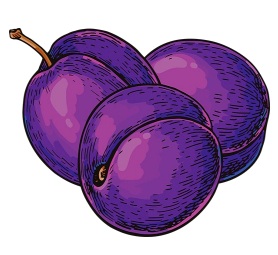
Plums belong to the rose family along with cherries, peaches, apricots and raspberries. There are hundreds of plum varieties grown throughout the world. The two types of plums, European and Japanese, both grow well in the Skagit Valley and most Italian prune types grow well in western Washington. The Japanese plums are a clingstone fruit, making the fruit hard to remove from the pit. They are very juicy and best eaten fresh, made into plum sauce, juice, jams and jellies and not well adapted to drying or canning. The European plums are a free stone fruit, which easily pulls away from the pit. They have a firm-flesh, often used for drying and canning.
Nutrition
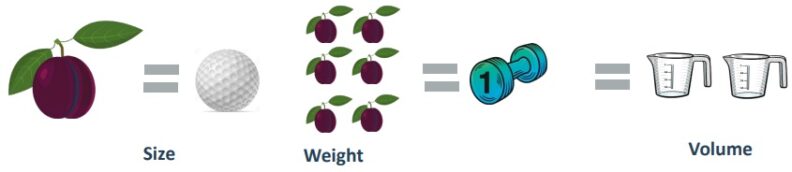
Plums are a fair source of vitamin A, vitamin C and vitamin K, and are a good source of fiber and antioxidants. One medium-size fresh plum, about two inches in diameter, has 27 calories, with no fat or cholesterol.
Selection
Choose tree-ripened fruit or slightly under-ripe fruit. Choose plums that are shiny, plump and firm to the touch. Avoid moldy, soft, bruised or those with broken skin. A little brown discoloration on the skin may indicate sunburn, but the plum is safe to eat. Before processing, clean surface with running water.
Storage
Plums are highly perishable fruits because they ripen quickly after harvest. Unripe plums continue to soften after picking. Place in a closed paper bag at room temperature for one or two days to hasten the ripening process. It is not recommended to refrigerate unripe plums. Ripe plums will keep well in the refrigerator for up to a week.
Measurements
Freezing
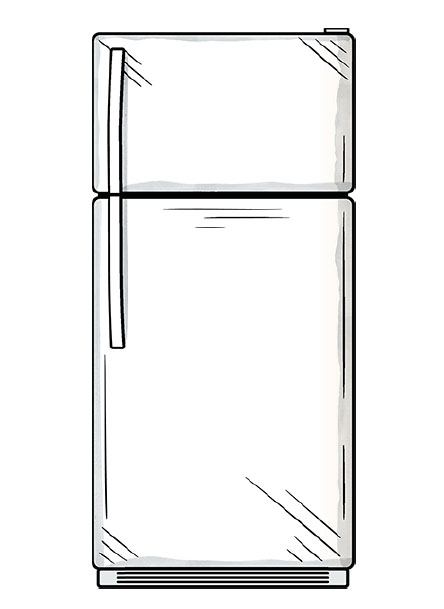
- Select fully ripe fruit that is not soft or mushy. Most fruit has the best flavor, color and food value when it is tree ripened.
- Carefully wash and sort fruit. Discard bruised, shriveled or over-ripe fruit.
- Leave whole, or cut to desired portions – halves, quarters, and remove pit.
- Pack plums in your choice of sugar syrup, sugar, or without sugar in moisture-vapor proof freezer containers or freezer weight plastic bags. Leave 1/2 inch of headspace for expansion during freezing.
- Plums can also be frozen first on a tray, then packed into moisture-vapor proof freezer containers or freezer weight plastic bags.
- Label, seal and freeze.
Drying
Preparation:
Choose sweet, fully ripe fruit. Wash, cut in half, pit and leave peel intact. Leave in halves or cut in quarters or slices. Many plums must be cut free from the stone (pit), others may have a freestone which is easily removed.
Pretreatment:
No pretreatment is necessary.
Drying Procedure:
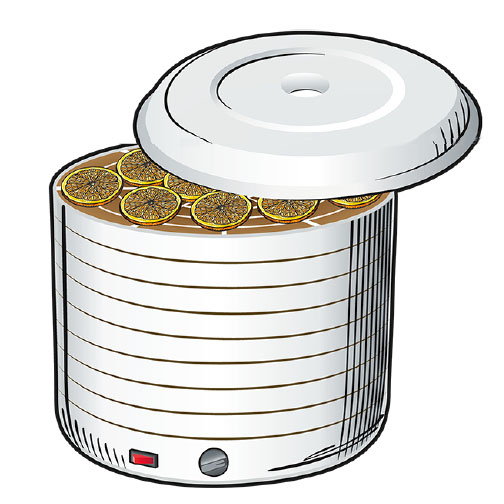
- Arrange in single layers on dehydrating trays, pit side up. Dry at 140°F for 24-36 hours for halves. Dry until leathery and somewhat pliable.
- Cool thoroughly. Package dried plums in moisture/vapor-proof containers. Label. Store in a cool, dark, dry place.

Tip: The plum will dry more evenly when pressed to flatten the fruit.
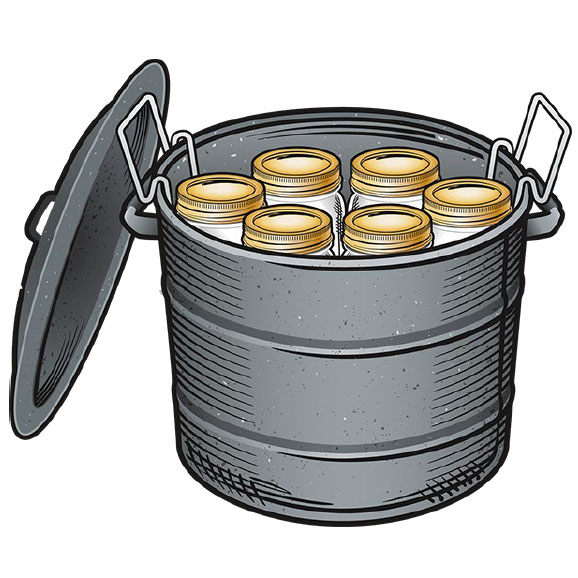
Water Bath Canning
Canned Plums
An average of 14 pounds is needed per canner load of 7 quarts; an average of 9 pounds is needed per canner load of 9 pints.
Remove stems and wash. To can whole plums, prick skins on two sides with a fork to prevent splitting. Freestone varieties may be halved and pitted.
Hot Pack. Heat plums in boiling water, sugar syrup of choice or juice. Boil for two minutes. Cover the saucepan and let the mixture stand for 20-30 minutes. Pack hot jars with hot plums, cover with cooking liquid, leaving ½ inch headspace.
Raw Pack. Fill hot jars with raw plums, packing firmly. Cover with boiling water, syrup, or juice, leaving ½ inch headspace. Remove air bubbles and adjust headspace if needed. Wipe rim with clean, damp paper towel. Adjust two[1]piece lids and process in boiling water canner according to directions below.
At the completion of processing, turn off heat and wait 5 minutes before removing jars. Let cool, undisturbed at room temperature, for 12 to 24 hours and check for seals. Wipe jars, remove rings, label, and store in a cool, dry place.
Processing Directions for Canned Plums:
| Style of pack | Jar Size | 1–1,000 ft | 1,001–3,000 ft |
| Hot or Raw | Pints | 20 minutes | 25 minutes |
| Hot or Raw | Quarts | 25 minutes | 30 minutes |
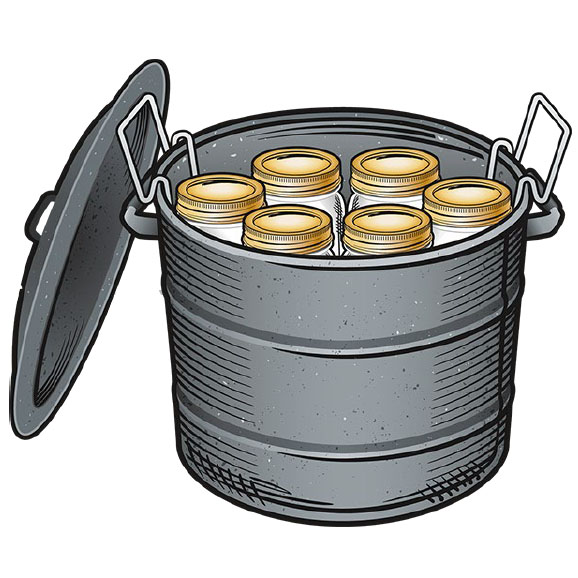
Water Bath Canning
Jams/Jellies/Preserves
Plums can be made into a variety of fruit spreads, either alone or in combination with other fruits. Recipes for jams, jellies and preserves can be found in commercial pectin packages.
Options are available for full sugar, low sugar and freezer jam products. Recipes using pectin have been carefully formulated and should be followed exactly. Cooked fruit spreads must be processed in a boiling water canner for storage at room temperature.
Plum Puree
Stem, wash, drain, peel, and remove pits if necessary. Measure plums into a large saucepan, crushing slightly if desired. Add 1 cup hot water for each quart of plums. Cook slowly until plums are soft, stirring frequently. Press through a sieve or food mill. If desired for flavor, add sugar to taste.
Reheat pulp to boil, or until sugar dissolves, if added. Fill hot plum mixture into hot clean jars, leaving 1/4- inch headspace. Remove air bubbles.
Wipe rim with clean, damp paper towel. Adjust two[1]piece lids and process in boiling water canner according to directions below.
Once processing is complete, turn off heat, remove canner lid and wait 5 minutes before removing jars. Let cool at room temperature, undisturbed, for 12 to 24 hours and check for seals. Wipe jars, remove rings, label, and store in a cool, dry place.
Processing Directions for Plum Puree:
| Style of pack | Jar Size | 1–1,000 ft | 1,001–3,000 ft |
| Hot | Pints or Quarts | 15 Minutes | 20 Minutes |
Water Bath Canning
Plum Conserve
Yield: About 10 half-pint jars
- 2 ½ quarts chopped, pitted plums (about 4lbs)
- ¾ cup thinly sliced orange peel
- 2 cups seedless raisins
- 1 ¾ cups chopped orange pulp (about 2 large)
- 6 cups sugar
- 2 cups broken pecans or other nuts
Sterilize canning jars. Combine plus, orange pulp and peel, raising, and sugar; slowly bring to boiling, stirring occasionally until sugar dissolves. Cook rapidly almost to jellying point, about 15-20 minutes. As the mixture thickens, stir frequently to prevent sticking. Add nuts the last 5 minutes of cooking. Pour hot conserving into hot jars, leaving ¼ inch head space.
Wipe rim with clean, damp paper towel. Adjust two[1]piece lids and process in boiling water canner according to directions below.
Once processing is complete, turn off heat, remove canner lid and wait 5 minutes before removing jars. Let cool at room temperature, undisturbed, for 12 to 24 hours and check for seals. Wipe jars, remove rings, label, and store in a cool, dry place.
Processing Directions for Plum Conserve:
| Style of pack | Jar Size | 1–1,000 ft | 1,001–3,000 ft |
| Hot | Half Pints | 5 Minutes | 10 Minutes |
Water Bath Canning
Damson Plum Jam without added pectin
Yield: About 6 half-pint jars
- 5 cups coarsely chopped Damson plums (about 2 pounds)
- 3 cups sugar
- ¾ cup water
Sterilize canning jars. Combine all ingredients; bring slowly to boiling, stirring occasionally until sugar dissolves. Cook rapidly to, or almost to, the jellying point (which is 8°F above the boiling point of water, or 220°F at sea level). As the mixture thickens, stir frequently to prevent sticking or burning.
Remove from heat and pour hot jam into hot, sterile jars, leaving ¼ inch headspace. Wipe rims of jars with a dampened clean paper towel; adjust two-piece metal canning lids. Process in a Boiling Water Canner.
Wipe rim with clean, damp paper towel. Adjust two-piece lids and process in boiling water canner according to directions below.
Once processing is complete, turn off heat, remove canner lid and wait 5 minutes before removing jars. Let cool at room temperature, undisturbed, for 12 to 24 hours and check for seals. Wipe jars, remove rings, label, and store in a cool, dry place.
Processing Directions for Damson Plum Jam:
| Style of pack | Jar Size | 1–1,000 ft | 1,001–3,000 ft |
| Hot | Half Pints or Pints | 5 Minutes | 10 Minutes |
Preserve Skagit Crop Sheets describe three food preservation techniques—freezing, drying, and boiling water canning—consistent with USDA Food Preservation and Food Safety recommendations. Pressure canning for low acid foods such as meats and vegetables is not included.
Additional resources and recipes, as well as information on Pressure Canning, can be found on the WSU Skagit Food Preservation Website https://extension.wsu.edu/skagit/fam/food-preservation/ or the National Center for Home Food Preservation https://nchfp.uga.edu/index.html.
Copyright 2022 WSU Skagit Extension. Any opinions, findings, conclusions, or recommendations expressed on this fact sheet are those of the author(s) and do not necessarily reflect the view of the USDA. WSU Extension programs are available to all without discrimination