Read Full Article: 3,700 WA farms shut down in 5 years Why?,
By Mara Mellits Seattle Times staff reporter
There’s an old saying in the Valley: the land remembers.
It remembers calloused hands. It remembers the boots of grandfathers and the bare feet of children. It remembers harvests hard-earned and winters survived. But what the land cannot carry—what it was never meant to bear—is the silent weight on a farmer’s chest when the math no longer adds up, and the soul begins to crack.
Don McMoran, Director of Skagit County Extension and fourth-generation farmer, stands on that kind of soil every day. The same fields his great-grandfather chose as home now face an uncertain future—not because Don stopped showing up, but because the world around him changed faster than the soil could keep up.
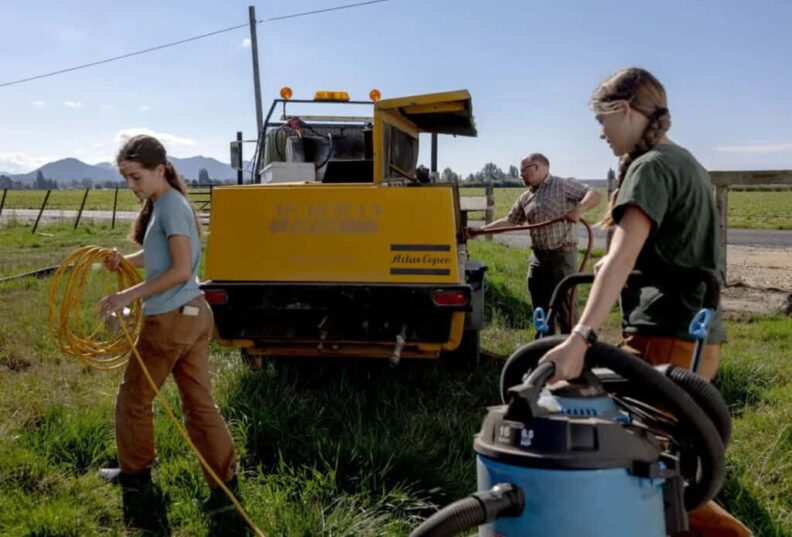
On a Wednesday morning in Mount Vernon, Don is not alone. His daughters, Allie and Abbie, both 16, move across the gravel with purpose. One carries supplies. The other helps vacuum fescue seed from a truck. They’re strong. Smart. Capable. But the story written into their DNA—the story of family farming—is starting to feel less like an inheritance and more like a burden.
“I don’t blame them,” Don says.
This isn’t sentiment. It’s fact. It’s the kind of truth you say with a shrug, not tears. Pressfield might call it Resistance—that invisible force that tells a warrior to lay down his sword. But for today’s farmers, Resistance doesn’t come cloaked in laziness or fear. It wears the mask of reality: soaring input costs, bureaucratic red tape, mental fatigue, and a marketplace that seems more interested in trend than tradition.

In five years, Washington lost 3,700 farms.
They didn’t go bankrupt all at once. They faded—silently—under the weight of diesel prices, labor costs, and the question every farmer asks at 4:30 a.m.: Why am I still doing this?
Don knows that question intimately.
“There was a time,” he says, “when you’d work hard and you could buy a new piece of land or replace your baler. Now, you bust your tail and end up asking the bank for a loan just to survive.”
It’s not just financial. It’s spiritual.

To farm is to live with failure as a neighbor and legacy as a shadow. You’re not just raising crops—you’re guarding a memory, trying not to let it slip through your hands. But the harder you hold on, the more it cuts.
When Don saw how many in his community were unraveling—good men, tough women—he didn’t keep working in silence. He did what few do in a profession built on stoicism: he spoke.
And he built something.
He and Dr. Conny Kirchhoff launched a free therapy voucher program for farmers and farmworkers—six sessions, no questions, virtual or in-person. No pickup trucks parked outside an office. No gossip in the co-op.
Just help.

And from that, something beautiful grew—Pizza for Producers, a dough-and-conversation model that gives farmers a place to breathe, laugh, and remember they’re not alone. It’s not therapy in the clinical sense. It’s communion. And sometimes, that’s where healing begins.
But what if none of this is enough?
What if Allie and Abbie never come back to the land?
What if the story ends here?
Don’s been asked that. He doesn’t flinch. “I’d love to work myself out of farm stress prevention,” he says. “But this year, it’s needed more than ever.”
This is not the part of the story with triumph and trumpets. It’s the part where the hero picks up his shovel again. Not because it’s easy. Not because the ending is guaranteed. But because that’s what you do.
Because the land remembers.
At Skagit County Extension, we’re not just holding workshops. We’re holding the line. We’re connecting people to mental health support, creating spaces for the next generation to find their own way into agriculture, and giving voice to those who’ve been told to bite their lip and keep pushing.
But maybe, just maybe, it’s time we stopped pushing and started reaching.
To the community.
To our neighbors.
To each other.
Because if we lose these farms, we don’t just lose fields. We lose stories. We lose roots. We lose the people who remember what this valley used to sound like in August—harvest in the air, laughter on the wind, and the quiet assurance that we were building something that would last.
Maybe we still are.
—
Read Full Article: 3,700 WA farms shut down in 5 years Why?,
By Mara Mellits Seattle Times staff reporter
Because this isn’t just about farming.
It’s about people.
And people matter.