Skip to main content Skip to navigation

Well and Septic System Maintenance Workshop (In-Person/Virtual)

Get Septic Certified and Save Money
Well & Septic System Maintenance and Septic Self-Inspection Certification
Tuesday March 31st, 2026
6:00 PM to 8:30 PM
In-Person or virtual options

Advanced registration is required and the cost is $18 per household (up to two). To register and find more details visit https://WS033126.eventbrite.com or email terry.koper@wsu.edu or call 564-397-5729. If you are unable to attend in-person, you may join online, by registering at https://WS033126_Online.eventbrite.com.

Clark County, WA –   Do you have a conventional gravity-fed septic system? Did you know Clark County requires you to have your conventional gravity-fed septic system inspected every 3 years? Attending this Well and Septic Workshop will allow you to inspect the system yourself every other time, instead of hiring a professional to do it for you each time. This can save you money. Having your septic system inspected by a professional often costs more than $100. You can save money by getting certified to self-inspect your system in our class which costs $18.00, saving homeowners money. Completing the workshop and a short exam will certify participants to self-inspect their own septic system every other time.

The workshop is taught by Clark County Public Health and will teach participants how to maintain and inspect their septic systems and safely maintain their well water. “Getting self-inspection certified is also a good long-term investment and participants will learn how to spot problems faster so they can have them fixed rather than looking at a costly system replacement”, says Terry Koper, Small Acreage Program Coordinator.

This workshop is hosted by the Small Acreage Program of Washington State University Clark County Extension with support from Clark County Public Works Clean Water. To find out about this and other events offered by the Small Acreage Program, visit http://go.wsu.edu/smallacreage.

Scholarships are available if registration costs are a barrier to attend. WSU Extension programs and employment are available to all without discrimination. Persons requiring special accommodations should call WSU Clark County Extension at (564) 397-5729 prior to the event.

Pruning Roses

MASTER GARDENER PROGRAM — MGs in the News

Broadcast on KATU, February 25, 2026

Liz Pike, WSU Extension Clark County Master Gardener, shared tips on Afternoon Live about pruning roses now for better blooms later.

See the video here.


The Washington State University Extension Clark County Master Gardener Program can be reached at (564) 397-5738, or by email: erika.d.johnson@wsu.edu

Current Use Taxation

Do You Qualify For Reduced Property Taxes?

Current Use Taxation

Current Use Vs. “Highest & Best Use”

 Current Use taxation designations provide landowners a tax break when their land use meets the criteria for farm/agricultural, timber land, open space, and forest land. Current use lands are taxed according to the value of the current use instead of the market value for development, such as residential, commercial, or industrial use. The development value is often called a land’s “highest and best use” which means its highest economic value if sold. However, these programs only defer taxes while the land remains in the designated current use. For this reason, landowners should plan to maintain these designations for the long-term. As outlined later, penalties make short-term classification costly.

Current use taxation promotes residents’ quality of life by preserving working landscapes that provide aesthetic, economic, and social benefits in the form of farms, forests, and open space. Encouraging these land uses also protects the quality of our water by maintaining vegetation and landscapes that filter and absorb storm water.

Types of Current Use Taxation

Farm and Agricultural Land

Requirements. For the three options below, applications require the signature of all owners of the land, a legal description, a site plan, and copies of IRS Farm Income Schedules for three of the previous five years. In some cases, a Farm Management Plan may be required.

Option One Criteria. Parcels or adjoining parcels must be twenty acres or more: 1) devoted mostly to livestock production or commercial agricultural commodity production; OR 2) registered in a federal conservation reserve program.

Option Two Criteria. Parcels or adjoining parcels must be less than twenty acres, but at least five acres in size generating at least

$200 per acre annually in commercial agricultural products during three of the preceding five years.

Option Three Criteria. Parcels must be less than five acres generating at least $1,500 per acre annually in commercial agricultural products during three of the preceding five years.

Qualifying lands can include up to 20% of the land in compatible incidental uses (such as a woodlot) along with buildings necessary to produce, prepare, or sell the agricultural products (e.g., barns, sheds) although potted nursery stock and greenhouse production may not count in Clark County.

Timber Land and Designated Forest Land

Requirements. Applications require the signature of all owners of the land and a Timber Management Plan.

Timber Land:

  • A minimum of 5 acres exclusive of the
  • Actively managed for growing timber for commercial
  • Must submit a timber management plan prepared by a professional
  • Must submit two copies of the complete application

Designated Forest Land:

  • A minimum of 5 contiguous acres in the same ownership, exclusive of
  • Actively managed for growing timber for commercial
  • Must meet minimum stocking level
  • Must submit a timber management plan prepared by a professional

Open Space

Requirements. Applications require the signature of all owners of the land and relevant documentation supporting the classification.

  • Mineral deposits on parcels exceeding 20 acres – or
  • Archaeological or historic sites listed on local, state, or national registry – or
  • Certain streams or springs on parcels exceeding 10 acres – or
  • Certain soil types on parcels exceeding 10 acres – or
  • Certain recreational opportunities on parcels exceeding 10
  • Must submit two copies of the complete application
Application Costs and Determining Land Value
Classification Current Use Value Cost to Apply *
Farm and Agricultural Land Based on earning capacity on similar land determined by soil class and commodity. $150 application
 

Timber Land

Based on land grades (composite of soil class and utility) used to determine per acre values supplied by DNR.  

$2,032 application

Designated Forest Land Based on land grades (composite of soil class and utility) used to determine per acre values supplied by DNR. recording fee
Open Space Based on soil classification. $2,032 application
* As of Janurary 2015, subject to change. Fees are non-refundable.


Timeline & Review Process

It takes over a year to process current use applications. Applications before December 31st of a given year will be processed during the following year and will apply to the taxes in the third year (application in 2004, processed in 2005, reduction in 2006 taxes if accepted).

Withdrawal from Current Use Taxation

Removing a property’s current use taxation designation prior to ten years automatically triggers a 20% penalty (mandated by state law) in addition to back taxes. When a property is withdrawn, the landowner must pay the deferred taxes for the previous seven years. The taxes are the difference between what was paid at the current use tax rate and what would have been paid had the property been taxed at the normal highest and best use tax rate. In other words, that is the amount of tax that was deferred while in the current use tax designation. In addition, the landowner will owe interest on the deferred tax amount consistent with the interest rate on delinquent taxes.

Classification Review Process for Accepted Applications
Farm and Agricultural Land Application review. Physical inspection. Assessor records tax lien with Auditor.
 

Timber Land

Application review. Physical inspection. County Planning Commission Public Hearing. County Commissioner Public Hearing. Applicants sign Community Development agreements. Assessor records tax lien with Auditor.
Designated Forest Land Application review. Physical inspection. Assessor records tax lien with Auditor.
 

Open Space

Application review. Physical inspection. County Planning Commission Public Hearing. County Commissioner Public Hearing. Applicants sign Community Development agreements. Assessor records tax lien with Auditor.

Selling Land in Current Use Taxation Status. The seller must pay the deferred taxes and any penalties and interest on the land being sold unless the buyer signs a Notice of Continuance on the Real Estate Excise Tax Affidavit and the Intent to Continue Current Use Classification form that demonstrate the buyer’s intent to maintain the property in the current use designation.

Plan for this to take some extra time to be processed. In this case, the buyer assumes the responsibilities required for the current use classification.

Current Use Example

In the following example, the owner of an 11 acre parcel wishes to place her land in the farm and agriculture current use designation. In this case, the homesite is considered one acre and is taxed at market value. The remaining 10 acres will be taxed at its current earning capacity. All parcels are unique and depend on specific conditions of each property. This example is for illustrative purposes only.

Market Value Taxation Current Use – Agricultural Land
 

Land Value

$129,500 for 11 acres $3,790 for 10 acres; One acre (homesite) @ $21,910; Total =

$25,710

Structure Value $48,500 $48,500
Total Value $178,000 $74,210
Taxes $2,670 per year $1,120 per year
Deferred Tax $1,550 per year


In this example, the landowner defers $1,550 each year while in the current use classification. When that land is withdrawn, the landowner will owe the last seven years of deferred taxes, plus seven years of interest on the deferred tax amount and any applicable penalties.

Who to Contact and Additional Resources

For further details and applications contact the Clark County Department of Assessment, 360-397-2092, ext. 5847 or current.use@clark.wa.gov. General office telephone 360-397-2391. Information and applications also available at: http://www.clark.wa.gov/assessor/ taxrelief/currentuse.html

WA Department of Revenue

References

Clark County, Clark County Chapter 3.08 Open Space Taxation, December 1996, 2 pages.

Clark County, Current Use Assessment, RCW Chapter 84.34, Farm and Agriculture, Timber Land and Open Space, Department of Assessment and GIS factsheet, February 13, 2003, 2 pages.

Clark County, Designated Forest Land General Information, Department of Assessment and GIS factsheet, March 3, 2003, 5 pages.

Clark County, Farm and Agricultural Land General Information, Department of Assessment and GIS factsheet, March 3, 2003, 5 pages.

Clark County, Open Space and Designated Forest Land General Information, Department of Assessment and GIS factsheet, March 3, 2003, 2 pages.

Clark County, Open Space Land General Information, Department of Assessment and GIS factsheet, March 3, 2003, 5 pages. Clark County, Timber Land General Information, Department of Assessment and GIS factsheet, March 3, 2003, 5 pages.

Washington State, Open Space Taxation Act, Current Use Assessment Information, Department of Revenue, Property Tax Division factsheet, January 1993, 11 pages.

Updated in 2014 by Eric Lambert.
Written by Doug Stienbarger with research assistance from Penny Ramey (February 2004).
The information in this publication is for informational purposes only and does not substitute for legal advice or obtaining guidance and advice directly from relevant Clark County departments. For specific and current information, contact Clark County.

The Small Acreage Program is sponsored in partnership by WSU Extension Clark County and the Clark County Clean Water Program.

Extension programs are available to all without discrimination.
Resources for School Gardens

MASTER GARDENER PROGRAM — Projects

Teachers often look to Master Gardeners for help creating in-class activities related to growing food, soil health, pollinators, and more.

This page of resources is in development. Please come back in March 2026.

Caring for Your Houseplants

MASTER GARDENER PROGRAM — MGs in the News

Broadcast on KATU, January 29, 2026

Ben Coleman, WSU Extension Clark County Master Gardener, shared tips on Afternoon Live about growing pest-free houseplants.

See the video here.


The Washington State University Extension Clark County Master Gardener Program can be reached at (564) 397-5738, or by email: erika.d.johnson@wsu.edu

Fruit Tree Pruning Workshop – Two Parts

MASTER GARDENER PROGRAM — Workshops & Events


Increase the beauty and productivity of your fruit trees with this informative, two-part, hands-on pruning class by locally renowned fruit tree expert, Monica Maggio. Timely pruning can improve the shape, strength, and fruit set of your trees, and help reduce pest and disease pressure.

Part One is a lecture on a Friday evening, delivered via Zoom (at your home), that will cover general pruning theory. You will be provided with a Zoom link a day or two prior to the class. Note: you must have a (free) Zoom account in order to attend.

Part Two is the following day, in an orchard. It will include experiential instruction on specific techniques to help you learn how to make the best cuts on your fruit trees with confidence and skill. This will be held rain or shine. This portion will include standing and walking the whole time. Dress for the weather and bring water. No tools necessary.

DATE/TIME: Friday, February 6, 2026 — 6:30pm to 8:30pm via Zoom and Saturday, February 7, 2025 — 10:00 a.m. to noon

LOCATION: East Vancouver. Location provided on registration.

COST: $50 plus Eventbrite fees and sales tax for both sessions. For the Friday evening online class, $20 plus Eventbrite fees and sales tax.

REGISTRATION Required. No admission without advance registration. Click here to register.

FOR MORE INFORMATION: (564) 397-5738 or Erika.d.johnson@wsu.edu.

Read about all Master Gardener upcoming events

WSU Extension programs and employment are available to all without discrimination. Evidence of noncompliance may be reported through your local WSU Extension office. Persons with disabilities who require alternative means for communication or program information or reasonable accommodation need to contact Erika Johnson at the above listed email, phone or mailing address at least two weeks prior to the event.

78th Street Heritage Farm Walking Tours

MASTER GARDENER PROGRAM — Workshops & Events

78th Street Heritage Farm
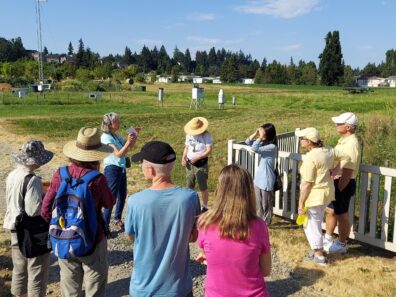
A Master Gardener docent leads a tour of Heritage Farm. One of the two weather stations at the site is visible in the background.

In 1924, if your family couldn’t pay its bills, what happened? You might have been sent to “the poor farm.”

That historic “poor farm” in Clark County is now the 78th Street Heritage Farm. It is home to demonstration gardens of the Master Gardeners program, with a history going back to 1865. Placed on the Washington Historic Register in 2012, the 79-acre property has a unique and compelling story for people of all ages.

Join a WSU Extension Clark County Master Gardener for a guided tour of the 78th Street Heritage Farm. Stroll the property with a knowledgeable docent and learn about the property’s storied history and its current role in horticulture education, agricultural research, food security and community enrichment.

Tours involve prolonged standing and walking on uneven ground with some elevation change. Bring water, dress for the weather. Advanced registration is required. Tour size is limited. Please don’t register if you aren’t sure you can attend.


DATES: Vary. See below under Registration.

LOCATION: Provided at registration.

COST: Free

REGISTRATION:

Saturday, May 30, 2026 10:00 a.m. – 11:30 a.m.

Saturday, June 13, 2026 10:00 a.m. – 11:30 a.m.

Tuesday, June 16, 2026 6:00 p.m. – 7:30 p.m.

Tuesday, June 23, 2026 6:00 p.m. – 7:30 p.m.

Saturday, June 27, 2026 10:00 a.m. – 11:30 a.m.

Tuesday, June 30, 2026 6:00 p.m. – 7:30 p.m.

QUESTIONS: Contact: erika.d.johnson@wsu.edu, 564-397-5738.

Read about all Master Gardener upcoming events

WSU Extension programs and employment are available to all without discrimination. Evidence of noncompliance may be reported through your local WSU Extension office. Persons with disabilities who require alternative means for communication or program information or reasonable accommodation need to contact Erika Johnson at the above listed email, phone or mailing address at least two weeks prior to the event.

Introduction to Plant Propagation (Hands On)

MASTER GARDENER PROGRAM — Workshops & Events

Looking for a cost-effective way to fill your garden? Have an heirloom plant you’d like to “make more of” and to share with family or friends?

There are literally thousands of plants you can propagate at home; all it takes are a few materials and a little technique. Join us for a fun, hands-on workshop with instruction on basic propagation techniques. Participants will take home two plants they propagate during the workshop.

If you have a small plant you’d like to propagate, bring it in a small pot. The class takes place in a greenhouse and requires standing. Bring drinking water and wear comfortable shoes.


DATE/TIME: Friday, April 3, 2026 / 9:30 a.m. to 11:00 a.m.

LOCATION: Information provided with registration.

COST: $10 plus taxes and Event Brite fee

REGISTRATION REQUIRED: Click here

FOR MORE INFORMATION: (564) 397-5738 or Erika.d.johnson@wsu.edu

Read about all of our upcoming events

WSU Extension programs and employment are available to all without discrimination. Evidence of noncompliance may be reported through your local WSU Extension office. Persons with disabilities who require alternative means for communication or program information or reasonable accommodation need to contact Erika Johnson at the above listed email, phone or mailing address at least two weeks prior to the event.

Hostas: Your Answer to Color in the Shade Garden

MASTER GARDENER PROGRAM — Workshops & Events

Think you can’t have color in your shade garden? You bet you can! Join Master Gardener John Wecks for a presentation on hostas, a variable and surprisingly colorful shade plant that thrives in the PNW. The talk will include tips on selection and planting as well as maintenance techniques for keeping your hostas healthy and happy. Learn how and when to divide them and share with friends.

DATE/TIME: Saturday, April 4, 2026 from 2:00 p.m. to 3:00 p.m.

LOCATION: Allene Wodaege Community Room
Ridgefield Community Library
210 North Main Avenue
Ridgefield, WA 98642

COST: Free

REGISTRATION: Not required

FOR MORE INFORMATION: Click here

Read about all Master Gardener upcoming events

WSU Extension programs and employment are available to all without discrimination. Evidence of noncompliance may be reported through your local WSU Extension office. Persons with disabilities who require alternative means for communication or program information or reasonable accommodation need to contact Erika Johnson at the above listed email, phone or mailing address at least two weeks prior to the event.

Grow Your Own Strawberries Workshop

MASTER GARDENER PROGRAM — Workshops & Events

Learn to grow your own strawberries!

There’s nothing better than a bowl of just-picked, sweet, juicy strawberries harvested from your own garden. Growing strawberries is something you can do without a lot of time or effort. Join WSU Extension Clark County Master Gardeners for an introductory workshop on growing strawberries.

The class will provide an overview of the three different types of strawberries followed by planting and care techniques for each. Common pests and diseases will be discussed. Participants will learn how to plant (and take home) a bareroot strawberry plant.

The class will be held outdoors and will require walking short distances on uneven ground. Those with mobility issues may drive into the site. Dress for the weather and bring water.


DATE/TIME: Saturday, April 11, 2026, 10:00 a.m. to 11:30 a.m.

LOCATION: Hazel Dell Neighborhood, address at registration. No admission without registration.

COST: $10 plus tax and Eventbrite fees = $10.61

REGISTRATION REQUIRED: Click here

FOR MORE INFORMATION: (564) 397-5738 or Erika.d.johnson@wsu.edu.

Read about all Master Gardener upcoming events

WSU Extension programs and employment are available to all without discrimination. Evidence of noncompliance may be reported through your local WSU Extension office. Persons with disabilities who require alternative means for communication or program information or reasonable accommodation need to contact Erika Johnson at the above listed email, phone or mailing address at least two weeks prior to the event.