Soil and Decay
Soil Formation
The formation of soil happens in a series of steps. At it’s very start, it’s erosion of stone, rich in mineral formation that it will release throughout its existence. You will see later how these minerals are extracted through synergy with microorganisms that form bonds with these materials, helping in the transfer to larger organisms and eventually our food sources.
The soil then, as you can imagine, forms slowly over time as rocks break down through weathering. During this time of accumulation, organic matter from plants, animals, and microorganisms living and dying, and decaying back into the cycle adding biological matter to the soil. Climate, living organisms, land geology and shape, as well as time interact to create distinct soil layers with different textures and nutrients. This ongoing process produces the living foundation that supports plant growth, water movement, and ecosystems. This process is known as the Five Factors of Soil Formation.
Soil formation is driven by five interacting factors — parent material, climate, time, biota, and topography — which together shape how sand, silt, and clay develop through physical and chemical weathering. Particle size reflects the degree of weathering over time: sand is least weathered and largest, silt is intermediate, and clay forms through extensive chemical transformation that increases water and nutrient holding capacity. To explore how these factors influence soil texture and development in greater detail, visit The University of Maryland Soil Basics for visual representation of this process.
The Addition of Organic Matter and Soil Food Web
Organic matter is the cornerstone of a healthy soil ecosystem, providing the essential biological and chemical foundations necessary for sustainable plant growth. Biologically, it serves as the primary energy and food source for a vast community of microorganisms, including bacteria and fungi, which are the catalysts for nutrient cycling and disease suppression.
The relationship between these organisms as they decompose organic materials, release critical nutrients such as nitrogen, phosphorus, and sulfur in forms that plants can easily absorb, effectively acting as a slow-release natural fertilizer. The soil food web is dynamic and integral to soil health. Chemically, organic matter significantly increases the soil’s cation exchange capacity (CEC), allowing it to hold onto positively charged nutrients like calcium and potassium, preventing them from leaching away while also buffering the soil against extreme pH fluctuations.
Learn more about your soil texture in two easy ways by performing first a Hand Texture Estimate and then a Slake Test. First you are going to learn about the feel of the soil and the parent material. Then the slake test will show you how the soil holds together under stress. When you do the hand texture test, make a prediction for what might happen during the slake. Compare what you learned to the NRCS Soil Database that has cataloged soils across the U.S. This is building intuition with your soil.
Physically, organic matter transforms the soil into a more resilient medium by dramatically improving its structure and water-handling capabilities. It acts much like a sponge, with the ability to absorb and hold up to 90% of its weight in water, which protects crops during dry periods and increases overall plant-available water by thousands of gallons per acre. This enhanced structure—characterized by stable aggregates and increased pore space—also promotes better aeration and faster water infiltration, which reduces the risk of surface crusting, runoff, and erosion. By darkening the soil, organic matter even helps it absorb more solar radiation, warming the ground more quickly in the spring to support earlier seed germination and more vigorous root development.
Organic Matter and Soil Stabilization
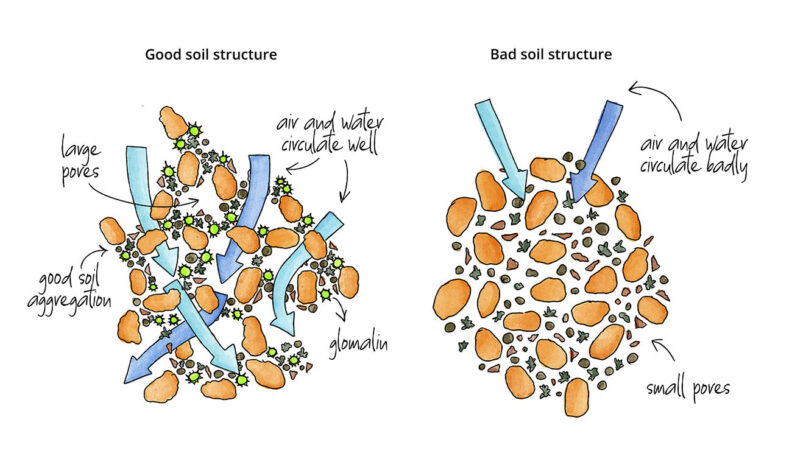
Organic matter is the cornerstone of a healthy soil ecosystem, serving as the primary fuel for a complex cycle of biological and chemical stabilization. As microorganisms like fungi and bacteria feed on organic residues, they secrete substances such as glomalin—a sticky, “soil-glue” protein that acts as a powerful short-term cementing agent to bind individual soil particles into stable aggregates. These microbial “organic glues,” combined with water-resistant substances produced by plant roots, provide the long-term structural integrity necessary for soil to resist erosion. Because these biological bonds take time to develop and are easily shattered, excessive tilling is discouraged; breaking up the soil physically disrupts these vital connections and rapidly reduces the soil’s ecological function.
This biologically-driven structure is what allows soil to master the balance between gravity and water retention. While large “macropores” created by these aggregates allow for rapid drainage and aeration, the tiny “micropores” within the aggregates use capillary tension to hold water against the downward pull of gravity. Through adhesion—water sticking to soil surfaces—and cohesion—water sticking to itself—the soil acts like a sponge, locking in moisture that would otherwise run through. By fostering these stable aggregates through organic matter, the soil creates a resilient environment. By increasing the total surface area for adhesion and the volume of micropores, every 1% increase in organic matter can help an acre of soil store thousands of additional gallons of water.
Composting Science
While nature’s pace is slow and unmanaged, human-led composting optimizes the recycling of organic matter through two distinct scientific paths: active (hot) and passive (cold) methods. In nature, decomposition happens sporadically based on the weather, but in composting, we intervene to ensure that organic residues are transformed into stable nutrients rather than simply rotting or off-gassing into the atmosphere. The science of composting is essentially the art of managing microbial metabolism—balancing air, water, and food to turn “waste” into a concentrated biological asset.
Passive composting, mimics the natural forest floor but with a more intentional focus on moisture and volume. It operates at ambient temperatures and relies on a broader cast of characters, including “cool” microbes and macro-organisms like red wiggler worms and mites. While it lacks the speed and sanitizing heat of a hot pile, passive composting is scientifically valuable because it preserves certain heat-sensitive beneficial fungi and microbes that might perish in a hot system. Both methods serve to hone the natural cycle, ensuring that carbon is sequestered back into the soil as humus rather than escaping as greenhouse gases.
Soil Health Resources
Did You Know?
Soil stability is a strong indicator of biological activity, energy flow, and nutrient cycling. Soil aggregates must be continuously rebuilt by living organisms—and composting is one of the most effective ways to support this living system.
Soil is alive, it isn’t just dirt—a living, breathing system shaped by geology, time, and the continuous cycle of growth and decomposition. Its structure, fertility, and resilience come from the plants, roots, and organisms that grew, died, and returned to the earth.
- Oregon State Extension Service Soil: The dirty secrets of a living landscape
- Rise Foundation: The Four Stages of Composting
- The Soil is Alive from Tianna DuPont, WSU Extension and Indika Ratnayake
- The role of Glomalin in Enhancing Soil Health and Stability by Greenwood Nursery U.K.
- Who they are and how to get them to stay: Beneficial Insects, Spiders, and Mites in Your Garden
- Life in the Soil – a 30 minute video shows how organisms interact, provides insight to farmed land, and natural pest management.
- Soil and Health Library: Repository of AU Research Articles
- What is in a Slake Test by United States Dept. of Agriculture
- How to do a Slake Test based on NRCS resources
- Video: Water and Soil Interactions: the Sponge Analogy for Soil Moisture
- Video: Determining Soil Texture by Hand by WSU By Dr Craig Cogger.
General information about soil properties. Enter your address for what soil series are present at your location.
- The Web Soil Survey website has soil survey information on-line that is easily accessible
- Also as an app called “SoilWeb” for Android or iPhone.
- WSU Whatcom County Extension: Sustainable Landscaping
- King County Solid Waste and Seattle Public Utilities: Natural Yard Care Booklet
- Seattle Public Utilities: Growing Healthy Soil
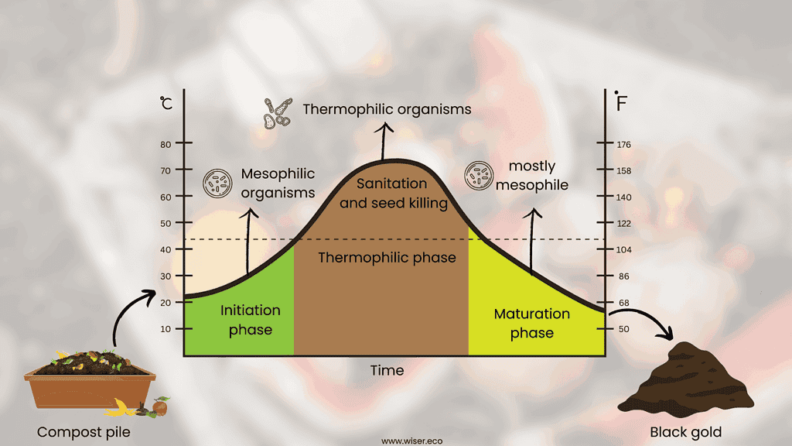
Hot composting is the high-intensity, managed version of this process. It relies on a specific Carbon-to-Nitrogen (C:N) ratio—ideally 30:1—to trigger a “microbial explosion.” By providing a perfect blend of “browns” (carbon for energy) and “greens” (nitrogen for protein), and maintaining a “wrung-out sponge” moisture level, we fuel thermophilic bacteria that generate temperatures up to 160°F. This heat is a byproduct of rapid respiration; it sanitizes the material by killing pathogens and weed seeds, finishing the process in weeks rather than years.
Composting helps any soil type move closer to loam-like function by improving soil structure, water behavior, and biological activity, even though it does not change the soil’s underlying texture. When added, compost binds’ sand, silt, and clay particles into stable aggregates, creating pore spaces that improve drainage in clay soils and water-holding capacity in sandy soils.
The Soil Food Web
Beyond physical structure, organic matter serves as the fuel for the soil food web, a complex network of organisms that function as a single, living organism. Just one teaspoon of healthy soil can contain over 15,000 species of bacteria, and fungi to larger protozoa, nematodes, and earthworms along with fungi and countless other organisms—more individual microbes than there are people on Earth. This diverse cast relies on symbiotic relationships where no species would thrive in isolation.
While plants provide sugars through their roots to feed microbes, the microbes in turn protect the plants and unlock minerals. This system acts as a biological reservoir; nutrients are “locked” within the bodies of these organisms and only become available to plants through the constant rotation of life and death. Through a process of “poop and decay,” predators consume prey and nitrogen-rich waste is excreted, precisely delivering nutrients to the root zone exactly when plants need them most.
The ultimate masterpiece of this biological activity is the formation of humus, the dark, stable, and long-lasting heart of soil fertility. Humus is not just decomposed matter; it is organic material that has been chemically transformed by soil biota into a substance that can resist further breakdown for decades or even centuries. This stable humus acts as a chemical sponge, significantly increasing a soil’s ability to hold water and nutrients while providing a permanent habitat for beneficial life. However, humus is not invincible. It can be lost through aggressive tilling, which introduces excess oxygen that causes microbes to “burn through” carbon reserves, or through leaving soil bare, which exposes it to erosion and high temperatures. Protecting humus is essential, as it represents the long-term “savings account” of the soil’s health and productivity.
Over time, these processes make soil behave more like loam: well-drained, moisture-retentive, fertile, and biologically active.
Our relationship with Organics Management
We put a lot of energy into growing food.
Land is used to grow crops—for people and for livestock. Plants rely on sunlight and water. People invest labor throughout the seasons, from planting to harvest. Food is transported to processing facilities, to markets, from the store to our homes—sometimes sitting on a shelf or in a refrigerator until someone says, “”Expired!”
When organic materials enter the waste stream instead of returning to the soil, the natural nutrient cycle is broken. In landfills, food waste is buried in oxygen-free (anaerobic) conditions, where it decomposes slowly and produces methane, a powerful greenhouse gas. For example, a head of lettuce can take up to 25 years to fully break down in a landfill because there is no oxygen, verse if the food is composted, it is diverted from the waste stream and can add to something more meaningful.
Funding for this education is provided by Kitsap County Public Works, Solid Waste Division.