Welcome to Composting & Food Waste Reduction
Community Action for Compost
Community composting plays a vital role in the Food Recovery Hierarchy by keeping food scraps out of landfill and returning nutrients to local soil. It transforms unavoidable food waste into a community resource, strengthening local food systems while reducing environmental impact.
Start a Community Compost Program:
- The Institute for Local Self-Reliance “Hierarchy to Reduce Food Waste & Grow Community
- Institute for Local Self-Reliance Using Bokashi in Community Composting: What, Why, How, Who (Video 1:35.43 hour, min)
Food Waste Reduction
We also offer resources and outreach for food safety, preservation, pressure gauge testing, and food storage, preparation, and planning to help you reduce food waste, keep more of your money in your pocket, while helping protect our natural environment!
- Food Safety and Food Preservation – Research-based food safety and preservation education that helps you store, preserve, and use food safely while reducing waste and making the most of seasonal abundance.
- Use Food Well – (coming soon) learn strategies to reduce food waste through planning, prepping, storage, and tips for extending foods usage.
Diverting Organic Landfill Waste is #1
No one wants to waste food, but it happens across our food system from farm to fork. The good news is that many high-impact solutions already exist like composting– they just need the right combination of motivation, stakeholder alignment, and financing to scale.
Nearly one-third of the material sent to landfills is organic. In an anaerobic landfill environment a head of lettuce can take decades to break down, producing methane instead of building healthy soil. Reducing food waste is one of the most impactful steps we can take to lessen our environmental footprint.
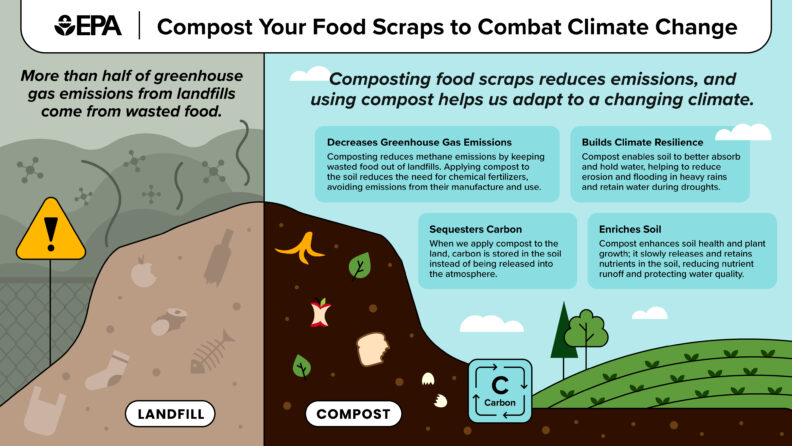
How big of an issue is food waste? Why is more than 40 percent of food thrown away—and how is it connected to climate change. The ReFed organization has been working to collect data across the nation to quantify the impacts of food waste and our opportunities for reduction and diversion.
It is clear we have a multi-level food waste issue that has some staggering impacts on the economy, environment, and the consumer, as indicated in the “From Surplus to Solutions:
2025 ReFED U.S. Food Waste Report.”
Our connection to carbon through composting shows how even small actions add up quickly. Climate change: Earth’s giant game of Tetris by Joss Fong illustrates the connection between carbon and climate change, but more so, how carbon should be put back in the soil rather than discarded like waste.
Please reach out if you have questions. I’m here to help with resources, education, and practical next steps wherever you’re starting from.

Paisley Gallagher (she, her, hers)
345 6th St Suite 550 Bremerton WA 98337
360-228-7302 or paisley.gallagher@wsu.edu
Office hours: Mon -Thur. 6am to 4pm
Funding for this education is provided by Kitsap County Public Works, Solid Waste Division.