Welcome to Composting & Food Waste Reduction
Welcome to Composting & Food Waste Reduction
This work began with reducing food waste by harvesting fruit from our urban landscape—then expanded to gardens and farms. But food waste doesn’t stop there. Grocery store overstock and produce that’s nearing the end of its shelf life can also be given a second life through food recovery efforts.
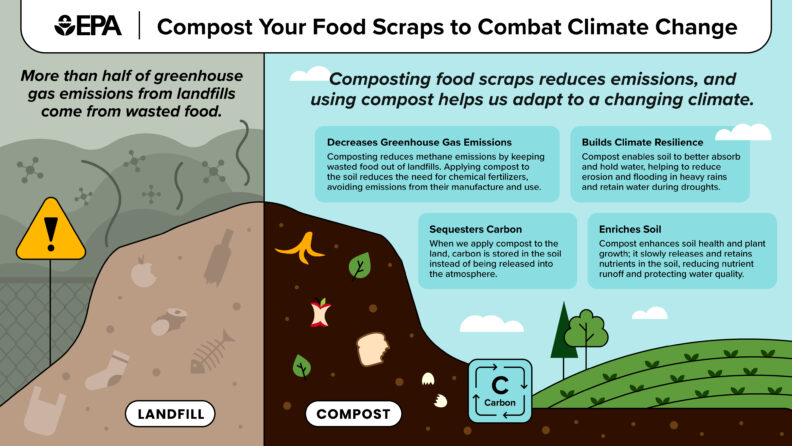
The most important place to focus is at home. Nearly 40% of food waste happens in our households, and studies show that about half of the food we throw away could have been edible. There is also the connection between food waste and methane, a potent greenhouse gas that affects climate change. How we manage our food—and our food scraps—matters.
Through Composting and Food Waste Reduction, I’ll share why composting is important, how simple it can be, and how recycling food scraps supports nature’s own recycling system. I’ll also help you make the most of the food you already have. For example, did you know that most food expiration dates are about quality, not safety? Or that wasted food costs households hundreds of dollars each year—not just in groceries, but in disposal?
This work is about making good choices easier, saving money, and caring for our community and environment at the same time.
We are the Change
No one wants to waste food, but it happens across our food system from farm to fork. The good news is that many high-impact solutions already exist like composting– they just need the right combination of motivation, stakeholder alignment, and financing to scale.
How big of an issue is food waste? Why is more than 40 percent of food thrown away—and how is it connected to climate change. The ReFed organization has been working to collect data across the nation to quantify the impacts of food waste and our opportunities for reduction and diversion.
It is clear we have a multi-level food waste issue that has some staggering impacts on the economy, environment, and the consumer, as indicated in the “From Surplus to Solutions:
2025 ReFED U.S. Food Waste Report.”
Our connection to carbon through composting shows how even small actions add up quickly. Climate change: Earth’s giant game of Tetris by Joss Fong illustrates the connection between carbon and climate change, but more so, how carbon should be put back in the soil rather than discarded like waste.
Collect your Food Scraps
When you decide to compost, you’ll be looking for every opportunity to collect “greens and browns,” and the easiest place to start is a collection method in the kitchen. There are several options that you might consider, as well as the kitchen compost toolkit provided by Kitsap County Public Works Solid Waste Division; available while supplies last. There is an option to use the “compostable” bags, but make note, that compostable bags will not breakdown in home composting due to a lack of heat and turning, in comparison to municipal composting systems.
Learn more about Backyard Composting
Composting may start as an endeavor for recycling organic material and maybe generating “black gold” for the garden. Then you learn that the process is alive, and when the soil is alive it functions as biology, and all of a sudden the ground under your feet turns into an ecosystem, in which we have come to exist and rely on, as it pertains to our food, and water mitigation. It really is exciting, and composting is your gateway to a new world.
- The Science of Soil and Decay – Understand how healthy soil functions as a natural recycling system, supporting plant immunity, water retention, deep roots, reduced erosion, pollutant filtration, and nutrient cycling.
- Composting 101 – Learn the basics of composting, including why it matters, what can be composted, and how to get started at home.
- Composting Methods – Explore different approaches to composting—active, passive, and backyard systems—and find the method that works best for you.
- Vermiculture – Discover how to create and maintain a healthy worm composting system that turns food scraps into nutrient-rich castings.
- Bokashi – Learn the fundamentals of the Bokashi fermentation system and how to transform food waste into a pre-compost material for your garden.
Community Action for Compost
Community composting plays a vital role in the Food Recovery Hierarchy by keeping food scraps out of landfill and returning nutrients to local soil. It transforms unavoidable food waste into a community resource, strengthening local food systems while reducing environmental impact.
Learn more about Food Waste Reduction
We also offer resources and outreach for food safety, preservation, pressure gauge testing, and food storage, preparation, and planning to help you reduce food waste, keep more of your money in your pocket, while helping protect our natural environment!
- Food Safety and Food Preservation – Research-based food safety and preservation education that helps you store, preserve, and use food safely while reducing waste and making the most of seasonal abundance.
- Use Food Well – (coming soon) learn strategies to reduce food waste through planning, prepping, storage, and tips for extending foods usage.
- Kitsap County Solid Waste – a community resource for reducing waste, managing materials responsibly, and helping residents understand recycling, composting, and disposal options.
- Kitsap Conservation District – provides guidance, training, and cost-share programs to support healthy soils, clean water, and sustainable land management practices.
- Clean Water Kitsap – supports the community with simple, effective ways to prevent runoff pollution and keep Kitsap’s water clean and healthy.
- Kitsap Harvest – a community gleaning organization that reduces food waste by harvesting surplus produce and distributing it to local food banks, meal programs, and neighbors in need.
- Root’s Farm Poulsbo – Farm Share Produce, Classes, Online Store, and Internships
Join us at a workshop
We offer accessible classes and hands-on learning opportunities that connect people to the natural systems right beneath our feet—soil, food, and organic materials—and our role in keeping those systems healthy. Learn alongside local experts and community members as you build practical skills, grow your understanding, and explore simple actions that reduce waste and return nutrients to the soil.
- Master Gardeners – The Master Gardener Program trains and supports community volunteers to provide research-based horticulture education that strengthens local gardens, landscapes, and environmental stewardship.
- WSU Soil Health – WSU Soil Health advances research and education that support healthy, living soils as the foundation for productive landscapes, resilient ecosystems, and sustainable land management.
- WSU Backyard Composting – The WSU Backyard Composting publication page offers research-based, practical guidance to help households turn organic waste into a valuable soil resource through safe and effective composting practices.
- Washington’s Water – This page is for homeowners, farmers, citizen scientists, or anyone simply enjoy life-long learning, you’ll find WSU Publications and resources here.
- The Institute for Local Self-Reliance “Hierarchy to Reduce Food Waste & Grow Community
- Institute for Local Self-Reliance Using Bokashi in Community Composting: What, Why, How, Who (Video 1:35.43 hour, min)
- Institute for Local Self-Reliance: Resources & Publications for Community Compost
- Institute for Local Self-Reliance (ISLR) podcast with NYC Compost Project
Please reach out if you have questions. I’m here to help with resources, education, and practical next steps wherever you’re starting from.

Paisley Gallagher (she, her, hers)
345 6th St Suite 550 Bremerton WA 98337
360-228-7302 or paisley.gallagher@wsu.edu
Office hours: Mon -Thur. 6am to 4pm
Funding for this education is provided by Kitsap County Public Works, Solid Waste Division.