Controlling insect pests, such as flies and mosquitoes, not only makes life more pleasant for our animals and ourselves, but also reduces the potential transfer of parasites and the numbers of insects serving as vectors for disease. While your first impulse is to reach for a chemical insecticide, some insects, such as flies, have begun showing resistance to chemicals. There are many simple and cost effective ways to reduce and manage flies on your land without pesticides. To effectively manage multiple pest species it is important to use more than one method for control. Utilizing natural controls as a first line of defense and chemicals as a last resort will provide better control than pesticides alone. In addition, over applying pesticides often pollutes runoff which can be harmful to animals and degrade our drinking water and surface water bodies.
Identification is Key
Effective pest control relies on first identifying the pests you have,
a very important but sometimes challenging task. Different flies prefer different habitats, necessitating different control methods. Pest management recommendations are often oversimplified, leading landowners to utilize just one method to kill all pests. Small acreage properties commonly have more than one pest species present.
Flies 101
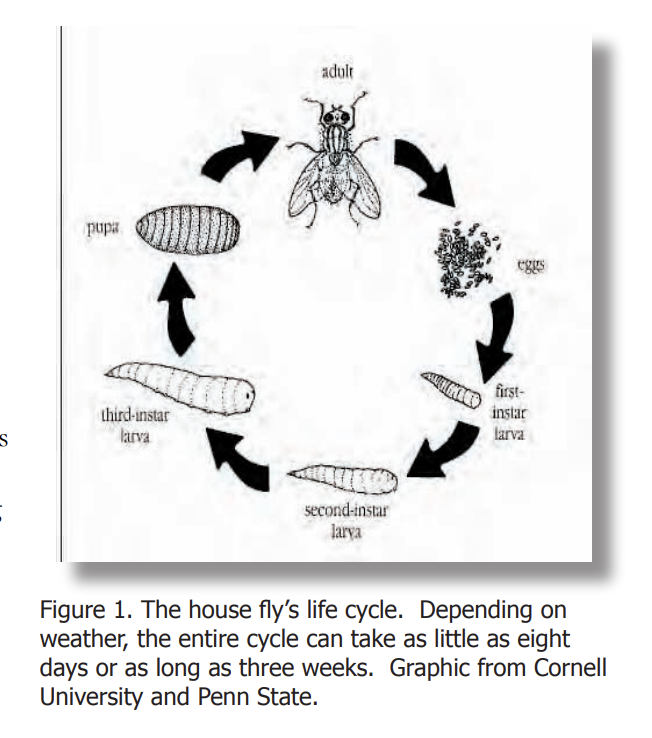
Every creature has a purpose, for flies, that purpose is to decompose rotting organic matter. With an abundance of organic matter such as manure and dead plants, it is no wonder animals and acreage properties generate an abundance of flies. Flies have four stages in their life cycle, which begins with an egg laid on or near rotting organic matter. The egg hatches into a worm-like larva that feeds on the organic matter, eventually pupating (similar to the way a butterfly encases itself in a cocoon), and finally emerging as an adult fly (Figure 1).
Because this cycle occurs in a short time period of eight to ten days, depending on weather, flies can rapidly multiply and become a problem, making fly control frustrating.
There are three main types of flies: filth flies, generalist flies, and species specific flies. Filth flies breed in animal manure or decaying plant material. This group includes non-biting house flies and face flies, as well as biting stable flies and horn flies (Figure 2). Both horn flies and face flies are resistant to pesticides. Generalist flies develop in aquatic or semi-aquatic habitats and include mosquitoes, black flies, deer flies, horse flies, and biting midges. Horse flies and deer flies can travel many miles for meals. Biting midges, also known as no-see-ums, transmit parasites and viral diseases. They also cause an allergic skin reaction, especially in horses, known as sweet itch. Species specific flies bother specific animals, such as the bot fly, which annoys horses. Due the understanding about their life cycles, species specific flies are easier to control, although they often require pesticide treatments.
Control
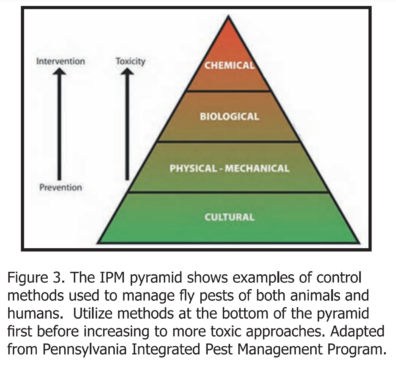
A comprehensive, well rounded approach utilizes several methods. This integrated pest management (or IPM) approach emphasizes prevention and using low toxicity methods first, increasing to more toxic approaches as a last resort or as intervention during an extremely bad outbreak (Figure 3). Low toxicity methods include cultural, physical, mechanical, and biological insect control methods.
Do your Groundwork
Removing the material in which insect larvae develop will break the pests’ life cycle and prevent subsequent adult flies. Properly managing animal wastes is one of the best ways to reduce and eliminate insect breeding habitat and is the first line of defense in controlling flies. Cleaning stalls, turnouts, and confinement areas regularly reduces the breeding grounds flies find in wet bedding and moist manure. Horn flies and face flies prefer breeding in fresh manure. Once collected, manure should be land-applied thinly to dry it out. Raw manure should only be spread on pastures April through October to reduce the chance for manure contaminated runoff. Harrowing pastures will further break up and dry out manure. Composting provides another method to manage manure and control flies. However, the pile needs to be covered and managed well to assure sufficient heat generation to kill the larvae
(see the video clip on Manure Management).
Controlling moisture also helps control insects, since fly eggs and larvae need a moist environment. It only takes three consecutive days of 40 degree weather for over-wintering flies to emerge and then lay more eggs a few days after emerging. All of the rain we receive creates mud and standing water, providing plenty of habitat for those adults to lay eggs. Mosquitoes breed in water as shallow as one inch and their larvae need less than a few weeks to mature and hatch out. Biting midges in particular like shallow, muddy areas. In order to reduce areas of standing water, install gutters and downspouts to collect roof runoff and divert the water where it will not pond (see the Managing Roof Runoff fact sheet). French drains and dry wells also help reduce standing water and mud (see the Improving Drainage fact sheet). Repair leaky faucets to reduce standing water. For animal watering, consider installing smaller watering containers, change water frequently, or install automatic or livestock activated watering devices. Footing materials such as gravel, sand or hog fuel can reduce mud in turnouts and confinement areas. Hog fuel is a byproduct of the lumber milling process that includes wood chips, sawdust, bark, planer shavings, and other wood waste. It’s created by grinding or chipping wood waste into smaller pieces using a machine called a “hogger”. Keep your land clean. Weeds and tall grasses around building foundations provide adult flies a place to rest and get out of extreme temperatures, so it is important to remove these. Collect and compost grass clippings, or make sure the cut grass is spread out so it fully dries out. Dispose of garbage and keep all cans covered with tight fitting lids. Lining garbage cans with plastic bags further reduces odors, therefore attracting fewer flies. Eliminate other potential breeding materials, such as rotting or damp hay bales or leaves. Recycle old bottles, buckets, and tires which may hold rainwater and create ideal mosquito habitat. Another option is to move animals away from wet areas or consider confining animals inside if flies are really pesky. Provide shaded areas where animals can rest away from pests. Some flies are attracted to animal movement, while others are attracted to carbon dioxide. Resting animals will move less and produce less carbon dioxide due to lower breathing rates. If you do have the ability to confine your animals when flies are at their worst, consider screening windows and door ways. This allows doors and windows to stay open to maintain a breeze, which can further deter flies, as most do not like to fly against the wind.
Go trapping! Traps help control adult flies missed by other methods. No one trap will capture all types of flies. Consider trapping to be another component of your overall integrated plan, and do not rely on it solely for control. Fly tapes are an inexpensive and safe way to control flies near entryways and areas where animals congregate, such as under an overhang. Some sticky traps have fly attractants, while others do not, but both types are effective. Sticky traps are most effective on house flies as they rest on hanging vertical surfaces more than other types of flies. Sticky traps and tapes dry out and become coated with dust or flies, so should be replaced regularly. When selecting a sticky trap, consider ease of disposal after it has become covered with flies. These traps can capture other insects, as well as occasionally bats or birds. Consider placement carefully to reduce the risk of capturing beneficial animals, while maximizing your chances of capturing pest flies.
Trap placement is important. Put traps around the perimeter of your barn and land to draw flies away from your barn and to catch flies coming from neighboring land. Place traps on top of fence posts, just out of reach of your animals. Set the traps close to breeding sites with the prevailing wind blowing from the trap to the breeding area, to carry the smell of the pheromone to the flies. Placing pheromone traps in buildings will only lure flies inside!
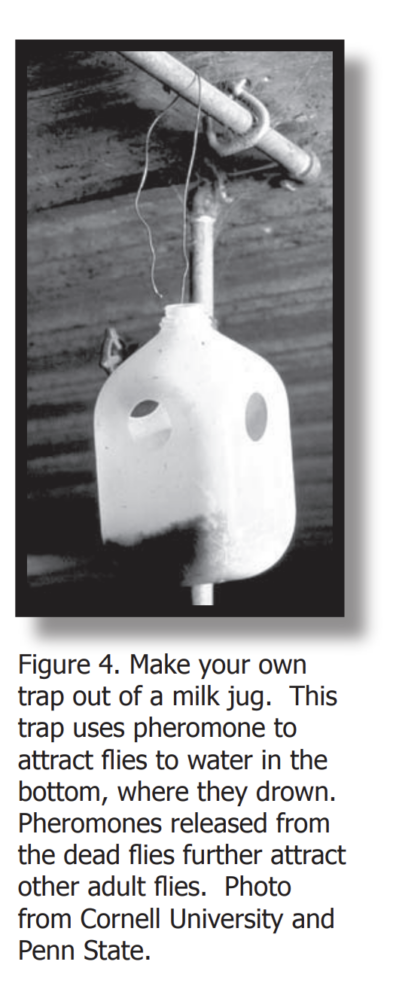
Pheromone traps use simple plastic bags, jars or jugs with one-way lids (Figure 4). A non-poisonous natural pheromone solution attracts flies into the container from which they cannot escape. Most tack and feed stores stock kits to convert milk jugs or other reusable containers into traps, as well as all-in-one traps. These traps generally work best on house flies, the most common fly pest. These traps generally attract flies within a radius of 100 to 150 feet. Homemade bait jars utilizing raw hamburger or fish in one inch of water at the bottom of a jar can be made but tend to smell and may attract household pets and wildlife, such as raccoons and opossums. These traps will not catch beneficial insects, as they are not attracted by the pheromone. Stable flies require a different pheromone so check the type of trap you are buying to ensure it will control stable flies. A sticky fly trap is also available that attracts biting flies such as stable flies. They are only available directly from the company. See the resources at the end of this fact sheet for stable fly traps. Movement attracts horse and deer flies, making pheromone traps ineffective. The US Department of Agriculture designed a special trap, called the Manitoba trap. The trap is a cone-shaped tent raised three feet off the ground, with a large black ball hanging in the middle. Horse flies are attracted to the movement of the ball in the breeze. When they realize the ball is not a food source, they fly up getting caught in the tent. As they continue to fly or crawl upwards, they are trapped in the jar at the top with a one-way lid, where they eventually die. Plans are available online for this trap, if you would like to build your own, or an entrepreneur adapted the trap to create the Horse Pal, which is available online for purchase. See internet resources at the end of this fact sheet.
Maintain a Healthy Farm Site
Naturally occurring dung beetles, mites, fungi, nematodes, and other flies prey on the common pests discussed above. They also reduce breeding habitat, exemplified by the dung beetles which buries manure. Mites feed on fly eggs and larvae, and can kill up to 36 house flies in a day. Pesticides meant to kill pest flies may also harm these beneficial insects, so it is best to limit pesticide use to particularly bad outbreaks or utilize pesticides that specially kill only pest flies. Parasitic wasps, knat-sized and non-biting, lay eggs in developing fly larva, but do not harm animals or people. These wasps can be purchased on-line from several companies (see the list on the last page). The wasps, still in their pupa stage, come in bags. Simply sprinkle them out of the bag near manure piles, where animals congregate, or where flies are a problem. The wasp pupa must be protected from being crushed by hooves, or covered with manure or dirt. Flies reproduce faster and in greater numbers than fly predators. Since the parasitic wasps take time to hatch, it may take 30 days to see reduced fly populations. For this reason, wasps should be released in small amounts throughout the fly season. Whether this occurs every two weeks or monthly depends on your site conditions: the number of animals you or your neighbors have, the extent of your fly problem, and if you employ other methods. Several companies will set up payment and automatic shipping and are willing to work with you to set up a program. Placing fish, such as inexpensive feeder goldfish, in your watering tanks will control mosquitoes. Landowners have also utilized mosquito fish, or Gambusia, but these are illegal in Washington State since they are considered invasive and compete with native fish species if they escape. If you use a pond to water your animals and it connects to a nearby stream or river, you should not even use goldfish since they can also escape and compete with native fish.
Studies show ultra violet light (bug zappers) kill far more beneficial insects and very few biting insects. They also attract mosquitoes which are repelled by the light close up, but may then stick around to annoy you or your animals.
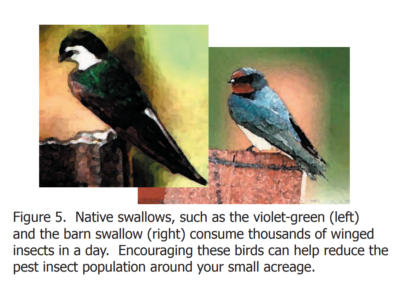
Encouraging bats and native birds to your land also helps control insect populations. Bats primarily eat nocturnal insects, such as mosquitoes. One bat can eat up to 600 mosquitoes an hour and more than 5,000 in a night. You can easily construct bat houses from plans available online or purchase them at local bird shops and garden stores. Bats are extremely particular about housing, so you should be sure you are constructing or purchasing the correct type of house. Bat houses should be placed by early April on the side of your barn, a nearby pole, or in a tree that receives as much sun as possible. It may take up to two years for a colony to inhabit your bat houses. Birds, such as the violet green swallow and barn swallow, are terrific at eating pest insects (Figure 5). One bird can consume up to 6,000 insects a day. Violet green swallows are cavity nesters and require a box with an appropriately sized hole. You can build your own from plans available online or purchase them locally. Barn swallows build their own cup shaped nests out of mud. On the negative side, these swallows can be messy, so cleaning up droppings may be necessary. Placing a board beneath their nests can help collect droppings to keep them off barn and building walls. More information on encouraging other native insect eating birds can be found from resources listed at the end of this fact sheet. With some of the simple solutions provided above, it is possible to reduce pest fly populations on your small acreage, and protect your animals, family and water quality.
Small Acreage
Quick Links
- Small Acreage Publications and Videos
- Natural Resources
- Water and Natural Resources
- Watershed Stewardship
Small Acreage Program Listserv
Receive emails about upcoming
classes and events.
Terry Koper,
Small Acreage Program Coordinator
If you would like additional information on insect control, mud and manure management and runoff control on your small acreage, contact:
WSU Clark County Extension
Small Acreage Program
1919 NE 78th St. Vancouver, WA 98665
Clark County Clean Water Program
1300 Franklin St. Vancouver, WA 98666
564.397.4345
Clark County Clean Water Program Email
Clark Conservation District
11018 NE 51st Circle Vancouver, WA 98682
360-859-4780
Fly Traps
Resources WSU Extension does not endorse any businesses or product listed here, nor is any criticism of unnamed businesses or products implied.
Newman Enterprises, Inc. Horse Pal Fly Trap
1-888-685-2244
Olson Products Inc.
1-330-723-3210
Farnam Companies, Inc. Fly and Insect Control
1-800-234-2269
Protecting Cattle from Horse Flies (University of Missouri Extension guide)
A Canopy Trap for Horse Fly Control – North Carolina Cooperative Extension Includes plans and instructions to build your own trap
Fly Parasite Suppliers
Arbico Organics Beneficial Insects
1-800-827-2847
Kunafin livestock pest control products
1-800-832-1113
Spalding Labs
Natural Fly Control
760 Printz Road Arroyo Grande, CA 93420
1-866-738-9632
Bird and Bat Box Sources
Backyard Bird Shop
8101 NE Parkway Dr # C5, Vancouver, WA 98662
360-253-5771
Bird Nest Box Dimensions – Audubon Society of Portland
503-292-6855
References
King County Conservation District. 1996. Environmentally Friendly Insect Control p 4
Visit the King County Conservation District website for more information.
Flietner, Maureen Blaney. 2006. A Farewell to Flies, Hobby Farms Magazine May/June.
Ohio State University. Livestock & Livestock Building Pest Management. Bulletin p 473
Visit Ohio State University Livestock & livestock Building Pest website for more information
Kaufman, P., D. Rutz, and C. Pitts. 2000. Pest Management Recommendations for Horses. Cornell University and Penn State University. Pest Management Recommendations for Horses (Cornell and Penn State guide, PDF)
Kaufman, P., D. Rutz, and C. Pitts. 2000. Pest Management Recommendations for Sheep, Goats and Swine. Cornell University and Penn State University. Pest Management for Sheep, Goats, and Swine (Cornell and Penn State guide, PDF)
Moors, D. 2006. Buzz Busters. Horse and Rider Magazine. April
A Guide to Control All Those Pesky Flies — Spalding Laboratories. n.d.
Written by Erin Harwood, WSU Extension Clark County (October 2006, updated October 2024).
The Small Acreage Program is sponsored in partnership by WSU Clark County Extension and Clark County Public Works – Clean Water