Beef Cattle MythBusters
Dr. Don Llewellyn
WSU Department of Animal Sciences and WSU Extension, Pullman, WA
As an Extension Specialist, I regularly get questions about beef grading and inspection. I’ve shared this with many of you before, but it I think it is definitely worthy of another look to alleviate the confusion. This topic comes up from time to time in my Youth for the Quality Care of Animals (YQCA) and Beef Quality Assurance (BQA) trainings as well. Now I’m not a meat scientist, but my undergraduate advisor at Oklahoma State University, Dr. Lowell Walters, was one of the great meat scientists of his era and I would like to think a little of that rubbed off on me! So here goes.
Myth: Beef grading and inspection are the same thing. Answer: nope, and here’s why:
USDA Quality Grades
Beef grading is voluntary and processors pay for the service. Beef grades are used to evaluate the palatability of beef and are related to tenderness, juiciness, and flavor. All of these factors relate to the consumers’ acceptability of beef products. In the end, that’s what we raise these calves for. Beef quality grades consider two factors: marbling and maturity. Figure 1 shows the relationship between marbling and maturity and how they contribute to determination of quality grade.
Marbling (intramuscular fat) is the distribution of fat within the lean of the ribeye muscle that is exposed when the carcass is ribbed between the 12th and 13th ribs. Determination of final quality grade is linked to maturity (Figure 1). Maturity is determined by indicators such as bone characteristics, ossification of cartilage, and the texture and color of the ribeye muscle. As the animal matures the color of the lean becomes darker, the texture gets coarser, and the cartilage turns to bone. Soft buttons of cartilage in areas such as the spinous processes of the thoracic vertebrae indicate younger carcasses, whereas more ossification (changing of cartilage to bone) and flattening of the ribs point toward more mature carcasses. Thoracic buttons ossify at about 30 months of age. Those with no ossification will generally fall into A maturity (less than 30 months of age), and those with 10% ossification will be in the B maturity category (30 to 42 months of age). The C, D, and E maturity groups represent cattle with maturities from 42 to 72 months (35% ossification), 72 to 96 months (70% ossification), and greater than 96 months of age (90% ossification), all older cattle, respectively (Figure 1).
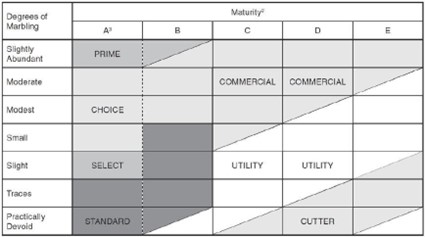
Figure 1. The relationship between maturity and degree of marbling in determination of USDA Quality Grade.
1Assumes the firmness of lean is comparably developed with the degree of marbling and that the carcass is not a “dark cutter.”
2Maturity increases from left to right (A through E).
3The A maturity portion of the figure is the only portion applicable to bullock carcasses. Adapted from https://www.beefresearch.org/resources/product-quality/fact-sheets/beef- grading
USDA Yields Grades
Yield grades are essentially an estimate of carcass cutability which is the % of closely trimmed, boneless, retail cuts from the loin, rib, round, and chuck (%CTBRC). The USDA Beef Yield Grades are 1, 2, 3, 4, and 5. Table 1 demonstrates that a lower numerical value for USDA Yield Grade represents a higher cutability (and therefore a leaner carcass). Note that USDA Yield Grades 2, 3, and 4 each represent a 2.3% range in %CTBRC.
Determination of the USDA Yield Grade requires evaluation of the ribeye area, external fat thickness over the ribeye, an estimation of the % kidney, pelvic, and heart fat (%KHP), and also considers hot carcass weight. Fat thickness is measured three-fourths of the distance of the length of the ribeye muscle at the 12th rib and may be adjusted by the grader for observed differences in the distribution of fat over the carcass. This adjustment and amount of fat thickness determines the preliminary USDA Yield Grade. Ribeye area is measured in square inches (at the 12th rib) and allows for comparison of carcass muscling in relation to carcass weight. Fat that remains in the carcass following slaughter also affects carcass cutability. These fat deposits known as kidney, pelvic, and heart fat (%KPH) typically range from 1% to 4%. Taken together, these factors are used in the following equation to determine USDA Yield Grade:
USDA Yield Grade = 2.5 + (2.5 x adjusted fat thickness, in.) + (.20 x KPH%) – (.32 x ribeye area, sq. in.) + (.0038 x hot carcass weight, lbs.)
In a practical sense, what does this mean? USDA Quality and USDA Yield Grades are an important part of being able to place cattle that vary in type, genetics, and physiology into uniform categories for beef marketing. Many marketing grids are in use by a variety of organizations today and are generally based on carcass weight, Quality Grade, and Yield Grade. Each has its own features. Quality and yield information is used to compare with standardized grid criteria to determine premiums and discounts. Knowledge of the fundamentals of beef grading is important for assessing how cattle are in alignment with the industry standards.
Table 1. The relationship between USDA Beef Yield Grade and %CTBRC1
| USDA Yield Grade | %CTBRC |
| 1 | >52.3 |
| 2 | 50.0 to 52.3 |
| 3 | 47.7 to 50.0 |
| 4 | 45.4 to 47.7 |
| 5 | <45.4 |
1 % closely trimmed, boneless retail cuts from the loin, rib, round, and chuck.
Adapted from https://www.beefresearch.org/resources/product-quality/fact-sheets/beef-grading
Beef Inspection
It is important to note that beef grading and beef inspection are two completely unrelated activities. Meat inspection is a mandatory service. It came about as a result of the Meat Inspection Act of 1906 in response to political pressure and stockyard conditions at the time. In addition, the Wholesome Meat Act of 1967 requires state inspection to be equal to the inspection program of the federal government. Meat inspectors focus on identifying meat as Healthy (no disease), Sound (clean and sanitary), Wholesome (not adulterated), and Properly Labeled (the product is as noted on the label). The federal government has jurisdiction of meat inspection for meat sold in interstate and/or foreign commerce. In some cases, if the product is sold only within intrastate commerce, state jurisdiction may apply. Meat inspection has the function of detection and destruction of diseased and/or contaminated meat; provide assurance that the handling and preparation of the meat was conducted under clean and sanitary conditions; to minimize microbial contamination of meat; to prevent adulteration (addition of harmful substances); and prevent false labeling. In total, to provide safe and wholesome beef products to consumers.
There you have it; the myth is busted! Beef grading and beef inspection are two completely different activities, but each is very important to providing safe and wholesome beef products to consumers and to give that awesome eating experience we all expect with U.S. produced beef.
For a more in-depth discussion of Beef Grading, see:
- https://www.beefresearch.org/resources/product-quality/fact-sheets/beef-grading
- https://meat.tamu.edu/beefgrading/
- https://meat.tamu.edu/meat-grading-
- history/#:~:text=These%20daily%20market%20reports%20by,beef%20were%20formulated%20in%201916
For more about meat inspection, see: https://meat.tamu.edu/ansc-307-honors/meat-inspection/
Please let us know how WSU Extension can assist you with your animal, pasture, and forage-related questions. Dr. Don Llewellyn, don.llewellyn@wsu.edu 509-335-8759