Physical ecosystem functions such as water cycling, soil building, and carbon sequestration are facilitated by the biological communities of the ecosystem. Generally speaking, a more biodiverse ecosystem provides enhanced ecosystem functions (cite) and greater resiliency to disturbances and changing conditions (cite). For this reason, biodiversity has become a critical consideration when managing for ecological outcomes.
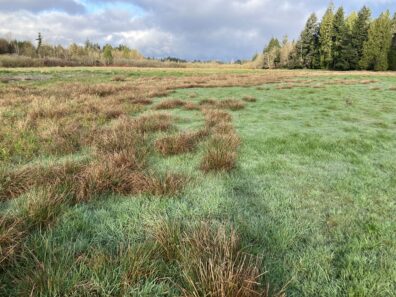
Biodiversity in turn is supported by a landscape with a variety of habitat types and a prevalence of ecotones (areas where two habitats intersect such as the field and forest boundary). This has been found to be especially relevant in situations where intensive agriculture has greatly simplified landscape structure (Benton 2003). While habitat types can be classified broadly at the regional scale (e.g. temperate coniferous forests, or seasonally inundated grasslands), habitat variations on the scale of acres or even square feet can be extremely valuable in creating additional niches for nesting or foraging thereby increasing site-specific biodiversity. This should lead to the prioritization of site heterogeneity when managing for ecological values, especially in areas where agricultural activity has simplified the structure and biodiversity from nearby natural areas. Heterogeneity occurs spatially across a site, but also temporally throughout the year and ideally between years as well allowing for increased biodiversity over time. So important might heterogeneity be for habitat value (for arthropods, birds, mammals, amphibians, reptiles, and other wildlife) that it has been described as a “keystone structure” critical to maintaining species diversity (Tews et al. 2003).
This ecological approach has not yet been widely adopted in the grazing community. Managing grazing to generate uneven, or heterogeneous, landscapes contrasts rather surprisingly with long-held objectives in the range and pasture sciences to manage grazing for even forage use (Toombs et al. 2009). Following historical overuse of many grazing lands in the 19th century, and with a focus primarily on livestock and forage production, the goal in range and pasture sciences has been to develop practices that maximize yield of palatable species at peak digestibility while minimizing bare ground and the associated negative ecological impacts (Freese et al. 2014, Fuhlendorf et al. 2012). This focus has been described as utilitarian, and the resulting landscape as lacking in ecologically significant variability, or heterogeneity.
Conversely, heterogeneity-based grazing balances forage maximization with the goal of creating diverse habitat niches. This may involve periodic and patchy intentional under- or over-grazing as understood by current best management grazing practices. These areas of less-than-optimal utilization are intended to rotate across the landscape creating a matrix of diverse habitat niches maximizing the biodiversity potential of the site.
This generalized embrace of spatial and temporal heterogeneity can be combined with targeted grazing for species-specific habitat modifications. Targeted grazing can focus impacts on individual species like reed canary grass when building Oregon spotted frog habitat (Figure 1), or it modify whole habitat for the benefit of a single species as in the creation of hundreds of acres of closely shorn grasslands for streaked horned lark nesting (Figure 2).