Beef Cattle Myth Buster
Dr. Don Llewellyn1, Gary Rohwer2, and Sarah Dreger1
1WSU Department of Animal Sciences and WSU Extension, Pullman, WA
2Bar Diamond, Inc., Parma, ID
Myth: Cheatgrass (Downy Brome) provides equal nutrition throughout the grazing season compared to native and improved bunchgrasses.
Forage quality and availability are major factors in determining total nutrient availability and timing of grazing in the Pacific Northwest. In the Pacific Northwest, many acres of rangeland contain significant amounts of cheatgrass (downy brome) which is a winter annual that competes with native and improved grasses and other forage species. This problem has been manifested over several decades and has been an important consideration in the management of those rangelands to optimize the use of the available forage for beef cattle. In many areas, cheatgrass has ultimately suppressed the native grasses.
While range rehabilitation is an option, it is a long-term solution to the problem. The focus of this column is: What do we need to know about cheatgrass from a forage quality standpoint and how can we manage around this problem until the native and/or improved grasses are reestablished and providing a more season-long forage resource?
When we compare cheatgrass with some of our native and improved bunchgrasses (and many of the readers of this column have observed this from personal experience), cheatgrass starts early in the spring with relatively high quality, but that quality declines with its rapid move toward vegetative maturity. Our native and improved grasses, take a bit longer to get going in the spring, but persist with a higher quality forage throughout a much longer period during the grazing season.
Researchers in Washington State found that Bluebunch Wheatgrass maintained its quality regardless of grazing treatments throughout the grazing season (Wagoner et al., 2013).
In general, Ganskopp and Bohnert (2001) found that Cheatgrass maintained moderate forage quality as measured by crude protein through about mid-June. Crude protein stayed in the moderate level for Bluebunch Wheatgrass until early July indicating an advantage in quality for a few more weeks during the grazing season (Figures 1 and 2).
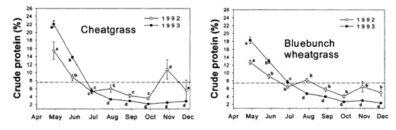
Figures 1 and 2. Crude protein content of Cheatgrass and Bluebunch Wheatgrass throughout the growing season (Ganskopp and Bohnert, 2001).
For In Vitro Organic Matter Disappearance (IVOMD), Bluebunch Wheatgrass maintained higher “digestibility” in August and September when compared to Cheatgrass demonstrating a potential to deliver more energy to the animal (Figures 3 and 4).
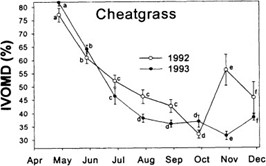
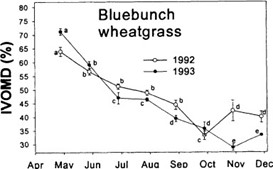
Figures 3 and 4. In Vitro Organic Matter Disappearance (IVOMD) of Cheatgrass and Bluebunch Wheatgrass throughout the growing season (Ganskopp and Bohnert, 2001).
Even though it started out lower, a measure of fiber (NDF) increased faster for Cheatgrass with advancing maturity and ultimately had more NDF relative to Bluebunch Wheatgrass and therefore has the potential to reduce intake (Figures 5 and 6).