Table of Contents
Cover Page
The cover page includes:
- Name and there is a block where youth attach a picture of themselves.
- Calendar year
- 4-H age, which is the age as of last October 1
- Number of years in 4-H
- Age Division, based on age last October 1
- Cloverbud, ages 5-7
- Junior, ages 8-10
- Intermediate, ages 11-13
- Senior, ages 14-not yet 19
- Main 4-H Club name
- List all projects entered in main club
- List any secondary 4-H Club names
- List projects entered in secondary clubs
Instructions:
- Complete entire Record Book with at least one project record. See table of contents for book order.
- Complete additional 4-H Project record as needed- one for each enrolled 4-H project.
- Complete and include the 4-H Permanent Record (separate file)
- For Cloverbud members (ages 5-7), record books are optional at the county level and not judged!
- For fair participation this record book must be up to date. The following sections have these requirements:
- 4-H Story- introduction only,
- Project goals-first page only
- Financial record add sheet-no totals needed for fair
- For year-end completion, ENTIRE record book must be completed.
- The 4-H member should complete this record book to the best of their ability.
- To request accommodations, please contact your leader or the Extension office by June 1st
A box to describe any accommodations necessary.
Table of Contents
Please put your 4-H Record Book in the order listed below.
Place and label dividers where noted!
- Overall Neatness/Spelling/Grammar
- Cover Page
- 4-H Calendar/Activity Log
Divider labeled 4-H Project Record
- Project Cover page (signatures & dates)
- Project Goals
- Project Photos
- For Fair- min of 1 photo needed with caption
- Project Financial Record
- Includes : inventory, financial record, and breeding/market record (if applicable)
Divider for each Additional Project Record (project name on divider)
Include one Project Record for each enrolled project
- Total Points for Project Record(s)
- For more than one project, project records are averaged
Divider–4-H Story
- 4-H Story
- For Fair – Introduction
- For Year End – Completed
Divider–General 4-H
- 4-H Photos
- For Fair- one photo needed with caption
- More about Me
- Life Skills Page
- 4-H Spirit Page
Divider–Permanent Record
- Permanent Record
- Total Points for Record Book
For fair and year end this is graded using the state record book judging form.
Blue: 65-75, Red 50-64, White 49 and below
4-H Calendar/Activity Log
List all 4-H meetings, club and county events, and project activities. You may group similar
activities by month. Example: June- Attended 3 Horse project workdays. If you did not attend
any events in a month, please write “NONE.” Notes are optional. Include year in dates.
October
They are given a table to fill in the date of each meeting attended this month, what the meeting, activity, or event was, and any notes they may have about it. The first fillable row has the general club meeting filled in as the event and in the notes has the option for them to check if the attended, didn’t attend, the meeting was cancelled, or if they hadn’t joined yet.
November
They are given a table to fill in the date of each meeting attended this month, what the meeting, activity, or event was, and any notes they may have about it. The first fillable row has the general club meeting filled in as the event and in the notes has the option for them to check if the attended, didn’t attend, the meeting was cancelled, or if they hadn’t joined yet.
December
They are given a table to fill in the date of each meeting attended this month, what the meeting, activity, or event was, and any notes they may have about it. The first fillable row has the general club meeting filled in as the event and in the notes has the option for them to check if the attended, didn’t attend, the meeting was cancelled, or if they hadn’t joined yet.
January
They are given a table to fill in the date of each meeting attended this month, what the meeting, activity, or event was, and any notes they may have about it. The first fillable row has the general club meeting filled in as the event and in the notes has the option for them to check if the attended, didn’t attend, the meeting was cancelled, or if they hadn’t joined yet.
February
They are given a table to fill in the date of each meeting attended this month, what the meeting, activity, or event was, and any notes they may have about it. The first fillable row has the general club meeting filled in as the event and in the notes has the option for them to check if the attended, didn’t attend, the meeting was cancelled, or if they hadn’t joined yet.
March
They are given a table to fill in the date of each meeting attended this month, what the meeting, activity, or event was, and any notes they may have about it. The first fillable row has the general club meeting filled in as the event and in the notes has the option for them to check if the attended, didn’t attend, the meeting was cancelled, or if they hadn’t joined yet.
April
They are given a table to fill in the date of each meeting attended this month, what the meeting, activity, or event was, and any notes they may have about it. The first fillable row has the general club meeting filled in as the event and in the notes has the option for them to check if the attended, didn’t attend, the meeting was cancelled, or if they hadn’t joined yet.
May
They are given a table to fill in the date of each meeting attended this month, what the meeting, activity, or event was, and any notes they may have about it. The first fillable row has the general club meeting filled in as the event and in the notes has the option for them to check if the attended, didn’t attend, the meeting was cancelled, or if they hadn’t joined yet.
June
They are given a table to fill in the date of each meeting attended this month, what the meeting, activity, or event was, and any notes they may have about it. The first fillable row has the general club meeting filled in as the event and in the notes has the option for them to check if the attended, didn’t attend, the meeting was cancelled, or if they hadn’t joined yet.
July
They are given a table to fill in the date of each meeting attended this month, what the meeting, activity, or event was, and any notes they may have about it. The first fillable row has the general club meeting filled in as the event and in the notes has the option for them to check if the attended, didn’t attend, the meeting was cancelled, or if they hadn’t joined yet.
August
They are given a table to fill in the date of each meeting attended this month, what the meeting, activity, or event was, and any notes they may have about it. The first fillable row has the general club meeting filled in as the event and in the notes has the option for them to check if the attended, didn’t attend, the meeting was cancelled, or if they hadn’t joined yet.
September
They are given a table to fill in the date of each meeting attended this month, what the meeting, activity, or event was, and any notes they may have about it. The first fillable row has the general club meeting filled in as the event and in the notes has the option for them to check if the attended, didn’t attend, the meeting was cancelled, or if they hadn’t joined yet.
This page is intentionally left blank in the record book to be removed and replaced with a divider.
4-H Project Record
Project Record Quick Links
Project Cover Page
Complete one project record for each project.
(No additional add sheets are required)
- Name
- Current 4-H year
- Project
- Discipline, horse and goat projects only
- Number of years you have been in this project, including this year.
- If this is your first year, the number of years in the project is 1.
Statement that this page is not complete without all signatures and dates
- Member’s signature and date
- I declare that the information in this book is correct and that I completed all my club and 4-H requirements to the best of my knowledge. I did my own work in this record book.
- Parent’s Signature and date
- I declare my child completed this record book with minimal assistance.
- Leader’s signature and date on the goals section
- I declare this member has completed and shown me their goals for the upcoming 4-H year. To be signed near the beginning of the 4-H year.
- Leader’s signature and date on the fair section
- I declare this member has met all club requirements for fair participation.
- Leader’s signature and date on the year end section
- I declare this member has met all club requirements for year-end completion.
Project Goals
Instructions: Think about what you want to achieve by participating in your 4-H Project(s)? Set goals that are interesting to you. Identify goals with goal 1), 2), 3). After you decide on a goal, plan what you will need to do to reach your goal. Write if you experienced any problems, successes, and if there is anything you would do differently in the future. Write in complete sentences!
Goal Requirements:
Cloverbuds and Juniors: 1 goal/project . Intermediates- 2 goals/project. Seniors-3 goals/project.
Horse Project Members: One goal per discipline. Example: 1) Performance 2) Games 3) Dressage
Example:
My goals number one, I will memorize parts of a hog by fair time.
Here is what I need to reach my goal number one, I will research the parts of a hog and lead a game at my 4-H meeting to help others practice.
- Enter my goals. List up to three
- Enter what I think I need to do to reach my goals, one for each goal.
At the end of the year complete the questions
- Did you have any problems reaching your goals? List up to three.
- What successes did you have while working toward these goals? List up to three.
- Based on what you know now, if you could go back to the beginning of the 4-H year and start over, what would you do differently to reach these goals? List up to three.
Project Inventory
Instructions:
- List all major project equipment (saddles, sewing machines, etc) you own, not just this year’s purchases.
- List animals by Name or Number and major equipment items used for this project.
- If you do not own your animal(s), please research and record estimated costs of the animal(s).
- You may group similar items (Example: Grooming Equipment).
- If item is lost, or sold, draw a line through it.
Appearance:
Youth are given a table to fill in with four columns labeled in the heading row as inventory, estimated value/cost at purchase, the date acquired, and notes.
The inventory row is sectioned so that it first asks about animals owned, then equipment such as saddles, sewing machine, or mixers, then it asks about food such as animal food or treats or cooking ingredients, then it asks about what supplies such as brush,
thread, or disposable baking dishes are owned.
The last row asks them to calculate the total value of all of the inventory.
Project Journal
Non-animal projects
This is a table that allows youth to list each item they made through the year.
- Date
- What did you do or make?
- How much or how many did you make?
- How much time did it take?
- How much did it cost you?
- How much income did you earn?
Towards the bottom of the page it asks the totals for how much time did it take, how much did it cost you, and how much income did you earn.
Under those totals it asks youth to calculate their total profit from the total of their time multiplied by $17 equals their wage. Then it asks to add their total cost to their wage. Then it asks if they made a profit once they included their income.
Summary of Income Expenses
Animal Projects
Provide a short description of this year’s expenses. If you don’t know the exact dollar amount, it is o.k. to estimate costs. If you purchased an animal this year put the expense under animal, health, and care. Some columns are specific to animal project areas. If you do not own your animal, please research and record estimated costs to feed and care for the animal.
Youth are then given a table to complete with eight columns and thirteen rows.
The columns as for the month, the hours spent working on projects, the expenses for equipment purchased this year with the example of a $15 feed bucket, the expenses for the animal or it’s health and care including animal purchase and any veterinary appoints or shots or medications. Then it asks for this year’s expenses for animal feed and supplements including the cost of feed, pastures, or supplements including the value of raised grain, hay, or pasture. Then it asks for other expenses including show fees, boarding, or hauling. There is then an income column for for income retained for home use such as animals or eggs produced and kept for breeding or eaten at home. Finally the bottom row asks them to total each columns expenses or income.
Under those totals it asks youth to calculate their total profit from the total of their time multiplied by $17 equals their wage. Then it asks to take their total income subtract their expenses and subtotal. Then it asks to take their total income subtract their expenses and the value of their time then total. They are then asked yes or no did they make a profit.
Animal Breeding or Market Record
If Applicable
Animal Breeding/Production Record (If applicable)
There is a question to mark a box if they do not have an animal project or breed their animal.
Instructions: Record any breeding or production activities with your project year.
There is now a table that asks in the sections across the top to enter the Female ID, the Male ID, Approximate Date Bred or Egg set, the approximate date of birth or date hatched, the number born or hatched, and the number weaned.
Animal Market (Auction) Weight Record, PNWJLA only (If applicable)
There is a question to mark a box if they do not have a market animal project.
There is now a table that asks in sections across the top to enter Animal Pen ID, which can be the name, tag number, brand ID or tattoo, a box for breed, born by date, date acquired, purchased weight, pre weigh-in weight, and the fair weigh-in weight.
Under this table there is another table that asks the total weight gain, the number of days of feed, and then the rate of gain which is the total gain divided by the number of days on feed.
Under this there is a section that allows youth to enter any notes they may have.
Project Photos
This page is for adding your favorite photos from this project of the current 4-H year.
For Fair: 1 photo needed. For year-end: 2 photos. You may add an additional page. Photos only please.
Label photos with date and caption.
Additional Optional Project Information
This page is for adding additional photos or information from this project of the current 4-H year.
This page is intentionally left blank in the record book to be removed and replaced with a divider.
4-H Story
Instructions:
- Complete your 4-H Story on a separate piece of paper. Stories may be typed or handwritten.
- Length Requirements:
Cloverbuds (optional): At least 1 paragraph;
Juniors – At least 3 paragraphs;
Intermediates and Seniors – At least 5 paragraphs. - Include an introduction, body, and conclusion.
- For fair participation, only your introduction (first paragraph) is needed.
- Complete your 4-H story for year-end completion and awards.
Let your creativity help you tell your 4-H story in a unique way. Here are some ideas to help guide your writing:
- Introduction–Tell about yourself, your name and club, your projects, number of years in 4-H.
- Body –What did you do in 4-H this year? What special events did you attend?
Write about your projects and describe your experiences with leadership and community service. Write about what your club did and if/how you participated. What did you learn in 4-H this year? What did you enjoy most? What was your greatest accomplishment? How has 4-H affected your life? - Conclusion What are your future plans in 4-H? How will you apply what you learned this year to your life?
You may include non-4-H activities and accomplishments, but make an effort to focus on your 4-H experiences.
Then there is a prompt to start writing on the next page.
The following page says Write story here, add pages as necessary. The rest of the page is blank lines for youth to write out.
General 4-H Photos
This page is for adding general 4-H photos from the current 4-H year. Include club or community 4-H activities such as leadership roles, community service, or special events.
Minimum 2 photos (one for fair deadline.)
You may include additional photos on the next page. Label photos with date and caption.
There is then an additional page that says Use this page for additional 4-H photos.
More About Me
Use this page to share information or photos about your non-project activities or accomplishments in the past year.
4-H Life Skills
Use this wheel to complete the following Life Skills Page.
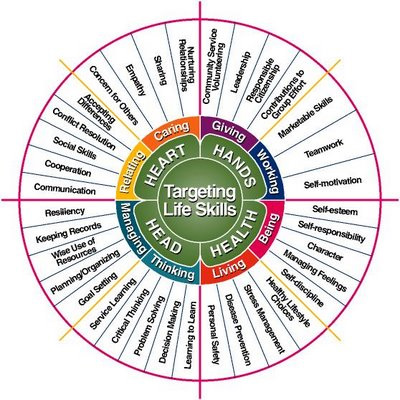
This image is called the Targeting life skills model and was created by Iowa State University Extension.
4-H Life Skills
In 4-H, youth develop life skills related to the 4 “H”s: Head, Heart, Hands and Health. Using the Life Skill Wheel on the previous page, identify at least one life skill per “H” that you have learned in 4-H. In the boxes below, describe how you have learned and practiced each life skill selected.
See example below.
Youth are then given four boxes to fill in one labeled each Heart, Hands, Head, and Health.
Optional Spirit Page
Use the space below to illustrate what 4-H Spirit means to you by using your creativity.
So put on your thinking cap and write a poem, a song, a story, or draw a picture.
Remember to be creative.
This page is intentionally left blank in the record book to be removed and replaced with a divider.
Permanent Record
Instructions: Make at least one entry per year in each section. If you do not have something to include for that section, at minimum enter the year and write “none”. For example “17-18” “none.”
For Fair participation: at minimum you must write the year in each section.
Then it asks their name, date the record was started, and date the recorded ended.
Public Presentations
List all the demonstrations, illustrated talks, and public presentations you gave.
List the related project, where given, and the award received. If presentation is non-project related please write “none.”
Leadership Experiences
List your offices in 4-H, e.g., President, Vice President, etc.
List any committees you work on each year. List any leadership activities you participated in.
Describe if it is for your club or county, or state and what you did.
Contests or Exhibits Entered
List all the contests you entered such as fitting and showing, kitchen activities, equitation or pleasure classes, judging, herdsmanship, educational displays at fairs,
shooting events, record book contest, talent show, etc. Also list all Exhibits entered and placings.
Mark an “x” if the contest was a 4-H contest. If the contest is non-project related, please right “none.”
Youth have four pages to enter their contests or exhibits.
Events Attended
List all the 4-H noncompetitive events you attended such as achievement programs, workshops, 4-H fundraising work and events, 4-H promotional events, talent show, camp, teen events, etc. An event has a definite time and place and can be project-related or general 4-H.
No need to list project or club meetings (they should be listed on your Calendar/Activity Log).
Community Service
List all the 4-H community services in which you participated. Be specific, such as volunteered at nursing home, cleaned county park, etc.
School and Community Responsibility
List the activities you did at school, church, in sports orcommunity events other than 4-H.
4-H Meeting Attendance
Type the total number of project meetings and general club meetings that you attended and the total number of general club meetings that were held.
Most Important Recognition
List the most important recognition you received in 4-H during the year, such as honors, awards, trips, etc, and what project you were recognized for.