Our Food Access Program works to ensure that locally grown food is distributed equitably so that all Clallam County residents have access to high quality, nutritious food.
Free Food Resource Lists
Extension staff maintain comprehensive lists of all free food resources available to the public across Clallam and Jefferson counties to help community members access food wherever they are. Most of the resources listed are free and available to anyone, except when noted otherwise. Use the following links to navigate to the lists, which are housed in Google Docs to ensure users always see the latest updates. If printing the list, check the date at the top for the most recent copy. Please send any recommended additions/edits to staff listed in the Free Food Resource Lists.
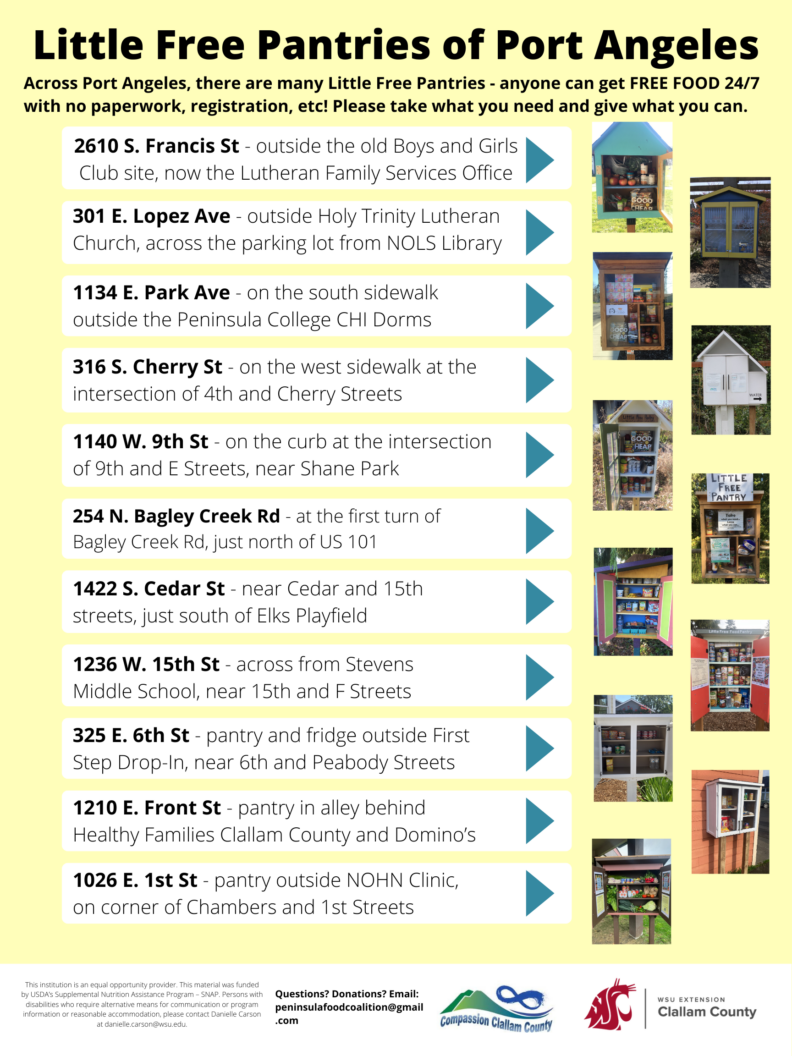
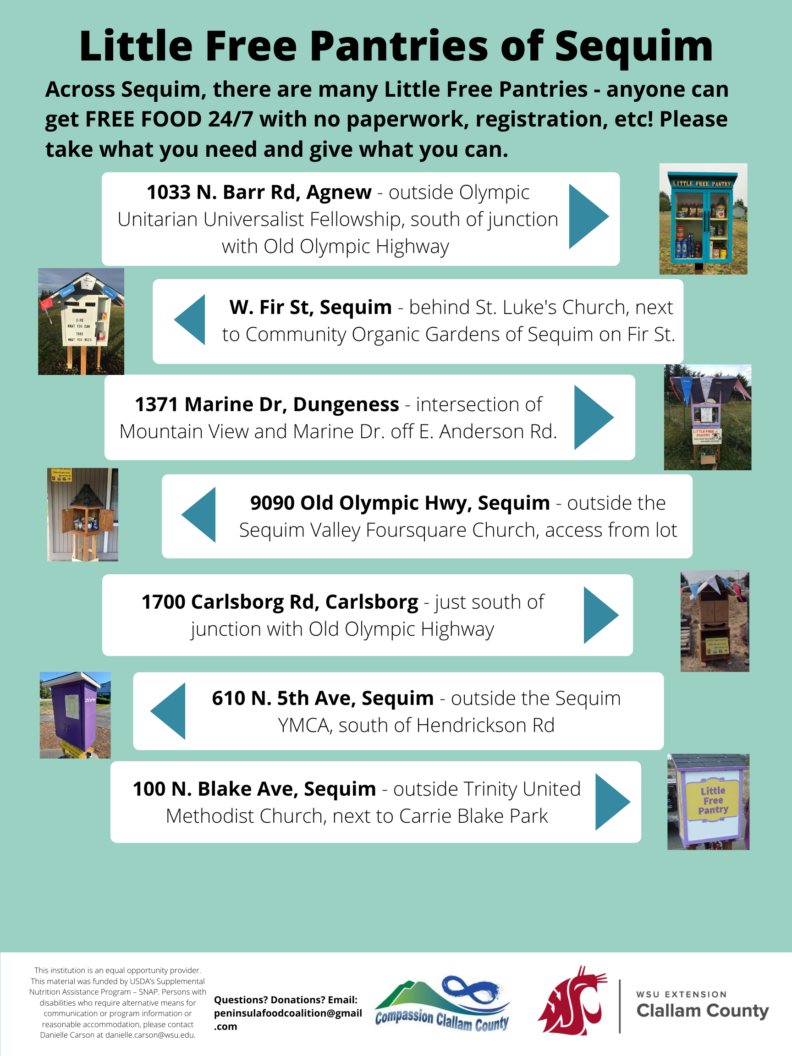
Little Free Pantries of Clallam County
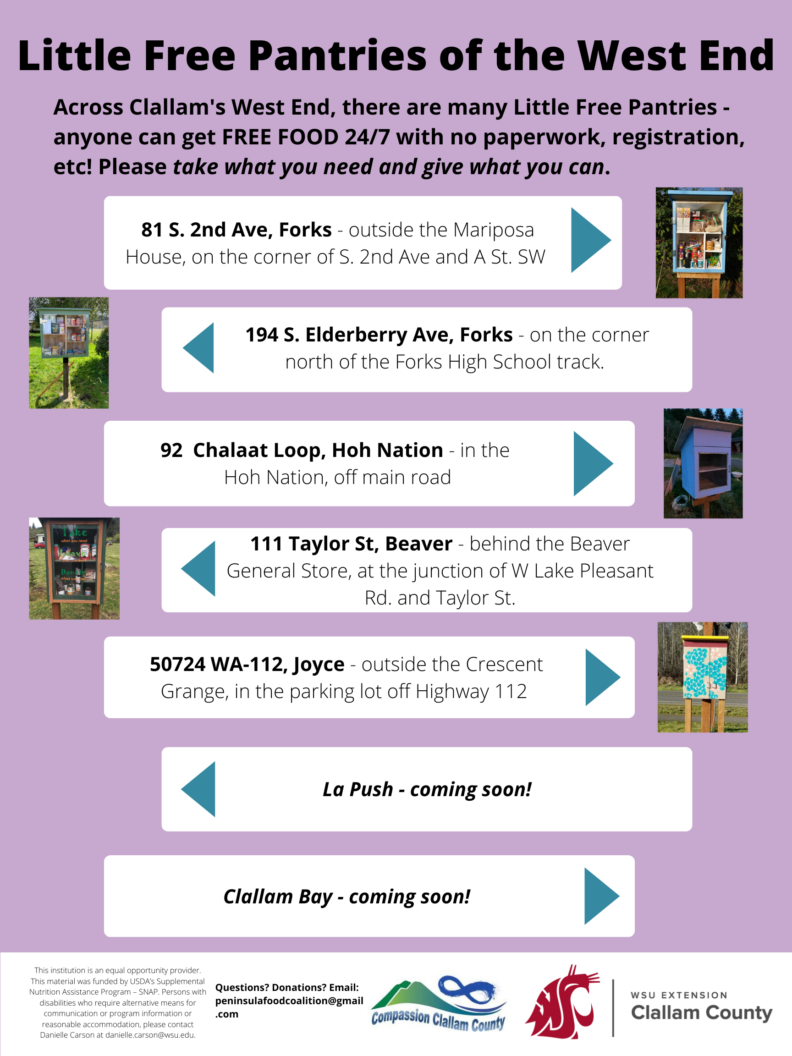
Little Free Pantries are 24/7 no-barrier miniature food pantries, stocked by neighbors and hosts and available to anyone at any time. The Extension office helps maintain the LFP network, with 25+ sites across the width of the County, and more added all the time. When using the LFPs, please remember: ‘take what you need and give what you can’.
Food Access at Local Farmers Markets
The Port Angeles and Sequim Farmer’s Markets work with state partners to offer dollar-for-dollar matching programs to shoppers paying with SNAP EBT. For every dollar spent with SNAP EBT at your local farmers market, you get $1 to spend on fresh produce. Shop local and get more food bucks to spend!
Learn more about WA SNAP Market Match
Learn more about our Community-Wide Health and Food Access Programming:
For More Information Contact:
Danielle Carson
Community Health and Food Access Program Lead
danielle.carson@wsu.edu
Benji Astrachan
Food Access Coordinator
benji.astrachan@wsu.edu
Looking for Nutrition Education? WSU Clallam County Extension was a SNAP-Ed Partner through the end of 2025.
The Supplemental Nutrition Assistance Program – plus the Educational Branch (SNAP-Ed)
Federal funding for Supplemental Nutrition Assistance Program-Education (also known as the National Education and Obesity Prevention Grant) ended on Sept. 30, 2025. As a result, Washington SNAP-Ed, along with many partners and community members, has worked to sunset the program across the state. This transition has created a significant deficit in capacity and resources for many community projects. In Washington State, SNAP-Ed was administered by the Department of Social and Health Services and implemented by Washington State University Extension, Washington State Department of Health, and over 60 local providers. It included classes, partnerships, social marketing, and promoting policy, systems, and environmental changes in local communities and statewide.
The Clallam County Extension Program provided eligible groups assistance in developing and implementing strategies, programs, and policies to improve nutrition and increase physical activity. It also provided practical, hands-on nutrition education to individuals receiving or eligible to receive Washington Basic Food (food stamps) and schools where 50% or more of students receive free or reduced lunches. This nutrition education program reached youth and adults in Clallam County with information to help participants practice healthy eating habits and choose physically active lifestyles consistent with the Dietary Guidelines for Americans. Some parts of the program are still being supported through grant funding.