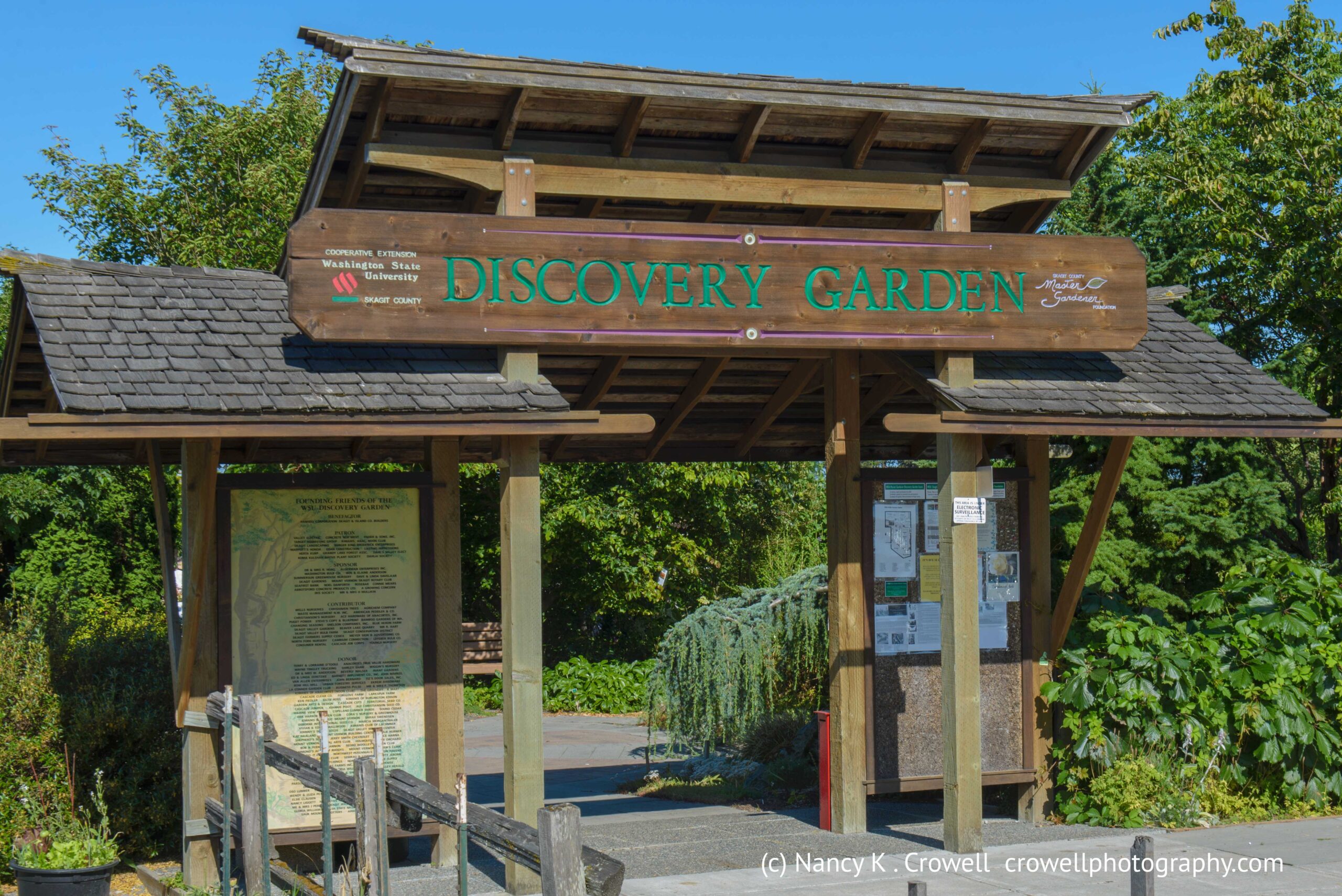
Skagit County Discovery Garden
Growing the Discovery Gardens since 1996
In 1994, the Skagit County WSU Extension Master Gardeners had a vision for a garden that would demonstrate best practices for gardening in the Skagit area. After two years of planning, the garden’s first structure of trees and fences was placed in the fall of 1996. Over the following two years, many committed WSU Extension Master gardeners, along with the help of the community, planted the gardens.
History of The Discovery Garden
- Design begins in 1994 to incorporates smaller, themed gardens into a larger garden.
- First donated trees, structures and fences are installed in 1996.
- Most of the smaller mini-gardens are completed by 1998.
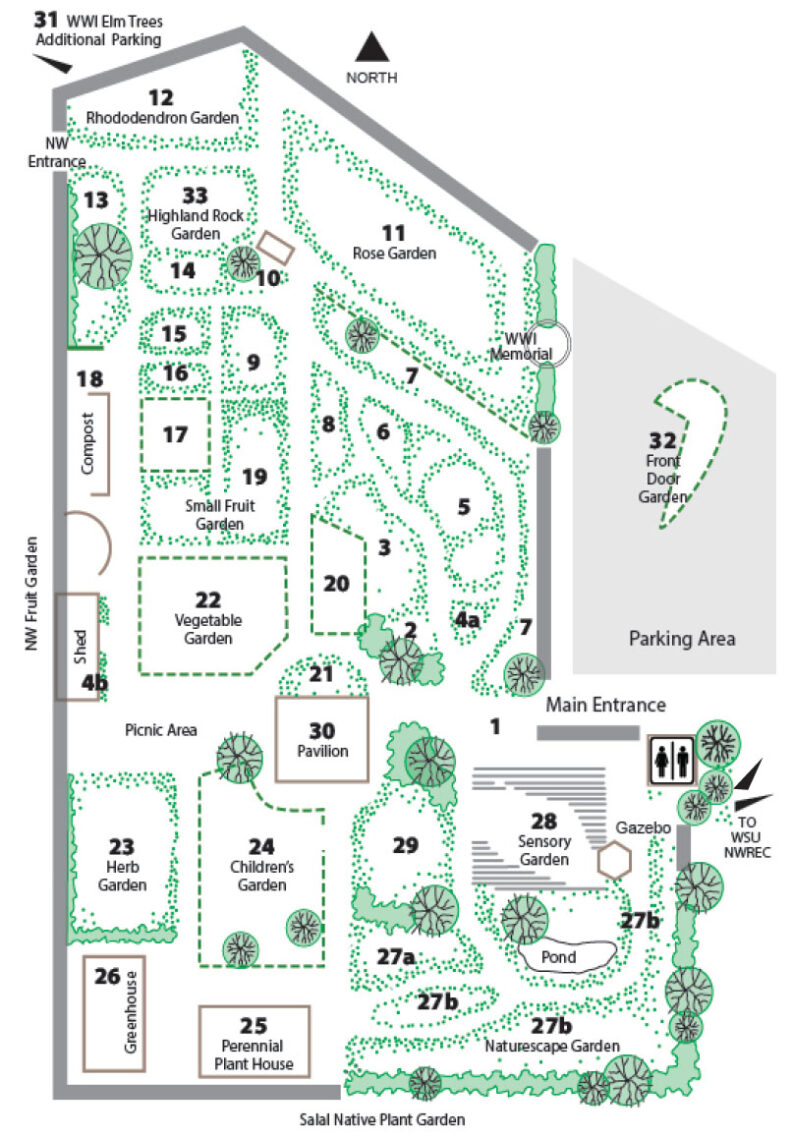
- The garden (see map below) as it appears curently.
Skagit County WSU Extension
Master Gardener Discovery Garden
WSU NW Washington Research & Extension Center
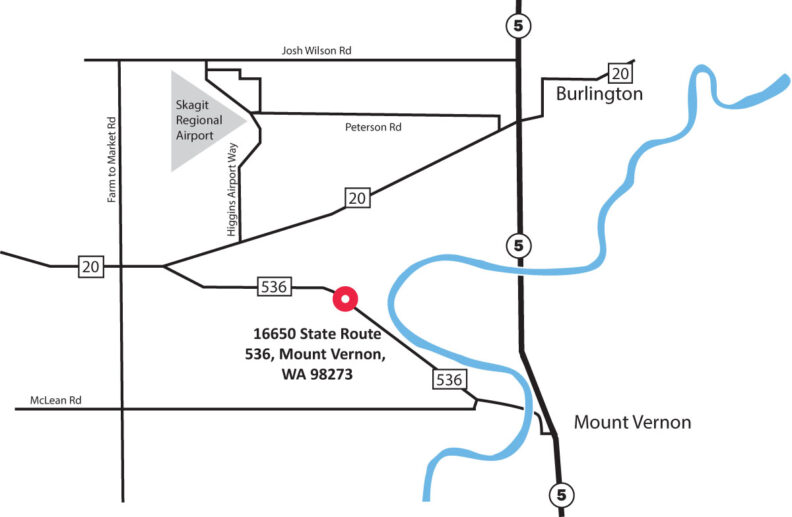
16602 State Route 536 (Memorial Hwy)
Mount Vernon, WA 98273
Open to the public daily, dawn until dusk

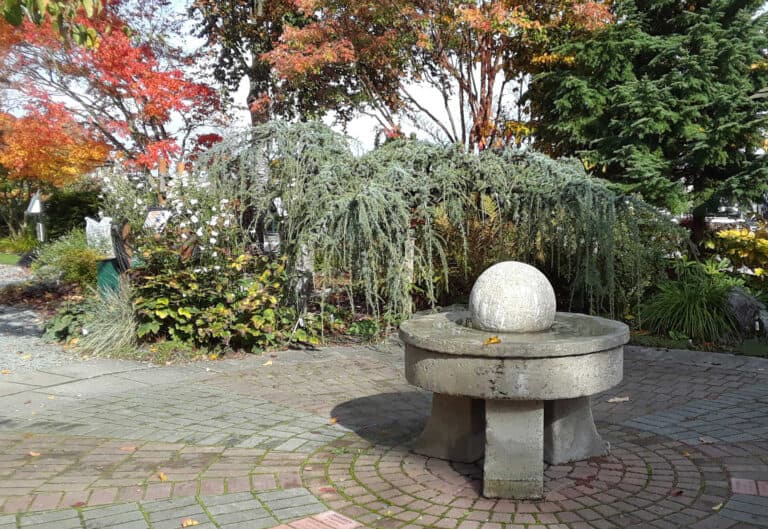
The small gardens fronting the fountain and lining the path to the pavilion
| Plant Number | Botanical Name | Common Name |
|---|---|---|
| 1 | Fatsia japonica | Japanese aralia |
| 2 | Helleborus | hellebore (assorted) |
| 3 | Pulmonaria officinalis | lungwort |
| 4 | Oxalis oregana | wood sorrel |
| 5 | Paeonia | peony (assorted) |
| 6 | Tsuga mertensiana | mountain hemlock |
| 8 | Cyclamen hederifolium | cyclamen |
| 9 | Sisyrinchium bellum | blue-eyed grass |
| 10 | Papaver | poppy (assorted) |
| 11 | Saxifraga x urbium | London pride |
| 12 | Hyacinthus orientalis | hyacinth |
| 13 | Primula vulgaris | primrose (assorted) |
| 14 | Tellima grandiflora | fringe cup |
| 15 | Polystichum munitum | swordfern |
| 16 | Aquilegia vulgaris | columbine |
| 17 | Euonymus japonicus | golden euonymus |
| 20 | Lobelia fulgens | purple lobelia |
| 21 | Acer palmatum | laceleaf maple |
| 22 | Thuja arborvitae | arborvitae |
| 23 | Nigella damascena | love-in-a-mist |
| 24 | Polygonatum multiflorum | Solomon's seal |
| 25 | Anemone blanda | Grecian windflower |
| 26 | Anemone quinquefolia | wood anemone |
| 27 | Hyacinthoides hispanica | Spanish bluebell |
| 28 | Hesperocyparis macrocarpa | cypress |
| 29 | Cyclamen hederifolium | cyclamen |
| 30 | Halimiocistus wintonensis | cistus |
| 31 | Alchemilla mollis | lady's mantle |
| 32 | Acer pensylvanicum | snake maple, striped bark maple |
| 33 | Narcissus | daffodil |
| 34 | Parrotia persica | Persian ironwood |
| 35 | Berberis thunbergii | redleaf Japanese barberry |
| 36 | Heuchera americana | coral bells |
| 37 | Davidia involucrata | dove tree |
| 38 | Tulipa | tulip |
| 39 | Hamamelis x intermedia | witch hazel |
| 40 | Myosotis sylvatica | woodland forget-me-not |
| 41 | Phlox paniculata | garden phlox |
| 42 | Skimmia japonica | Japanese skimmia |
| 43 | Fragaria | wild strawberry |
| 44 | Astilbe japonica | astilbe, false spirea |
| 45 | Helleborus | hellebore |
| 46 | Sarcococca ruscifolia | fragrant sweetbox |
| 47 | Berberis thunbergii f. atropurpurea | Japanese barberry |
| 49 | Gaultheria shallon | salal |
| 53 | Adiantum venustum | Himalayan maidenhair fern |
| 54 | Epimedium x perralchicum | bishop's mitre |
| 55 | Dryopteris wallichiana | fern |
| 56 | Dicentra spectabilis | bleeding heart |
| 57 | Styrax japonicus | Japanese snowbell |
| 58 | Hosta | plantain lily |
| 59 | Rhododendron | rhododendron, dwarf rhododendron |
| 60 | Camellia | self-pruning camellia |
| 61 | Berberis thunbergii | golden barberry |
| 64 | Bergenia crassifolia | bergenia |
| 65 | Buxus sempervirens | columnar boxwood |
| 66 | Polystichum polyblepharum | tassel fern |
| 67 | Astrantia major | masterwort |
| 68 | Viola glabella | yellow wood violet, Johnny jump-up |
| 69 | Heuchera | coral bells |
| 70 | Polemonium caeruleum | Jacob's ladder |
| 71 | Tanacetum parthenium | feverfew |
| 72 | Andromeda polifolia | bog rosemary |
| 73 | Astelia nervosa | silver-red mountain astelia |
| 74 | Brunnera macrphylla | Siberian bugloss |
| 75 | Hydrangea serrata | reblooming mountain hydrangea |
- ENTRANCE GARDEN The small gardens fronting the fountain and lining the path to the pavilion greet visitors with plants having year-round interest. Easy-care, layered plantings are chosen for the Pacific Northwest climate.
- SHADE GARDEN Does your garden have a “shady” personality? This garden suggests alternatives to sun-loving plants so even a shady garden can bask in color, texture, and smell.
- COOL COLOR GARDEN Are you needing to feel cool and relaxed? This garden creates a cool-feeling border by including plants with texture and shades of blue, green, purple, lavender, silver, and white.
- 4a & 4b: POLLINATOR GARDENS These two areas are planted with an assortment of both native and non-native shrubs, perennials and annuals. Plants chosen are known to be nectar and pollen sources for a diversity of pollinators. 4a is watered, 4b is dry scape.
- JAPANESE GARDEN There are five distinct types of Japanese gardens: hill and pond, dry landscape, tea, courtyard, and stroll. Ours is of the stroll design. Odd numbers of plants and stones are used in groupings and spaced unevenly. Dry rock beds symbolize rushing rivers; large rocks represent mountains. Not surprisingly, water features are an integral part of Japanese gardens.
- PASSAGE GARDEN This garden consists of a pathway through two long and narrow borders. The plants are pruned to accommodate the characteristics of a passageway. They include a dogwood, two hydrangeas, a “Golden Spirit” smoke bush and a smoke tree, and numerous hellebores.
- FOUR SEASONS GARDEN Year-round interest and minimal care are key to this diverse mixed border garden. Trees, shrubs and a fence are the backdrop for perennials, vines, and biennials punctuated by annuals and bulbs to add a pop of seasonal color. Evergreens and foundation specimens anchor the garden’s silhouette.
- FALL & WINTER GARDEN This garden showcases fall-blooming perennials, bright berries, and brilliant foliage giving way to bare branches and beautiful bark. Evergreen foliage, winter blooms, and early bulbs lead the way to spring.
- DOC’S ARBOR Created in memory of Dr. Richard “Doc” Hoag, one of a small group of master gardeners who envisioned the Discovery Garden. He and his wife gave the first “seed” money donation. Doc grew grapes and made many different kinds of wine.
- ORNAMENTAL GRASSES Many ornamental grasses are especially well-suited to thrive in Skagit County, and will add texture, movement, and interest in any landscape. Sizes, colors and shapes can fit a variety of needs and conditions.
- ROSE GARDEN Considering a new rose for your garden? Walk through the 40+ varieties of traditional and modern roses blooming May through first frost.
- RHODODENDRON GARDEN Since 2007 this garden has provided a harmonious space to view the wide variety of rhododendrons that can be grown in the Pacific Northwest climate.
- LLOYD EIGHME’S HEATHER GARDEN With year-round interest, heather is in bloom every month in this garden. These varieties show growth patterns from ground covers to tree forms.
- IRIS GARDEN The iris plantings display different species and their bloom cycles from late winter through summer.
- GROUND COVERS AND CONIFERS Ground covers can be used to smother weeds, fill in areas under trees, stabilize hillsides, soften the edges of pathways, and reduce evaporation. Here master gardeners have showcased commonly available shade and sun-tolerant plants and dwarf conifers.
- SUCCULENT GARDEN Succulents are drought tolerant and easy to propagate. Available in a wide variety of textures, shapes, sizes, and colors, they are low-maintenance, requiring well-drained soil and full sun for optimal growth. See the many that are hardy in this area.
- DISCOVERY IN GARDENING IS TERRIFIC! Master gardeners host day-long field trips for area 2nd graders. DIG-IT!, one of six activities, gives students hands-on gardening experience in the style of the Three Sisters garden—beans, corn, and squash— a planting technique used by native cultures.
- COMPOSTING AREA Magic happens here! Throughout the growing season, the sorted and chipped pruning’s, browns, and greens are combined and turned. Mother Nature does her part, giving us nutrient-rich compost in a few months.
- SMALL FRUITS Multiple types of berries, currants, and small fruits are grown here. See Heritage and Cascade Delight raspberries, low-bush blueberries, lingonberries, strawberries, boysenberries, evergreen huckleberries, and Triple Crown thornless blackberries.
- COTTAGE GARDEN This somewhat whimsical garden dates back to the 1300s when space was limited around each home. Ornamental and edible varieties were commonly planted together to maximize every available inch.
- HARDY FUCHSIA GARDEN Originally planted by members of the North Cascade Fuchsia Society, all the varieties in this garden are hardy enough to survive Skagit County winters. Even in the shade of the pavilion, the garden blooms in beautiful colors from early summer until frost.
- VEGETABLE GARDEN The garden features a no-till garden demonstrating raised borderless beds in addition to those constructed of wood and/or metal. Here, favorite older and newer varieties are selected to grow well in our Northwest maritime climate. Educational and inspirational, this garden emphasizes the importance of soil health, trellis styles, and crop rotation.
- HERB GARDEN Skagit Valley’s climate is perfect for herbs. The classic English herb garden structure, history, and purpose have been interpreted for Northwest living. Different hedging materials surround the formal design creating a garden room with themed gardens planted within.
- CHILDREN’S GARDEN Parents and children share the pleasure of Children’s Garden. Enter through a mulberry arch and find a perfect place to play hide-and-seek. Here, kids of all ages can play games, make music, or captain a boat. Enjoy a snack at the picnic table and find ideas to take home.
- PERENNIAL PLANT HOUSE Home to perennials and plants propagated throughout the year for the annual Plant Fair in May.
- GREENHOUSE The greenhouse is busy in late winter through spring as master gardeners start seeds and take cuttings for new plants that are used in the garden or sold at the Plant Fair held the Saturday before Mother’s Day in May.
- 27a. MEADOW Designed as an open area with year-round interest, the Meadow is a low-maintenance, large space incorporating ornamental grasses, native plants, and a wildlife snag to create visual interest in this natural space.
27b. NATURESCAPE This informal garden room features meandering footpaths bordered by native and non-native plantings. Stroll the paths and contemplate the variety of eco-systems represented by the sunny meadow, the pond, and the shady corner. Find inspiration for your personal green space isolated from adjacent buildings and traffic. - SENSORY GARDEN This garden will be a place for everyone to explore their senses as they connect with plants. This work in progress will focus on accessible approaches to ensure everyone can enjoy this garden space.
- JOE’S PLACE The large anchor at the entrance is in memory of Navy veteran, Joe Dupré, an early graduate of the program. Some of Joe’s favorite plantings reside here, including primroses, fuchsias, fig tree, and ferns.
- PAVILION This sheltered gathering place is used for master gardener lunches, educational activities, seminars, and workshops. Reserve the space through our website at skagitmg.org/home/discovery-garden/
- WWI ELM TREE MEMORIAL Fifty elms are planted along Memorial Highway honoring the men from Skagit County who died in WWI. Granite plaques placed by each tree name each of the fifty men lost. Each May, master gardeners have a ceremony to commemorate their sacrifice.
- FRONT DOOR GARDEN Located in the center of the gravel parking lot at the entry to the Discovery Garden, this garden welcomes visitors with a large metal sculpture, featuring three Pacific Dogwood blossoms and a bee.
- HIGHLAND ROCK GARDEN This rock-strewn garden features plants that thrive in challenging Alpine elevations or rocky coastal cliffs. Rocks and well-drained soils are the foundation. The plants are low growing with splashes of color.
WSU is an equal opportunity provider. If you need a reasonable accommodation or language access to participate in an event, please contact Alex duPont, Skagit County WSU Extension Master Gardener Program Coordinator, at alex.dupont@wsu.edu or (360) 395-2367 at least two weeks prior to the planned event. Language access services, such as interpretation or translation of vital information, will be provided free of charge to limited English proficient individuals upon request.