Plant Health Care and Integrated Pest Management
Updated by:
Carrie Foss, Extension Urban IPM Coordinator, Puyallup Research and Extension Center, Washington State University
Original Authors:
Arthur L. Antonelli, Extension Entomologist Emeritus, Washington State University
Van Bobbitt, Horticulture Instructor/Arboretum Coordinator, South Seattle Community College
Carrie Foss, Extension Urban IPM Coordinator, Puyallup Research and Extension Center, Washington State University
Introduction
Many of the sick plants submitted for diagnosis at plant clinics are not suffering from insect pests or disease organisms. Instead, their problems result from cultural and environmental factors such as overwatering, drought stress, or winter damage. These problems do not have a simple, one-shot cure and require a big-picture assessment of the landscape or garden in order to promote overall health.
Plant Health Care (PHC)
In an attempt to develop a holistic system that focuses on healthy landscapes, several terms have been suggested: integrated plant management, integrated landscape management, sustainable landscaping and gardening. One term that has received widespread acceptance in the tree care industry is plant health care (opens in new window) (PHC).
Plant health care is as much a change in attitudes as a change in techniques. Not only does it emphasize plant health over pest management but it also takes an ecosystems approach that emphasizes working with nature instead of fighting nature; it sees proper culture as the foundation of a healthy landscape and healthy gardens as well.
The first step in implementing a plant health care system is to identify and list all plants in your yard. How can you take care of your plants if you do not know what they are? Once you have a plant list, do some research to learn more about your plants: their cultural needs, likely pest problems, and common environmental problems. During this research, you will uncover some key plants (opens in new window)—those that are problem prone and likely to require the most attention.
After identifying the plants in your garden, you can determine the key problems (opens in new window), both biotic (caused by an organism) and abiotic (environmental or physiological). Key problems are the ones most likely to impact plant health and require your attention.
For example, in western Washington, rhododendrons are often diagnosed as suffering from root weevils or poorly drained soil. In eastern Washington, rhododendrons most often suffer from root weevils and iron-deficiency-induced chlorosis from alkaline soil. Learn more about these key problems if you grow rhododendrons. For pests, learn to identify various stages of their life cycles, recognize symptoms of damage, and learn which management options are both effective and environmentally sound.
The next step is to study your yard’s ecosystem. Your garden truly is an ecosystem with complex interrelationships among flora, fauna, soil, weather, and other factors. Be aware of climatic factors such as minimum temperatures, the amount of sun that various parts of your garden receive, prevailing wind patterns, and seasonal patterns of precipitation. Understand soils and drainage patterns. This information is essential, because healthy gardens result from carefully matching plants to the environmental conditions in your yard or garden.
Landscapes and gardens are dynamic. A key to any plant health care program is frequent monitoring: at least every two weeks during the growing season and perhaps once a month during the winter. When monitoring, pay particular attention to symptoms of plant stress (yellow or wilted leaves, dead branches, etc.) and be on the lookout for developing pest problems. Concentrate your monitoring on key plants and key problems.
With knowledge of your plants, their potential problems, and your yard’s ecosystem, you have the tools to optimize plant health. A healthy landscape or garden starts with smart planning: select pest-resistant plant species, match plants to the existing climatic and soil conditions (“right plant—right place”), and include a diversity of plant species to limit the severity of infestations due to monocultures and to support a diversity of beneficial organisms.
Employ good cultural practices: improve soil conditions by using mulches, practicing correct planting methods (as outlined in Chapter 12: Trees and Woody Landscape Plants), and paying careful attention to watering, fertilizing, and pruning (too much of these last three may be just as bad as too little; see Chapter 12: Trees and Woody Landscape Plants and Chapter 23: Pruning Woody Landscape Plants). Sound cultural practices are the basis of a plant health care program. They benefit any landscape or garden whether new or well established.
When we promote total plant health (“preventive medicine”), we avoid many problems. Cultural and environmental problems are minimized, and healthy plants are better able to withstand insect, disease, and weather-related damage.
The following components of plant health care include:
- Knowing your plants
- Determining key problems: biotic and abiotic
- Studying the landscape or garden’s ecosystem
- Optimizing overall plant and garden health
- Employing integrated pest management techniques
Integrated Pest Management (IPM)
When monitoring indicates that pests require attention, plant health care employs an integrated pest management (IPM) (opens in new window) approach to managing pests. Integrated pest management is an environmentally friendly and common sense approach to managing insects, diseases, weeds, and other pests of landscapes and gardens by using all the various tools available to gardeners, starting with their skills of observation.
Gardeners should always be watching to see what is growing, creeping, and crawling in their yards and gardens. Besides the entertainment value, this provides gardeners with the earliest alert about possible problems. IPM depends on that frequent monitoring of plants and pests so that control strategies are used only when and where needed.
With IPM, a variety of control methods—cultural, mechanical, biological, and chemical—may be employed. Furthermore, IPM takes a holistic approach to pest control encompassing all herbivore pests (including vertebrates, insects, mites, and slugs), weeds, diseases, and the monitoring thereof, rather than singling out only one pest-plant problem.
Right Plant—Right Place
What exactly does the notion of “Right Plant, Right Place” mean?
Getting plants, including trees, in the right place means considering all of a plant’s traits and requirements—cold hardiness; light, soil, and water requirements; and mature size—before purchasing and planting something.
IPM can reduce pesticide usage in the landscape by 50 to 90 percent without sacrificing the appearance of plants (see the Holmes and Davidson reference in the Further Reading section for more information). Pesticide usage in the garden also may be greatly reduced using IPM strategies.
IPM Decision-Making
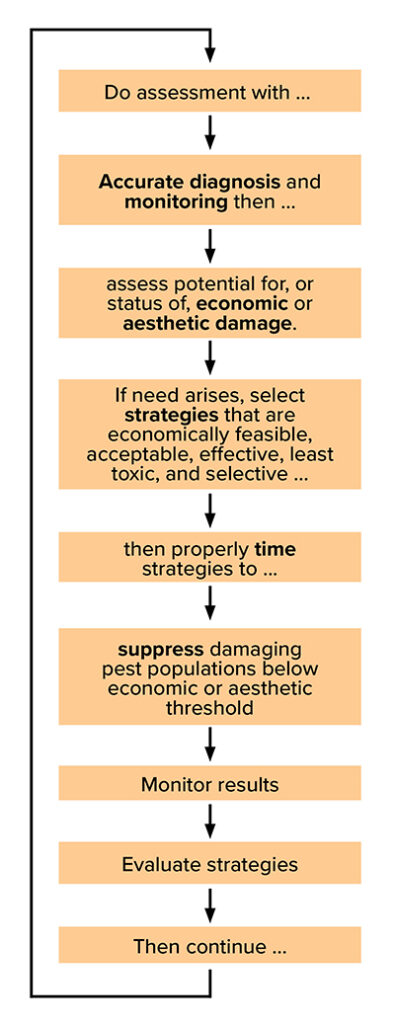
IPM is a decision-making process that begins with accurate identification of the plant pest and determination of the pest status (Figure 1). Next in the IPM process is monitoring of the pest population size and then threshold assessment. Then, environmentally friendly and least hazardous management methods are used to achieve pest suppression.
Pest Diagnosis
Accurate diagnosis is the first step in IPM. A wrong identification can result in choosing the incorrect management options, leading to ineffective actions and possibly misapplication of a pesticide.
For effective IPM, a gardener or property owner must be able to identify the pest and understand pest life cycles and behaviors. Whatever control method is chosen must coincide with a pest’s most vulnerable stages. With insects, this often is the immature feeding stage.
It is also important to know where the pest occurs on the host plant. For instance, applying a protective fungicide to a plant’s leaves will do nothing to protect the roots from soilborne pathogenic fungi. Neither can you “pick off” fungi from the soil like you can hand-pick some foliar-based insects. Because root rot organisms thoroughly infest soil, removal of the entire infected plant would probably be necessary. A different plant, resistant to the disease-causing organism, could then be planted in the contaminated soil. There are many examples like these, so knowledge of life cycles and behaviors will most certainly make the gardener a more effective pest manager.
Monitoring
Once you have determined that a pest is causing plant damage, it must be monitored from that point on. It may be that the pest is low in numbers when first noticed and may not reach levels where control is necessary. You will not know this unless you regularly monitor the population. A gardener has access to a number of different monitoring tools that range from frequent visual monitoring (simply looking) to complex chemical traps (attracting and catching samples). We will discuss a few examples.
Visual Monitoring
With visual monitoring, we count the pests that we see to determine whether the population is increasing.
Sometimes insect pests are elusive and can only be observed at night with a flashlight. Weevils of many kinds fall into this group. Keep a diary so you can document real increases. Monitoring includes noting numbers of aphids or mites per leaf or grubs or larvae per square foot of turf. Sometimes the pest numbers increase slowly during the sampling period (as with mites). At other times, the population increases quickly (as with crane fly larvae in turf). Usually with pests that have several generations per season, like aphids and spider mites, sampling will continue until the decision to control the pest is made. Conversely, pests with one generation per season often require only a single sampling to determine what action to take.
Trap Monitoring
Some insect pests are difficult to monitor without some sort of trap. One common type of monitoring trap is the colored sticky trap. The color yellow is a powerful attractant for many insect pests, including whiteflies, fungus gnats, and certain beetles. Blue sticky traps are particularly attractive to certain thrips. Colored sticky traps are easy for gardeners to construct. Other traps rely on the sense of smell.
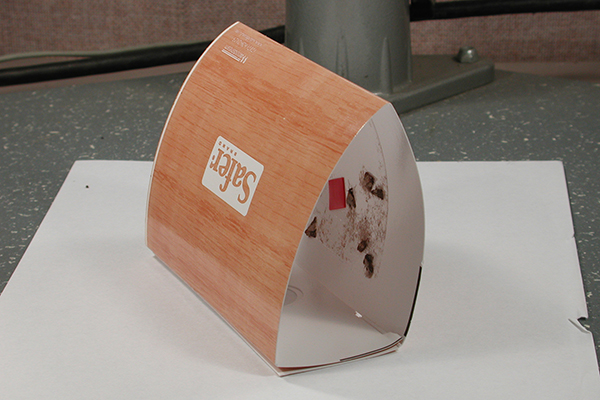
Traps baited with olfactory lures are commercially available for wasps and other pests. Home gardeners are now able to purchase pheromone traps (Figure 2) for various pests, usually some kind of moth. These sticky traps, treated with synthetic female sex lures, attract males.
Determining Thresholds
If a pest is life-threatening to a plant—such as certain diseases or virus vectors—mere presence may dictate management action.
However, mere presence does not always require action. For example, most arborists agree that deciduous trees and many other plants can take up to 25 percent defoliation before plant health is impaired, unless the plants are also otherwise stressed.
Pest damage can have two types of thresholds: economic and aesthetic. The economic threshold (opens in new window) is defined as the point at which the cost of crop losses resulting from the pest problem equals the cost of control. Usually this principle is used in agricultural situations, but it also applies if you have to decide whether to manage a pest or replace plants in a landscape.
In landscapes we also talk about aesthetic thresholds (opens in new window) which are determined by how much of the pest problem or plant damage the property owner can tolerate. An aesthetic threshold is hard to quantify and is often quite low because our society is quite intolerant of pest problems and plant damage. However, when people understand that, for example, deciduous trees can tolerate up to 25 percent foliar loss from chewing pests and still be healthy, they tend to become more tolerant.
Timing of Control Methods
Proper timing is an essential component of IPM whether it is for a mechanical method, the release of biological control (opens in new window) agents, or a chemical application. In terms of population management, there is almost always a window of opportunity or period of maximum vulnerability when an application will give you the “biggest bang for the buck.” One guideline, of course, is monitoring to determine when pest feeding begins, or when the pest emerges, or when the eggs are laid. These events often indicate when it is time to implement control.
Sometimes monitoring tools are not available, so another guideline may be used. A pest’s life stages are often related to the plant’s phenology (opens in new window) or life cycle stage (bud break, bloom, new growth, etc.). For example, with some insect pests there is a temporal correlation between leaf emergence and egg hatch. Each year, leaf emergence may begin on a different calendar date and that date may vary by as much as a month from one year to the next because it is related to weather and other environmental factors. The timing of insect egg hatch will vary just as the plant growth does, for some of the same environmental reasons, or because of the plant’s development, or because of the interplay between all of those conditions.
Plant diseases can also be related to a plant’s phenology. Certain fungal diseases only infect the blossoms or the new growth of the plant, so this would be the most critical period to manage these problems. When fungicides are used as part of an IPM approach, the application is usually timed to prevent the fungus from penetrating the plant surface.
Weeds, too, are more easily controlled during some stages of their growth. In general, it is usually true that weeds can be controlled most easily when they are small.
Timing is especially important when using biological controls for pest management. There is a species-specific appropriate time for release of live biological control agents. If you wait too long to release a particular biological agent, it may be too late to effectively manage the problem. The pest population may have increased to a point where it outpaces the biological control agent’s ability to control it before severe damage occurs. However, biocontrol efforts are for management, not eradication of the pest.
Strategies for Pest Management
The methods for suppressing or preventing pest damage to plants include mechanical, cultural, biological, and chemical controls. There are numerous techniques within each of these categories.
Mechanical Control
This approach probably goes back to when humankind first saw a wild horse using its tail as a fly swatter. Mechanical control techniques involve some method of removal and physical destruction of the pest. The fly swatter was probably the earliest mechanical tool after simply stepping on or squishing insects. Some forms of mechanical control can be quite effective and inexpensive in many cases. Mechanical control is most effective if implemented early in the season when pest populations are low.
Insect Removal. A fairly strong stream of water can wash away aphids or sawfly larvae, known as pear slugs. This works well if the tree or shrub can be sprayed on both its upper and lower leaf surfaces. These insects cannot usually reinvade the host tree and often die stranded on the ground. Hand-removal of large caterpillars or hornworms from garden plants such as tomatoes works well for many gardeners.
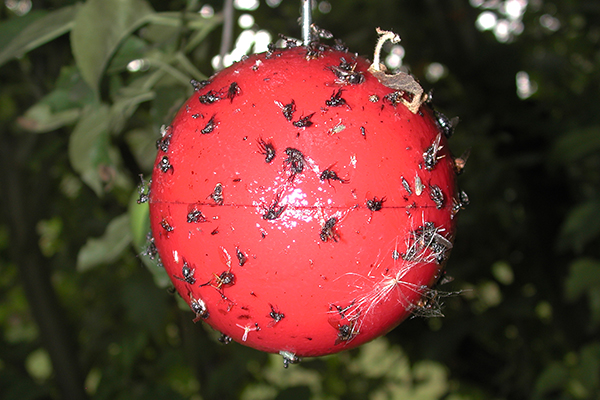
Insect Traps. Insect traps are considered to be a mechanical approach (Figure 3), and they are often used along with monitoring tools. If placed early enough, colored sticky traps like those used for detecting whiteflies can often adequately suppress a pest population. This is also true of pitfall traps and other traps used for monitoring. Sticky tree wraps are quite effective when used for certain migrating caterpillars.
Electric “zapper traps” are not a recommended IPM tool for outdoors. They involve an ultraviolet light that attracts insects and an electrocution grid that kills them. When used outdoors they attract many pest insects from long distances but they also attract and kill a huge number of beneficial insects.
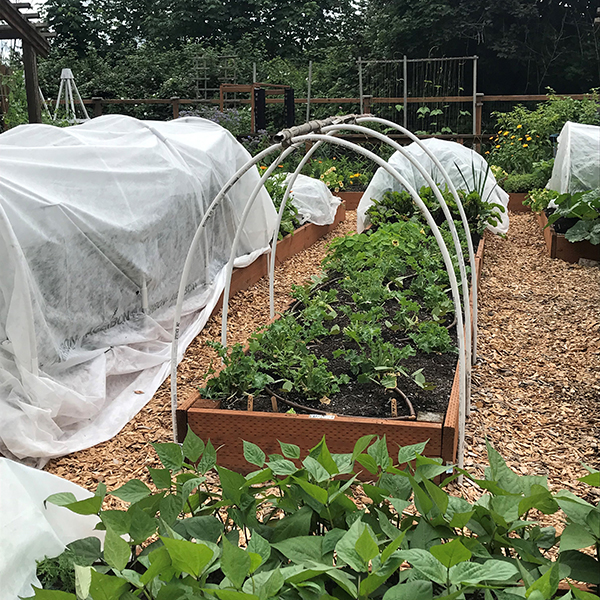
Floating Row Covers. This very popular cultural method involves the use of lightweight spun material to prevent egg laying on or near several types of vegetables. This method was pioneered during some WSU organic gardening research many years ago (Figure 4). Some of the success stories include prevention of cabbage maggot establishment on cabbage, broccoli, turnips, and radishes, as well as preventing carrot rust fly on carrots and spinach leafminer on beets and spinach. Basically, this approach can be used on virtually any garden crop that does not require pollination by bees and where the pest has not yet infested the soil.
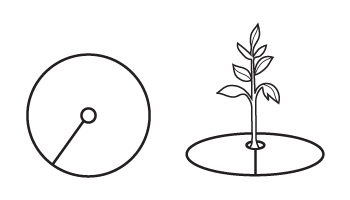
Insect Barriers. Variations of the floating row cover method may be pest- and plant-specific, such as using paper disks to keep root maggots from infesting the crowns of brassicas, radishes, and turnips (Figure 5).
Cultural Control
Cultural control techniques were probably the most common management strategies before pesticides were widely used. With cultural management, the plant or the environment, or both, are changed to make them less conducive for pest problems. Cultural management can include a variety of approaches.
Right Plant—Right Place
This philosophy encourages gardeners to choose plants that are well suited to the region where they will be planted. Most plants have an ideal site or set of conditions in which they will flourish; if they are planted in a site without their preferred conditions, they become stressed and more prone to pest attacks. If a particular plant is known to have a serious pest problem in your area, do not plant it. For example, spruce does well in eastern Washington and is relatively pest free with one exception: Cooley spruce gall adelgid. But in western Washington, it is prone to attack by three serious pests: spruce spider mite, spruce aphid, and Cooley spruce gall adelgid. Always select plants that are suitable for the site.
Even if a plant is selected that is well adapted to the region, it must also be suitable for the planting site. For example, if landscape plant species are planted in an appropriate site with proper drainage, adequate shade or sun exposure, etc., then we can predict a successful plant with the ability to tolerate some pest presence. However, all too often, gardeners inappropriately place new trees and shrubs in very wet soils where the plants are jeopardized by root rot and other problems. Conversely, if a tree or shrub that prefers a damp site gets placed in gravelly, well-drained soil, it may gradually decline. Bark beetles may be attracted to pheromones released by the damaged tree. Paying attention to the plant’s preferred conditions and providing proper health care will go a long way in plant survival and the ability to avoid, or at least tolerate, certain pest species.
Plant Resistance. The use of resistant plant varieties to avoid several insects and many plant diseases is yet another cultural technique. There are quite a few landscape and garden plants that have shown resistance to some of our common insect and disease problems. Flowering crabapple is a desirable landscape tree but is susceptible to powdery mildew and scab. Crabapple varieties that are resistant to these diseases were identified through research conducted at the WSU Mount Vernon Northwestern Washington Research and Extension Center. Information on resistant varieties for Washington gardens and landscapes can be obtained from university resources and experienced nursery specialists.
Proper Planting Techniques and Dates. Many plants will not survive if they are improperly planted. During plant selection, check the plants for developing root problems, particularly in pot-bound plants. Plants with circling and girdling roots should be avoided, because those roots will continue to grow, encircling and strangling the root mass in a manner that will lead to drought stress. Planting dates can also affect pests and diseases and the plant’s susceptibility to them. For example, waiting until a later date so soil temperatures can rise or using floating row covers to raise soil temperatures can prevent some diseases of roots and seedlings.
Crop Rotation. Crop rotation is an age-old practice that still has value as a cultural method of pest management. Planting garden crops in the same spot year after year encourages the buildup of many diseases and arthropod pests. You can suppress pest buildup or even stop it if you change types of plants each year in a garden bed. This is particularly true with annual ornamentals or edible crops that are planted every year.
See Chapter 7: Vegetable Gardening for more information.
Pruning. Pruning can be considered a cultural method for disease management. When pruning is used to thin tree and shrub canopies, it increases air circulation, and leaves dry more quickly. The environment in the canopy is then less conducive to the development of fungal diseases such as scab.
Roguing. Simple removal and destruction of problem plants that have chronic pest problems is known as roguing (opens in new window) and is a viable cultural approach.
Induced Competition. This can be accomplished by establishing dense ground covers that can outcompete weeds. Maintaining a weed-free vegetable garden will go a long way toward limiting unwanted pests.
Mulching. Another cultural strategy that should not be overlooked is mulching to help suppress weeds. Mulch can be made of organic materials such as wood chips, wet newspaper covered with seasoned sawdust, or other wood products. There are also inorganic mulches available, such as plastics and gravel or rock. Mulches can be an effective method of weed management. See Chapter 12: Trees and Woody Landscape Plants for a more detailed discussion of mulches and how to apply them.
Biological Control
Biological control is primarily the use of living organisms to suppress other pest organisms. It can be done, for instance, by releasing herbivores such as goats to feed on and control noxious weeds or the release of arthropod predators to control pest insects such as mites. Some biological control agents are even more finely tuned; parasitoids can be purchased that selectively associate with a specific pest. There has been a history of success with the deliberate implementation of biological controls in the past century or so. One of the landmark cases is the introduction of the vedalia beetle to control cottony cushion scale on California citrus trees in the 1880s. But the history of biocontrol success goes back even further: in ancient times, the Egyptians employed cats for rodent control. In recent decades, biological control has become quite sophisticated and is frequently used in the IPM process as a primary means of pest control.
There are three main types of biological control: conservation, augmentation, and classical biocontrol.
Conservation Biocontrol. This method strives to protect nontarget (non-pest) organisms that act as biological agents in places where they are already performing natural control. Improving habitat by incorporating blooming plants into landscapes and gardens to attract and support beneficial insects helps conserve agents. When using insecticides, a selective product should be chosen—one least likely to affect the natural population of predators and parasites, in order to protect existing agents.
Augmentation Biocontrol. This method enhances existing (usually native) beneficial insects by increasing their numbers or rejuvenates a dwindling population of a beneficial organism.
Insects may be purchased for release to augment a local population, and habitat can be improved to encourage their survival. Some prime examples of augmentation biocontrol include the addition of native green lacewings to suppress aphids and their relatives, and the use of parasitic wasps to control many pests.
Classical Biocontrol. This method is used when an invasive pest or foreign species becomes established in the US. Government agencies locate and import the natural enemies of this new pest from its land of origin. When required quarantine periods have passed and necessary screening is completed, the foreign beneficial is released into the infested area. A good example of classical biocontrol in the Pacific Northwest is the introduction of the tansy ragwort flea beetle. Both the larvae and adults are destructive to tansy ragwort, a noxious weed.
Note that some beneficial insects are not good candidates for release on small tracts of land. Lady beetles are one example. Because of genetically controlled behavior, lady beetles must disperse after hibernation before they can settle down, mate, and lay eggs. Since they are normally collected during hibernation and sold before dispersal flight occurs, purchasers are usually chagrined by the disappearance of the flocks they just released—often occurring by the following day. To keep purchased lady beetles around, release small amounts of the beetles at a time in an enclosed space such as a greenhouse, cold frame, or under a row cover. This limits the area to which they can disperse while allowing them to follow their natural instincts.
Competitive Exclusion. For disease management, competitive exclusion (opens in new window) uses certain beneficial bacteria or fungi to suppress pest organisms through competition for attachment sites on plants.
As an example used in agriculture, crown gall caused by Agrobacterium radiobacter is an infectious disease that can be prevented by using a non-infective bacterium Agrobacterium radiobacter strain K1026 before the infectious strain invades. There are no home and garden products available with this bacterial strain. Infection sites are locked up or filled by the non-infective bacterial strain, thereby preventing the establishment of the infective strain.
Mating Disruption. This management method is biologically based, as the synthetic pheromone (chemical message produced by insects to impact behavior) applied mimics the sex-related signals emitted by females of the pest of concern. The agricultural crop to be protected is cloaked in cloud of sex lure scent that obscures the actual pheromones produced by female insects. This effect is called male confusion (opens in new window), and it prevents males from successfully finding females, thereby reducing or preventing procreation of the next pest generation. These pheromones can be applied to the crop canopy in a variety of ways from slow-release dispensers that are easily attached to the crop to sprays containing the pheromone.
Chemical Control
Chemical control—the use of pesticides—can be a viable option in an IPM program or approach. When gardeners consider using a pesticide, they should first ask several questions.
- Am I really at a point where my plant will be in jeopardy?
- Is there a selective and environmentally friendly choice among the pesticides available?
- Can the application of the pesticide product be done in a manner to protect pollinators?
- Among those pesticides that are effective, which is the least hazardous chemical option?
- Have I read and understood the pesticide label, including what personal protective equipment to use?
When pesticides are used to manage diseases instead of insects, the approaches are somewhat different but the IPM goals are the same: a well-timed, least hazardous but still-effective application. Pest managers monitor pest populations and plant responses. If the numbers necessary for management action are not reached, then spraying is avoided.
Bee Warning
Many insecticides are highly toxic to honey bees, bumble bees, and other wild bees. The EPA requires that these products have a bee warning on the pesticide label—look for the terms “toxic to bees” or “highly toxic to bees” under the Environmental Hazards section on the label. These products should not be used where bees are foraging on blooming weeds and other flowers. Simple steps like removing (mowing) blooming clover should always be taken before applying materials hazardous to bees. Avoid using dusts if possible. Sprays are preferred for bee safety.
See Chapter 16: Pollinators for more information.
Complications
Several negative outcomes can result if pesticides are applied routinely and without monitoring. This approach may result in pest resurgence (opens in new window) or secondary pest explosion (opens in new window). It could also result in the selection of a resistant strain of the pest and development of other unnecessary environmental impacts. Pest resurgence and secondary pest explosions commonly occur when IPM is not used consistently.
Pest Resurgence
![A line graph shows how pesticide use affects populations of a target pest and its natural predator over time. The x-axis represents time, with a vertical dashed line marking when a pesticide is applied. The y-axis shows population size. The target pest (illustrated by a gold line labeled “Target pest [e.g., aphid]”) increases steadily until just before the pesticide is applied, when it peaks slightly below a horizontal line labeled “Economic Threshold.” After the pesticide is applied, the pest population briefly declines but then rebounds and grows rapidly. The pest predator (shown by a green line labeled “Pest predator [e.g., ladybeetle]”) follows a lower curve, rising more slowly, then dropping sharply after pesticide application and remaining low. The figure illustrates how pesticide application can suppress both pest and beneficial predator populations, leading to a later pest resurgence above the economic threshold.](https://wpcdn.web.wsu.edu/extension/uploads/sites/62/2025/10/Fig_06-copy.jpg)
This occurs when a non-selective garden insecticide is used and, as usually happens, it fails to achieve 100% control. Not only does the non-selective insecticide affect the target pest, but the application is harmful to the beneficial arthropods that otherwise might have suppressed the pest population and kept it below the damage threshold. The pesticide may kill the beneficial directly, or the beneficial may starve or leave because its food source (the primary pest) is no longer available. It may take a season or more for the beneficial insect population to recover and build back up to effective levels. If the target pest is a multiple-generation pest, such as whiteflies, mites, or aphids, that pest population will continue to increase, often quickly rebounding to beyond where it was at the time of the original pesticide application (Figure 6). The gardener may have to continue applying pesticides for the rest of the growing season to keep the pest from destroying the crop. This illustrates the common saying: when you kill a beneficial insect, you inherit its work!
Secondary Pest Explosion
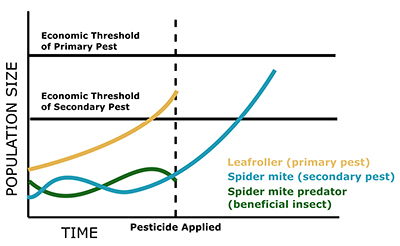
A secondary pest explosion or outbreak somewhat resembles a pest resurgence. It occurs when a gardener applies a broad-spectrum insecticide to a primary pest before its numbers threaten the crop (below the economic threshold). While the product may be effective on the target pest, it can also be quite effective in killing any beneficial predator insects that might be keeping other unnoticed pest species in check as well. This can allow another (a secondary) pest to prosper because the beneficial insect that had been keeping it under control has been removed. Figure 7 illustrates an example of this. The graph documents a leafroller (primary pest) population and a separate, unrelated predator population and what happened as a result of poorly chosen or timed insecticide application. The insecticide killed the predator as well as the target pest. Then, without the predator present, the spider mites (a previously undetected secondary pest) increased beyond tolerable numbers (“Economic threshold of secondary pest” in Figure 7), and additional pesticide applications had to be made to control it. If a selective material had been used just to control the leafrollers, the spider mite predator would have been spared and would have continued managing the spider mite population.
Pest Resistance
Since the inception of synthetic pesticides, improper use has led to hundreds of resistant pests, including weeds, insects, mites, and diseases. When the same pesticides or the same class of pesticides are used repeatedly, pests that are tolerant to them survive and reproduce. We are now aware that resistance management must be practiced to prevent further development of resistant strains. Gardeners can practice resistance management by following a few simple rules:
- Be tolerant of a pest’s presence when possible. Remember, it takes a certain number of pests to do damage that exceeds the determined threshold.
- Use all of the available, effective IPM options when you need to manage a pest problem.
- Choose to apply pesticides only when necessary.
- Do not rely on the same class of pesticide year after year.
If you choose to make pesticide applications, choose your products carefully and find one that will have the least impact on the environment and nontarget organisms. Only buy ready-to-use premixed products, so that mixing of any solution and calibration of a sprayer are not necessary. Read all product label directions and follow them carefully. Spot spray only the impacted plant instead of treating all similar plants or the whole property. You may have only one rhododendron with the pest problem. Why spray the surrounding vegetation if it is not threatened by the target pest?
Summary
The PHC approach must include garden and landscape planning and consideration of plants’ needs. A proactive approach will go a long way in avoiding pest problems. If a pest problem arises, the gardener must get an accurate diagnosis of the problem and determine which IPM options are effective.
The IPM decision-making process is not always the same. Whatever strategies are used, it is important for the gardener to evaluate the strategies after using them and determine how well they worked. Keeping good records is essential for useful evaluation of results. Gardeners must also take advantage of educational opportunities to further their knowledge of new IPM developments.
And remember, the outcome of a successful IPM approach is to suppress pest populations, not necessarily to eradicate them. It is usually not practical to eradicate a pest. Eradication is usually only attempted when a new invasive species arrives. Once pests are established, our management goals are to successfully suppress the pests below damaging levels while minimizing impacts on the environment.
Further Reading
WSU Extension publications (opens in new window).
Driestadt, S.K. 2016. Pests of Landscape Trees and Shrubs: An Integrated Pest Management Guide, 3rd edition. University of California Agriculture and Natural Resources Publication 3359.
Funk, R. 1988. Davey’s Plant Health Care. Journal of Arboriculture 14:285–287.
Guilland, B. n.d. Approved References for Pest Management Recommendations (links to PDF document). Washington State University Extension.
Holmes, J.J., and J.A Davidson. 1984. Integrated Pest Management for Arborists: Implementation of a Pilot Program. Journal of Arboriculture 10:65–70.
Olkowski, W., S. Daar, H. Olkowski, and S. Ash. 2014. The Gardener’s Guide to Common-Sense Pest Control: Completely Revised and Updated. The Taunton Press.
Smith, M.S.L., and J.E. Lloyd. 2002. A Guide to the Plant Health Care Management System. International Society of Arboriculture Books.