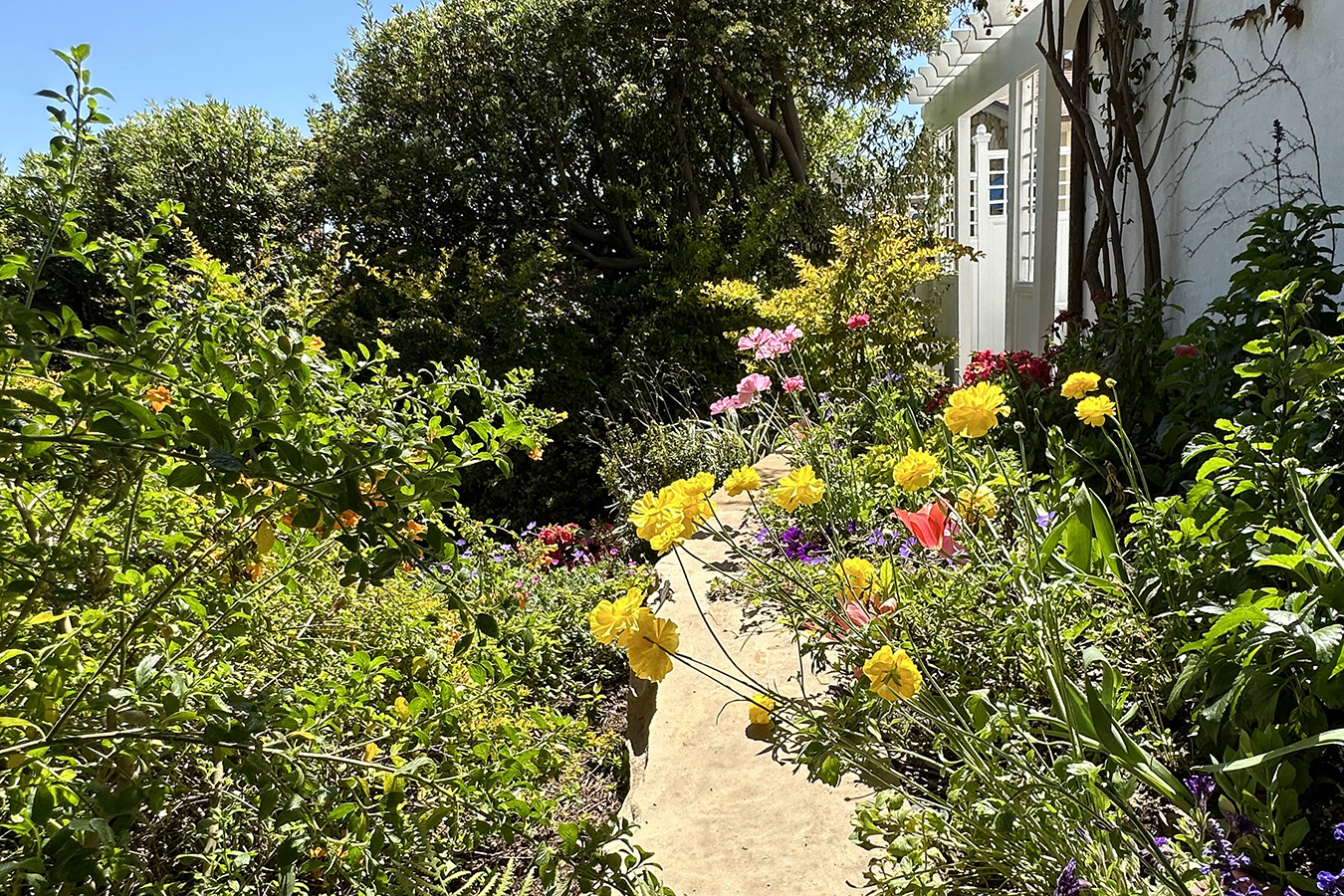
Creating a Sustainable Home Landscape
Adapted from “Natural Yard Care—Five Steps to Make Your Piece of the Planet a Healthier Place to Live” by King County Department of Natural Resources and Parks, Solid Waste Division; City of Seattle, Seattle Public Utilities; and Saving Water Partnership.
Casey Leigh, Master Gardener, WSU Chelan/Douglas Master Gardener Program
Introduction
Sustainable gardening and sustainable landscaping require knowledge of all the subjects in this handbook. The two main focuses in sustainable landscaping are water conservation and protecting water quality. It is important to understand that while a single garden’s contribution to water contamination may seem negligible, the sheer number of gardens requires that we all take responsibility for conserving and protecting our precious water supply by practicing, and encouraging others to practice, sustainable gardening techniques.
A sustainable landscape could be defined as one that requires minimal inputs of labor, water, fertilizer, and pesticides to thrive. Such a landscape is in balance with the local climate and should be aesthetically pleasing. We can modify or replace gardens that (1) are designed without attention to environmental conditions, (2) contain many plants that cannot exist naturally in the local climate, (3) demand scheduled pesticide applications without regard to need or allowance for beneficial insects, (4) do not provide wildlife habitat, and (5) whose purpose is to be faultlessly green, weed-free, and without a single insect or disease.
You have been introduced to research-based horticultural theories and practices that are aimed at protecting the environment while improving community health and wellness. This chapter, which will teach you to design and maintain gardens and landscapes that are functional, cost-efficient, visually pleasing, and environmentally friendly, summarizes and reinforces everything you have learned so far.
Putting Nature to Work: Creating a Sustainable Landscape
Nature wastes nothing. In natural landscapes, soil life recycles dead plants into food for new plant growth. Plants are adapted to the water, sun, and soil available in their site. And the wide variety of plants, soil organisms, insects, and animals keep most pests and diseases in check. A sustainable landscape that emulates nature saves money and time, is a healthy outdoor space for family and friends, and protects the environment by conserving water and reducing the need to use harmful chemicals.
How do we create a sustainable home landscape? By integrating five steps into our gardening practices: (1) build healthy soil, (2) plant right for the site, (3) practice smart watering, (4) think twice before using pesticides, and (5) practice natural lawn care.
Step #1: Building Healthy Soil
First, get to know your soil. Healthy soil has a high organic content, full of decomposing plant material and beneficial organisms that together provide nutrients to plants and enhance the soil’s ability to absorb and retain water. If you haven’t already, check what type of soil you have. Dig up a small sample of soil from various places in your garden and roll it between your palms. If the soil forms a ribbon up to two inches long, you have clay soil. If it falls apart easily and does not make a ribbon, your soil is sandy. If the soil forms a ribbon about one inch long, smile, as you have loamy soil, which is considered the ideal soil.
Another method for checking soil type is to lift a shovel’s width of soil and check for the following. Light-colored soil that is sandy or gravelly will have poor nutrition and will not retain water. Gray, sticky soil indicates a high clay content that does not absorb water well. Yellow, gray, blue, or black heavy soil means your soil has poor drainage. Heavy, compacted soil has insufficient organic matter.
Happily, all is not lost if your soil has problems. The answer is to add organic content in the form of compost. Work in one to three inches of compost (up to 20–25% compost in your soil mix) when making new beds or planting lawns. Compost benefits all soils. It helps sandy soils hold nutrients and water, and it loosens clay soils.
Lack of nutrients can be caused by factors other than soil type. Have your soil tested for nutrient levels so that you can more accurately decide whether to fertilize, how much to apply, and what types of fertilizer need to be applied. If you need to fertilize, consider using an organic fertilizer. Most trees and shrubs can get all the nutrients they need from the soil and by mulching once a year. But annual plants, vegetable gardens, and lawns sometimes need extra nutrients. When shopping for fertilizers, look for the words “natural organic” or “slow release” on the bag. Unlike “quick release” fertilizers, natural organic fertilizers will not wash off into streams so easily, and they will feed your plants slowly to keep them looking good longer.
Finally, don’t forget to mulch by spreading a layer of organic material like leaves, wood chips, compost, or grass clippings around your plants in spring or fall. Mulching conserves water, prevents weeds, and feeds the soil, creating healthier plants. For flower beds and vegetable gardens, use 1–3 inches of leaves, compost, or grass clippings. Trees, shrubs, and woody perennials benefit from 2–4 inches of woody mulches, like wood chips or fall leaves.
Now, what to plant in all that beautiful, healthy soil? The next step helps you analyze your site so that you choose the right plants for your landscape.
Step #2: Plant Right for Your Site
A common refrain you will hear from knowledgeable home gardeners is “Right Plant, Right Place.” That short phrase sums up so much! All gardeners want their plants to thrive. A key to accomplishing that goal is knowing the characteristics of your garden site, for example, amount of sunlight and shade, soil type and health, climate and microclimates, topography, size, water availability, and view planes. Also, what physical obstructions or limiting factors are present, such as telephone poles, driveways, sidewalks, and fences? Another consideration is the types of uses your family will make of your site. Do you have young children who need room to play? Or pets who need some outdoor space? Do you want to attract or deter wildlife? Do you want to grow some or all of your food? Finally, although not the least important, how much time and effort are you willing to put into maintaining your landscape?
Once you have answers to those questions, you can plan or modify your landscape. Consider the amount of sun, the type of soil, and the availability of water in different locations around your yard, then select plants that will thrive under those specific conditions. Think about how big a tree or shrub will be when mature (especially next to a house or under power lines). Observe your neighbors’ yards, visit local demonstration gardens, make note of plants that do well in sites similar to yours, and research what plants do well in your area. Visit local nurseries to see what pest-resistant and water-conserving plants are available. Many pest- and disease-resistant varieties are available now. Choosing plants that are labeled “low water use” or “drought tolerant” will help conserve water resources and, with less money spent on your water bill, leave you with more to spend on plants!! Remove or replace any plants that haven’t been thriving in their current location.
Grouping plants by their needs saves resources and time. Put plants that require similar sunlight, soil, and water in the same area. If a plant you want for a specific spot can’t thrive there, consider planting a similar looking one instead. Lawns have their own special needs. Avoid putting trees or shrubs within a lawn area.
Planting properly is as important as planting in the right spot. Plants need a good start in order to thrive. Be sure your soil is healthy. When planting trees and shrubs, mix compost into the whole planting bed if the native soil needs nutrients. Adding compost only to the planting holes can limit root growth. Often, plants that come in pots have encircling roots. It is important to spread out the roots in the hole before adding water and tamping down the soil. As the final step, apply mulch. New plantings, even drought-tolerant ones, need regular watering to help their roots develop properly.
Finally, regardless of your site, choose plants that will invite pollinators such as birds, butterflies, bees, and other beneficial insects. Providing a birdbath will give birds a water source. Add native plants that grow well in your area. Some beautiful plants are actually noxious weeds. To ensure you are not propagating a noxious weed, check your plant list against the ones on the Washington Noxious Weed List (opens in new window). Use principles of integrated pest management (IPM) to reduce your use of pesticides.
Once you have chosen plants that will do well in your garden or landscape, they will need your help to thrive. The art and science of proper watering is the next step.
Step #3: Practice Smart Watering
Smart watering is a critical component of sustainable gardening. Under- or overwatering is the cause of many plant problems. “Just right” is the amount of water you need to ensure a healthy landscape. The trick is figuring out what “just right” is. Researching the water needs of your plants will give you a good start in planning your smart watering regime. In addition, there are some general principles to help. Deep and infrequent watering rather than shallow, frequent watering develops strong root systems. Most plants do best if the soil is allowed to partially dry out between waterings. Vegetables and annual flowers should be watered at the first sign of wilting. Perennials, however, may look wilted during the day but bounce back after it cools off in the evening, indicating they still have enough moisture. If your footprints show when you walk across your lawn, it is time to water.
Tools are available to confirm that your watering practices are working. One option to check whether the root zone is sufficiently moist is to dig into the soil with a trowel an hour after watering to check moisture depth. Soil probes, which cause less soil disturbance than digging, can also be used to check moisture levels. Probes range from simple tile and hollow tubes to those with a built-in moisture indicator. Probes can be used an hour or two after watering or in between waterings.
Adopt practices that conserve water. To reduce the loss of water due to evaporation, avoid watering during the heat of the day. Using soaker hoses or drip irrigation on your beds is more efficient than sprinklers, as little water is lost to evaporation. Water trees and lawns separately from other plantings using a sprinkler system. Position the sprinkler heads so that you are watering the trees and grass only, not your driveway or sidewalk! Sprinkler coverage should overlap slightly to ensure your watering is uniform. Using a timer system not only saves you time and effort but also ensures consistency in watering. However, it is important to monitor it regularly for leaks or malfunction. Adjust your watering schedule according to the season—plants need more water in the heat of summer than in spring or fall. Finally, avoid watering on days that Mother Nature is doing your job for you!
Even when you have chosen the right plants, planted them in an appropriate place, and given just the right amount of water, weeds and insects are likely to make an appearance. Step four gives you ways to deal with these unwanted pests while using little or no chemical pesticides.
Step #4: Think Twice Before Using Pesticides
Many people react to bugs or weeds in their gardens by spraying them with pesticides without first stopping to think about whether there is a better way to control them. However, the vast majority of the time, a better, safer, and more effective solution is available. And sometimes, what seems to be a problem, isn’t!
To reduce the need for pesticides, first follow the three steps above. Healthy soil protects plants from many diseases and insect pest problems. Selecting the right plant for the right place and watering correctly ensures plants have the resources they need to thrive and fend off threats. You can also take other preventive steps. Clean up and dispose of diseased plants, pull weeds as soon as they emerge, and compost your spent plants in the fall to reduce hiding places for insect pests.
An important but often overlooked task is regular monitoring for problems. Monitoring helps you identify the nature of the problem from its beginning. Early detection can lead to needing less drastic solutions. Rather than spraying at the first sign of leaf damage, figure out what causes that type of damage. Perhaps it was an earwig, or a caterpillar, or damage from a particularly windy day. Develop your solution around the most likely cause. Sometimes the best solution is to be patient. Natural predators often bring pests under control, but it can take time. Be prepared to accept a little damage. Although not aesthetically pleasing, the damage may be inconsequential to the overall health of the plant. Check with friends and neighbors to see whether they are having similar problems.
Finally, if you observe insects or other intruders in your garden, do not act until you know whether they are pests that need to be controlled. If after careful monitoring and research you conclude that you have a problem that needs to be dealt with, use the least toxic solution. Explore whether mechanical, cultural, or biological controls will be effective. Include in your garden plants that attract beneficial insects that predate on the destructive ones. Physical controls like traps, barriers, and fabric row covers work for some pests. Long-handled weed pullers pop weeds like dandelions out easily and are less stressful on your back than weeding on your hands and knees. Often, less toxic products, like soaps, horticultural oils, and plant-based insecticides, will suffice.
If after doing all of the above you determine that you have a problem that jeopardizes one or more plants in your garden, you may choose to use chemical control in the form of a pesticide. Once again, doing your homework is important. Select the pesticide with the fewest unwanted side effects. Given a choice of chemical control options, use the least toxic product. Check to see if it is safe for bees. Spot apply the pesticide only where it is needed and at a time that it will work most effectively. Carefully read the label on the pesticide and follow the instructions. This is one case when more is not better!
The fifth and final step applies all of the above concepts to the place in your landscape that often gets the most use—your outdoor play and socializing area, otherwise known as your lawn.
Step #5: Practice Natural Yard Care
Have you ever experienced lawn envy when driving by someone’s perfectly green, perfectly manicured yard? Did you wonder how they managed to create such perfection? Hopefully not with unnecessary use of chemical pesticides and fertilizer but by following the four steps above. Lawns need healthy soil in which to grow. “Right Plant, Right Place” is applicable to lawns as well as garden areas. Smart watering principles are important whether your lawn is newly planted or well established. A well-cared-for lawn requires little, if any, chemical treatment.
Lawns have their own special maintenance requirements. Turfgrasses grow best in moderately textured soil with good drainage. Water deeply and infrequently to ensure deep root growth. Let the lawn almost completely dry between waterings to prevent lawn disease and save water. Knowing what type of grass your lawn consists of is important, as some turfgrasses tolerate shade while others need full sun.
Keep your mowing blades sharp, and mow regularly and consistently at the height recommended for the type of grass you have. Although leaving grass clippings on a lawn can be unsightly, grass clippings provide free fertilizer. When to fertilize and how much to apply depend on your soil’s nutrient levels and the type of turf you have. Once you know the turf type and nutrient levels, research which fertilizing schedule will work best and whether quick-release fertilizer, slow-release fertilizer, or a combination will work best. Yes, once again, time to dig into some research!
Add dethatching and aerating to your lawn maintenance schedule. Aerating benefits your lawn by increasing the oxygen level in your soil. Although some thatch is a normal part of the underground portion of your turfgrass, it can become a problem when the thatch layer gets too thick. By checking your thatch layer each year, you will know when it is time to dethatch.
A well-maintained lawn will reduce or eliminate the need for using chemicals to control weeds and insects. Weeds in a yard can be controlled much the same way as in your garden area. Accept a few weeds and keep them under control with hand pulling. Weeding is easiest when the soil is moist. If you have weeds that you cannot control by natural means, spot spray the problem areas.
Finally, ask yourself, Do I really want that perfectly manicured lawn? If your lawn is a place for outdoor fun and entertainment and your time for tending it is limited, aesthetics may have to give way to practicality.
Conclusion
First-time gardeners are often heard exclaiming, “Wow, I didn’t know that gardening was so complicated and takes so much time!” Like most activities that are done well, gardening sustainably requires planning and a great deal of sweat equity. But as seasoned gardeners know, the benefits are more than worth it! Integrating the five steps of natural yard care—building healthy soil, planting right for your site, practicing smart watering, thinking twice before using pesticides, and practicing natural lawn care—will help ensure that the time you spend tending to your garden landscape will reap the most rewards.