
Club Members
and Families
The Clallam County 4-H program teaches life skills through Positive Youth Development. 4-H record books, public presentations, meeting participation, and project work are a few of the ways 4-Hers develop those skills throughout the year.
The resources below are designed to help our members and families navigate the educational components of our 4-H program.
Read our current county policies in our 4-H Member and Family Handbook.



Why Informational Posters and Educational Displays?
Youth involved in 4-H programs have great experiences, knowledge, and insights to share! Whether it’s at county fair, a public meeting, or a 4-H Club, Informational Posters and Educational Displays are just one tool for sharing your knowledge with others in our community.
Which One: Informational Poster or Educational Display?
Depending on how much information you have to share, you can choose which display tool is best for you. Here are some things to consider when deciding between doing an Informational Poster or Educational Display:
| Posters | Displays | |
| Purpose: | To grab viewers’ attention and teach them something in less than one minute | To grab viewers’ attention, teach them something, and hold their attention for a longer period of time |
| Size: | regular 22”x”28 works best | Multiple posters, a tri-fold display, mobile, charts, or 3D display |
| Viewing Distance: | 10 feet, Minimum letter size 1/2 inch and Minimum line thickness 3/32 inch 32 feet Minimum letter size 1 inch 64 feet, Minimum letter size 2 inches | 3 feet or less |
| Copyrited Material: | Not Allowed | Allowed with appropriate acknowledments |
| Content: | ONE clear thought | Multiple thoughts on one subject |
| Content accuracy: | Content MUST be accurate | Content accuracy Not checked |
| Data Source: | Must be listed on the back of the poster | Data source not required |
Choosing Colors
Color combinations affect how easily the message is read as well as the overall appearance of the poster.
- Consider the Contrast: This means you use dark letters on a light background, and light letters on a dark background.
- Let the most important items be the most important color.
- Colors that are close to the background shade will not show up well and cannot be read at a distance.
- Avoid using too many different colors. Two or three should be sufficient. This is for the purpose of letters and backgrounds, color photos or clipart may be added to enhance your poster, just be sure they do not overwhelm your main point!
- Avoid putting red and green next to each other- this is hard to focus on if a person is colorblind.
- Avoid bright neon colors- they may catch the eye, but they are hard to focus on.
Lettering
- Lower case letters are easier to read than all capitals. Use capitals only for emphasizing an important phrase or word to give variety.
- Save fancy or script lettering for catching the attention of the viewer.
- When hand lettering, always use guidelines. Using a ruler, lightly pencil in straight lines that can be erased when your poster is complete.
- Letters may be cutout and glued on, or precut letters may be purchased.
- Keep written material to a minimum. Use only headings, captions and signs necessary to tell the story. Use different size lettering for items of varying importance.
- Allow margins to keep things from running together and looking too cluttered.
Dos and Don’ts
- Do Not use the phrase “Did you know?”
- Do Not use copy write or registered materials. No use of commercial cartoon characters, company logos or trademarks.
- Do check your spelling and grammar. Miss spelled words or incorrect punctuation will drop ribbon placement.
- Do plan the poster layout prior to starting work. Difficult to adjust layout once you’ve started
- Do ensure that all items attached to the poster are securely attached. For glued items, all edges must be securely glued.
- Do include the requested information on the back of the poster. Could help your placement if there are content questions.
- Do ensure when using a second language that all words have been translated accurately.
- Do ensure content of poster is age appropriate for age group being entered.
- Do ensure the content is applicable to the department being entered.
- Do keep it simple
Informational Poster Examples:
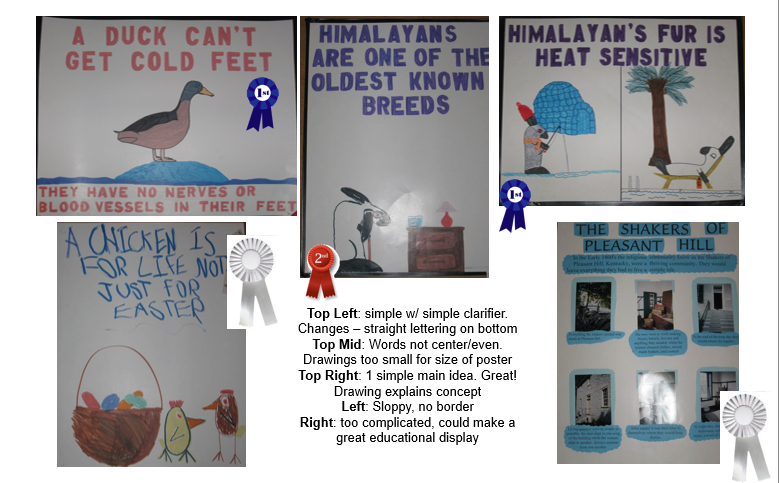
Educational Display Examples:
Printable Resources
General Guidelines & Tips
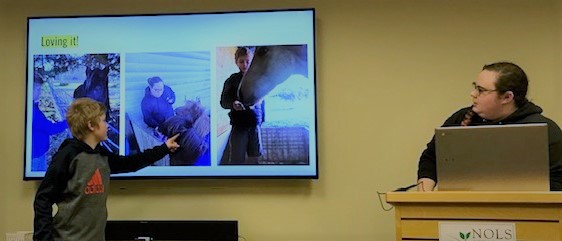
Why Do 4-Hers Make Public Presentations?
The logo above is a good reminder of the “4 Essential Elements” for youth development: a sense of belonging, mastery, independence, and generosity. In combination, these essential elements help youth to grow into competent, caring, and contributing adults. When it comes to the element of “mastery” in particular, all youth want to be good at something (adults do too!). Mastery is building knowledge, skills, and attitudes and then demonstrating the competent use of the knowledge and skills. Youth need to feel and believe that they are capable, and experience success at solving problems and meeting challenges to develop their self-confidence.
Practicing and offering 4-H public presentations give youth an ideal opportunity to stretch and grow in the “mastery” of the activities. Settings that promote mastery – like 4-H Club meetings, County Fair, State Fair – encourage youth to take risks, seek out challenges, and focus on self-improvement rather than comparing themselves to their peers.
Types of 4-H Presentations
- A DEMONSTRATION puts words into action. An effective demonstration teaches others how to do something by showing while telling. At the end of a demonstration, you should have a finished product to show your audience.
Sample titles include: how to cook an egg, how to groom a dog, how to needle-felt - An ILLUSTRATED TALK makes us of posters, pictures, PowerPoint (for Junior, Intermediate, and Senior 4-Hers), or other visuals to show how to do something or illustrate a process. No finished product is required.
Sample titles include: how to plan a garden, how to distinguish horse markings, how to lead a fun and effective carwash - PUBLIC SPEAKING is a prepared speech on a specific subject for an audience. Usually, no props or visual aids are used. 4-Hers use this type of presentation to teach, entertain, and/or inform their audiences.
Sample titles include: why I like the 4-H cat project, 4-H around the world, what compassion looks like in my community
Individual and Team Presentations
Presentations can be given by individuals or by teams. When trying to decide between the two, ask yourself, “Can I do this best by myself or with someone else?” While individual presentations tend to take less time in planning and presenting, team presentations are a great way to learn team planning and cooperation. And, they offer the viewing audience a change of voices and personalities and, perhaps, understand a subject from different perspectives. Teamwork is encouraged throughout the planning and presentation itself. Shifting the presentation from one team member to another should occur at natural, and relatively equal intervals.
Here are a few things to keep in mind with team presentations:
- If you plan to compete at State Fair, only members of the same age division should compete as a team.
- Be sure that all members of the team share in the preparation, doing, and telling.
- Team presentations take more practice in order to flow as if only one person is giving the demonstration. So, allow for plenty of practice time.
Recommended Time Limits for 4-H Presentations
For demonstrations and illustrated talks the minimum time is 3 minutes and the maximum is 20 minutes, depending on 4-H “age” (your age on Oct. 1 of the current 4-H year). For public speeches the minimum time is 5 minutes and a maximum time is 10 minutes (at State Fair, a penalty of 5 points per minute under or over is deducted).
| 4-H Age Division | Age | Time limits |
| Cloverbuds | 5-7 years old | Less than 5 minutes |
| Juniors | 8-10 years old | 3-8 minutes |
| Intermediates | 11-13 years old | 5-15 minutes |
| Seniors | 14-<19 years old | 10-20 minutes |
Getting Ready to Present
Shaping the Presentation
- Choose a topic that is of great interest to you! If you need ideas, talk with your 4-H friends and Leader; look at the 4-H catalog: talk with other adults and youth in your life; or look in the library, magazines, newspaper, and other media.
- Choose a title that gives an interesting hint at what your topic is about. For example, if you are going to do an illustrated talk about rabbits’ eyelids, you might want to call it “The Eyes Have It” instead of “Rabbit Eyelids.”
- Prepare a written outline of the 3 main parts of your presentation. You are welcome (and encouraged) to use your outline and brief notes as you present (no need to memorize!). You might want to use the template on the next page help you with your outline:
Anatomy of a 4-H Presentation
Introduction
- Start with an attention-grabbing line (e.g., “I didn’t know that the boat was going to sink… really I didn’t!”), a quotation, or an appropriate trick.
- Introduce yourself: “Hello, my name is [insert name here]. I am a member of the [Insert name of club] 4-H Club/Project. This is my [Insert number of year(s)] year in 4-H, and my [Insert number of year(s)] year in the [Insert name of project] project. This is my presentation on [Insert name of presentation] (e.g., “How To Keep Your Boat Afloat”).”
- Share why
Body
This is the part of the presentation in which you show and/or tell how you will address the heart of your topic – your main idea. What do you need to Do, Show, and/or Say to express your main idea? Pay close attention to the order in which you put your ideas – your audience should be able to follow your ideas in a logical, natural order.
What will you…
Do or Show?
Say?
Need (supplies, equipment, visuals)?
Summary Statement and Q&A
- This is your last chance to express your main idea to your audience. What do you really want your audience to remember? What was accomplished? What does this really mean to you? (Never introduce new material in the summary.)
- Then ask your audience “Do you have any questions?” The audience will have 3-5 minutes to ask questions. Before responding, always Repeat the question being asked. If you do not know an answer, you might say something like, “I don’t know, but I suspect that you can find your answer
- [on website, in the library, etc.]
- “Tell your audience where you found your information (e.g., website name, library name).
- Thank your audience for listening to your presentation on [restate the title of your presentation].
General Preparation Tips
- Choose a different topic each year.
- Decide whether you’d like to present as an individual or as a team.
- Use the template on the previous page to help you structure your presentation.
- Use illustrations, posters, and visuals (including models, tools, etc.) to help your audience understand your presentation – avoid any visuals that DISTRACT attention from your main idea. Make sure lettering and images on graphics can be viewed from the back of the room and at every angle (easels are available). Live animals are not permitted in 4-H public demonstrations.
- Have your material well organized in a logical order. Perhaps trays, boxes, bowls etc. will help your to manage your materials. If you use these, look for transparent containers so that your audience can see the contents. Also consider labeling containers so that your audience sees the materials and the process.
- Plan what you’ll wear. Your clothes should be simple, neat, and clean. Those doing food presentations should wear short sleeves. Hair should be under control. Don’t wear DISTRACTING clothes, jewelry, or makeup. Choose clothing appropriate for your presentation: e.g., clown gear for a clowning presentation, period clothing for a presentation on John Muir.
- Prepare to bring any reference materials to your presentation and be prepared to share your references with your audience at the end of your presentation.
- PRACTICE often, out loud, and pull in lots of different people to serve as your audience. Be sure to ask your practice audience questions like: “What was not clear in my presentation?” “What really struck you?” “How can I make my presentation even better?”
Presentation Day!
Gearing Up Tips
- Attend to your basic needs. Get a good night sleep and healthy meal before your presentation. If you think you’ll need a glass of water, have one ready. (No gum chewing please. And clean hands and nails are a plus!)
- Get to know your equipment well – especially if you’re planning to use computer and/or projection equipment.
- Arrange equipment and supplies neatly and so that the audience can see clearly. Place any extra equipment on a second table away from the main demonstration table. Keep a hand towel, paper towels, garbage can, etc. handy if needed.
- If using posters, be prepared to remove or turn posters as soon as you have made your point.
Presentation Tips
You’ll find lots of tips in the “38 Tips for Persuasive Presentations” handout; here are a few more:
- Show enthusiasm for your topic. Look like you enjoy what you’re presenting (others will too). Weave personal experience into your presentation where appropriate.
- Have good, gentle eye contact with your audience. Stand tall.
- Again, bring notes, but do not read directly from them (this cuts down on eye contact.)
- Make your voice gentle, appropriately loud, and clear. (You’ll have a microphone at Fair.)
- Name any supplies and hold them up so that your audience can see.
- Keep your work/demonstration area organized – move materials from right to left if you are right-handed, or left to right if you are left-handed.
- Label the backs of posters, books, etc. that you’ll want to reference during your presentation (but you don’t want your audience to necessarily see).
- Goof-ups happen to everyone! Go right ahead with your presentation; explain what happened.
- Thank your audience for their attention.
Presentation Score Card
Public Presentation Scoresheet (PDF) (WSU) is the “score card” that Judges use to evaluate 4-H Demonstrations, Illustrated Talks, and Presentations.
This handout was produced by Jefferson County (WA) 4-H and is an adapted consolidation of three WSU resources: “How to Make a 4-H Public Presentation (PDF)” (WSU publication #EM4787), “4-H Public Presentations,” and “How to Give a Public Demonstration.”
4-H Presentation Resources
Watch this video on how to prepare a presentation.
Educational Requirements for Fair and Year End Completion (PDF) (Clallam County)
Demonstration Procedure (PDF) (Clallam County)
Public Speaking (PDF) (WSU)
Remember awards applications are due by Oct 1. Award applications can be emailed to Melanie or mailed to Clallam County 4-H at the extension office.
Awards
- 2025 Awards Handbook (PDF)
- 2023 Awards Cover Page (PDF)
- 2023 Awards Application Page (PDF)
- 2023 Awards Leader Nomination (PDF)
Scholarships
- 2026 Council Scholarship Application and Requirements (PDF)
- 2026 Council Lifetime Achievement Bonus Scholarship Application and Requirements (PDF)
- WSU Statewide 4-H scholarship Information
Junior Royalty Application
- Junior Royalty Application 2025 (DOC) Open to 4-H Members in grades 3-8.
The 4-H year begins October 1st and ends on September 30th of each year.
To complete the 4-H Year and be eligible for awards and a scholarship, a Clallam County 4-H member has to complete the following:
- Complete all of the fair requirements listed above.
- Turn in a completed Clallam County 4-H Record Book to club leader before October 1st.
- Members completing the 4-H year are eligible for County Awards and Scholarships. See Awards Handbook and 4-H Council Scholarship program.
4-H Leader Requirements
- Educational Requirements for Fair and Year End Completion (PDF) (Clallam County)
- Record Book Procedure for Club Leaders (PDF)
- Year End Completion List (PDF) – Due October 1.
Grievances
For concerns requiring the Council Grievance Committee use the Grievance/Appeal Form.
For written concerns for the extension office and not Council please use the Care to Share Form.

Program Contact
Melanie Greer, 4-H and Youth Empowerment CoordinatorPhone Number360-912-2062 Email Address • melanie.greer@wsu.edu