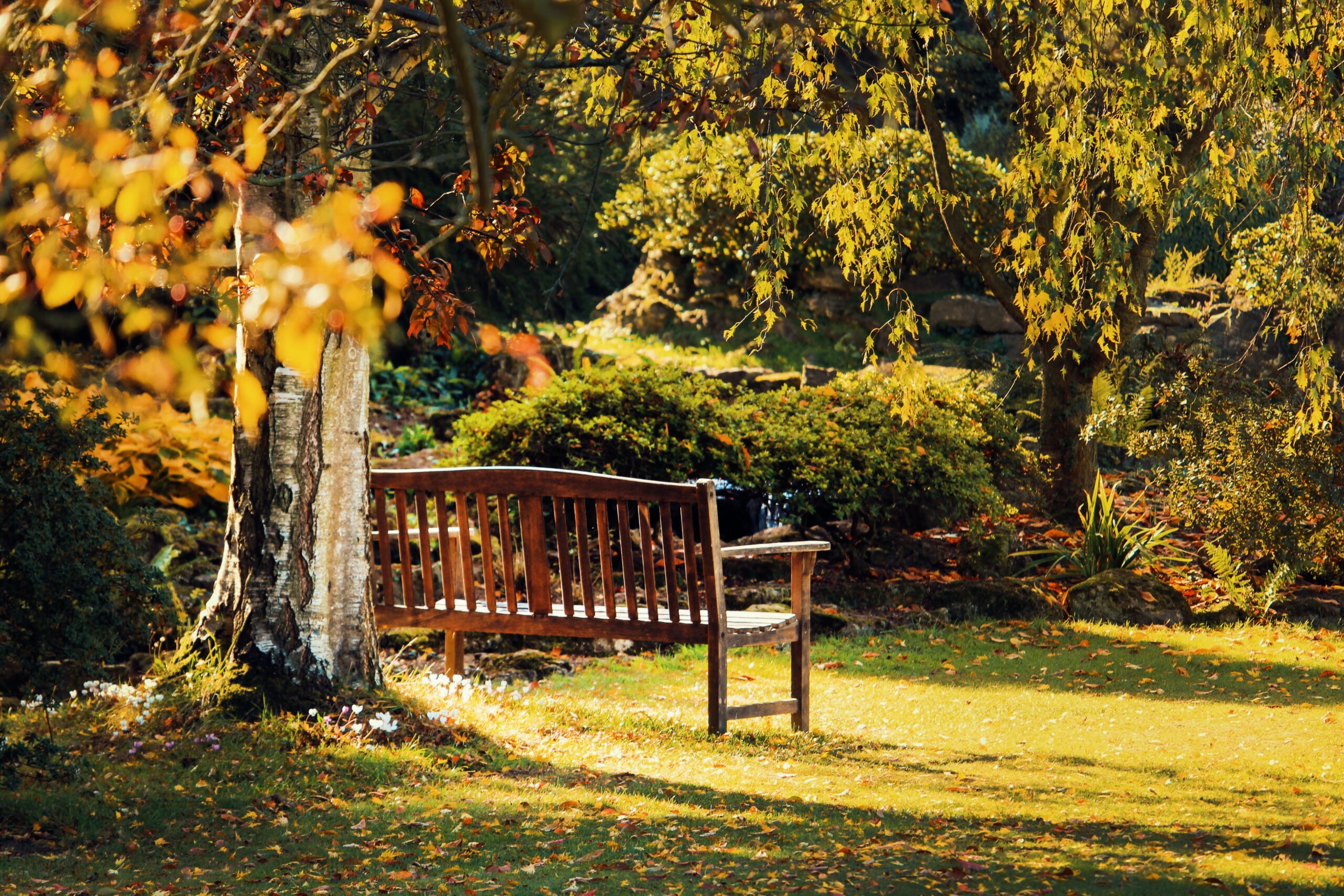
Sustainable Landscaping Provides Many Benefits
There are many ways to make your landscape more sustainable such choosing naturally drought tolerant and pest resistant plants, nourishing healthy soil, applying a coarse woody mulch, using better watering techniques and tools, and mulching the soil. Sustainable landscaping can be beautiful, lower maintenance, and keep our waters healthier for people, fish, and other critters.
Pollution from common yard care products such as fertilizers and pesticides makes its way to our lakes, streams and other water ways.
Sustainable landscaping practices reduce common sources of pollution and restore soil health. Healthier soils not only help your landscape plants thrive, but they also help to keep our waters clean by absorbing and filtering rainwater. To learn more about why this matters, check out either of these short videos:
Solving Stormwater by the Nature Conservancy and WSU https://www.washingtonnature.org/cities/solvingstormwater, and this short video
Eutrophication Explained, by FuseSchool https://youtu.be/6LAT1gLMPu4?si=gNvgVtq6KhG-792R
Sustainable Landscaping can Reduce your Maintenance Chores
Sustainable landscaping practices can help you work smarter, not harder. Many sustainable landscaping practices can actually reduce your garden chores.
For example, you can nourish healthy soils by:
- Leaving the leaves – decomposed leaf litter nourishes the soil.
- Applying mulch – a 4” deep layer of woody mulch not only enhances soil health, it also saves water and suppresses weeds.
- Grass-cycling – instead of bagging and disposing of grass clippings, you can leave clippings on the lawn where they will supply some of your lawn’s nitrogen needs for free!
Note that if you live in the Lake Whatcom watershed, you’ll want to be extra careful to avoid adding nutrient pollution to the lake. For guidance on sustainable landscaping in the Lake Whatcom watershed and a great list of low-phosphorus mulch, compost, and soil products for your yard, look here: https://www.lakewhatcom.whatcomcounty.org/get-involved/at-home/gardening
And, with a little research, you can choose:
- Plants that are naturally pest resistant.
- Plants that will thrive where you put them – in shade, or sun, or in lousy soils.
- Drought-tolerant plants that will look good with less watering.
- Plants that are the right size for your space and won’t need ongoing pruning work.
- You can avoid plants that might try to take over your garden such as noxious weeds and other invasives.
Learn How to Practice Sustainable Landscaping
You can grow healthy plants and have a satisfying landscape by learning some key sustainable landscaping practices including how to:
- Lighten your lawn load
- Know your site
- Understand your soil texture and drainage
- Nourish healthy soils
- Pick great plants
- Conserve water with better landscape design
- Conserve water with better watering techniques and tools
- Use mulch and apply it properly
All of these practices are explained here but if you’d like more guidance and hands-on exercises that will help you create a custom landscaping plan for your site, WSU Whatcom County Extension offers facilitated Gardening Green courses. You can learn more about Gardening Green courses here: https://extension.wsu.edu/whatcom/nr/gardening-green/
Lighten your Lawn Load
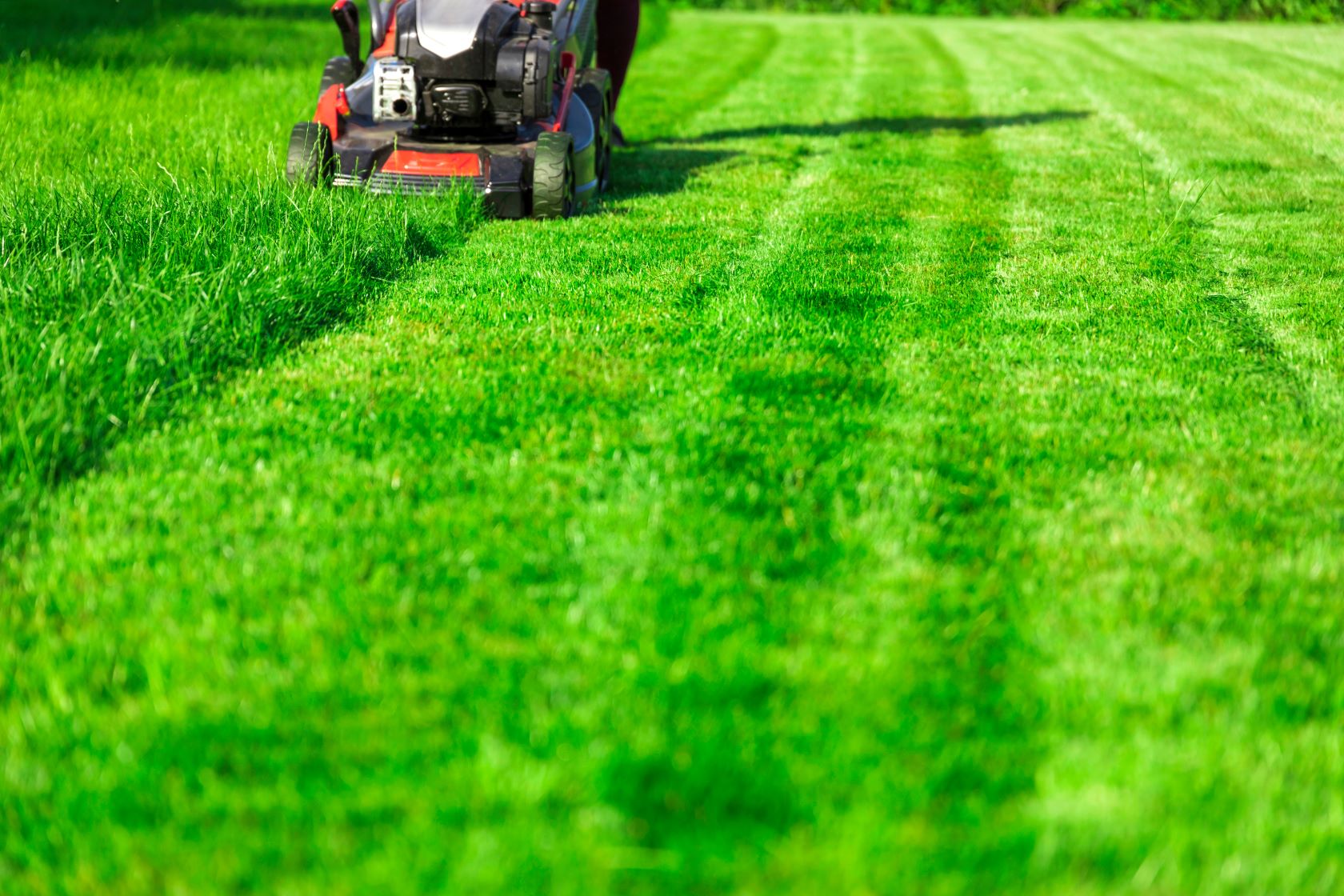
A healthy, attractive lawn is possible without pesticides, wasted water, or fertilizer run-off and there are many resources available to help guide you.
Check out these great lawn care videos created by the Saving Water Partnership: https://www.savingwater.org/lawn-garden/gardening-videos/ and
WSU King County Extension’s lawn care tip sheet: https://extension.wsu.edu/king/tip-sheet-11-lawns/
Know your Site
Picking landscape plants that will thrive in your existing site conditions and will grow to be the right size for your landscape is the cornerstone of a sustainable landscape.
Plants that are grown in their preferred environmental conditions will be healthier with little to no fertilizer or pesticides. You can also choose plants that will grow well and look great with less water. Choosing your plants carefully can save you time and money!
You already know that some plants thrive in a shady forest environment – think of our ferns and red huckleberries – while others prefer drier, sunnier sites. There are lots of great books and online resources to help you find the perfect plant, but the key to making the best use of these resources and choosing great plants for your yard is understanding your site conditions – the sun exposure, climate zone, microclimate, soil condition, and soil drainage where you want to plant.
Sun Exposure
A plant’s preferred sun exposure is usually described in terms such as full sun, part sun, part shade or full shade. Here’s what these terms mean:
Full Sun: 6-8 hours direct sun
Part Sun: 4-6 hours direct or filtered sun
Part Shade: 2-4 hours direct or filtered sun
Full Shade: Only reflected or indirect sun
Deep Shade: No sunlight
Know that different gardening authorities have slightly different definitions of full sun, part sun, shade, etc. Don’t sweat the small differences!
Assess the sun exposure in any given area of your yard during the growing season. After the trees leaf out in late spring is the prime growing season for most plants, but keep in mind that some plants have very early or very late growing seasons and go dormant over summer. A couple of examples are spring bulbs and cyclamen. When considering where to place these plants, sun exposure during their growing season will be more important than sun exposure in the middle of summer.
Climate Zones
Climate and microclimate are also very important factors to consider. The USDA Plant Hardiness Zones tell you the average coldest winter temperature for your area. You can easily find the hardiness zone for a particular plant on the nursery tag or in gardening guides and this will help you select plants that are likely to survive the winter where you live. But it’s important to note that hardiness zones tell you the coldest average winter temperature – not the coldest possible temperature. Plants that are hardy to one or two climate zones colder than yours are more likely to survive the winters especially if your property is subject to strong winter winds.
The maritime Pacific Northwest generally falls into USDA zones 7 and 8.
Microclimates
That shady spot under a tree, that low spot that stays moist most of the year, that west facing wall that gets warm early in the season and then bakes in high summer – these are all examples of microclimates and they matter a lot to plants. If you’d like to learn more about microclimates, check out WSU Extension’s publication, How to Determine your Garden Microclimate https://pubs.extension.wsu.edu/how-to-determine-your-garden-microclimate
Understand your Soil Texture and Drainage
“There can be no life without soil and no soil without life; they have evolved together.”
– Dr. Charles Kellogg, Soil Scientist & Chief of Bureau for Chemistry & Soils at USDA
Soil can seem technical and mysterious. There are many different soil types, soil horizons, and soil textures but the home gardener is best served by knowing a few key things about soil texture and drainage and how to improve soil over time. You can send a soil sample to a laboratory for a test and there are also some simple ways to learn about your soil if you are willing to get your hands dirty.
Soil Texture
You may have heard the terms “clay,” and “sandy loam” used to describe soil. But what do they mean? All soils are composed of different sized particles – clay, sand, and silt. The relative abundance of these particles is what gives soil its texture. Soil texture influences the nutrients available to plants as well as the soil’s ability to hold water which determines what will grow well there. Some plants require the sharp drainage provided by sandy soil, while others will thrive in very wet heavy clay soils, or even standing water! It’s very difficult to alter the texture of your soil. A far more fruitful approach is to work with your soil rather than against it. Learn about your soil and choose plants that will be happy in it.
You can get a professional soil test at a local laboratory for a modest fee. You’ll find instructions for collecting a soil sample and some local soil testing options on WSU Whatcom County Extension’s Soil Testing webpage https://extension.wsu.edu/whatcom/hg/soil-testing/. Trained WSU Extension Master Gardener volunteers would be happy to help you understand the results of your test. See the Diagnostic Plant Clinic webpage https://extension.wsu.edu/whatcom/hg/hg-plant-clinic/ for more information on how to get in touch with them.
A very simple technique for assessing your soil’s texture requires nothing more than a trowel and some water. You can follow along with retired WSU soil instructor Dr. Craig Cogger in this video Determining Soil Texture by Hand, Dr. Craig Cogger https://puyallup.wsu.edu/soils/video_soiltexture/
Soil Drainage
Soil texture will give you clues as to soil drainage but you can get an even better understanding by testing your soil drainage directly.
Follow the instructions below to conduct a simple soil drainage test. You’ll need a shovel, water, ruler, and a time-keeping device.
Directions:
- Dig a 1-foot-deep hole that is between 4 and 12 inches wide.
- Fill the hole with water and let it drain (the soil must be moist – this test will not work with dry or saturated soils).
- Fill the hole with water again.
- Measure and record the depth of the water.
- Measure the depth again in 1 hour to learn the drainage rate of your soil.
Drainage rates and what they mean for plant selection:
- Less than 1-inch per hour is inadequate drainage for most plants. Use plants adapted to wet soil.
- 1-3 inches per hour is considered good drainage for the healthy growth of most garden plants.
- Greater than 4-inches per hour is considered a very sandy soil that will not retain adequate moisture for most plants. Use plants that can tolerate dry conditions.
Soil conditions can vary from place to place in your yard. Repeat this test wherever you have questions about soil drainage.
The Magic of Healthy Soil
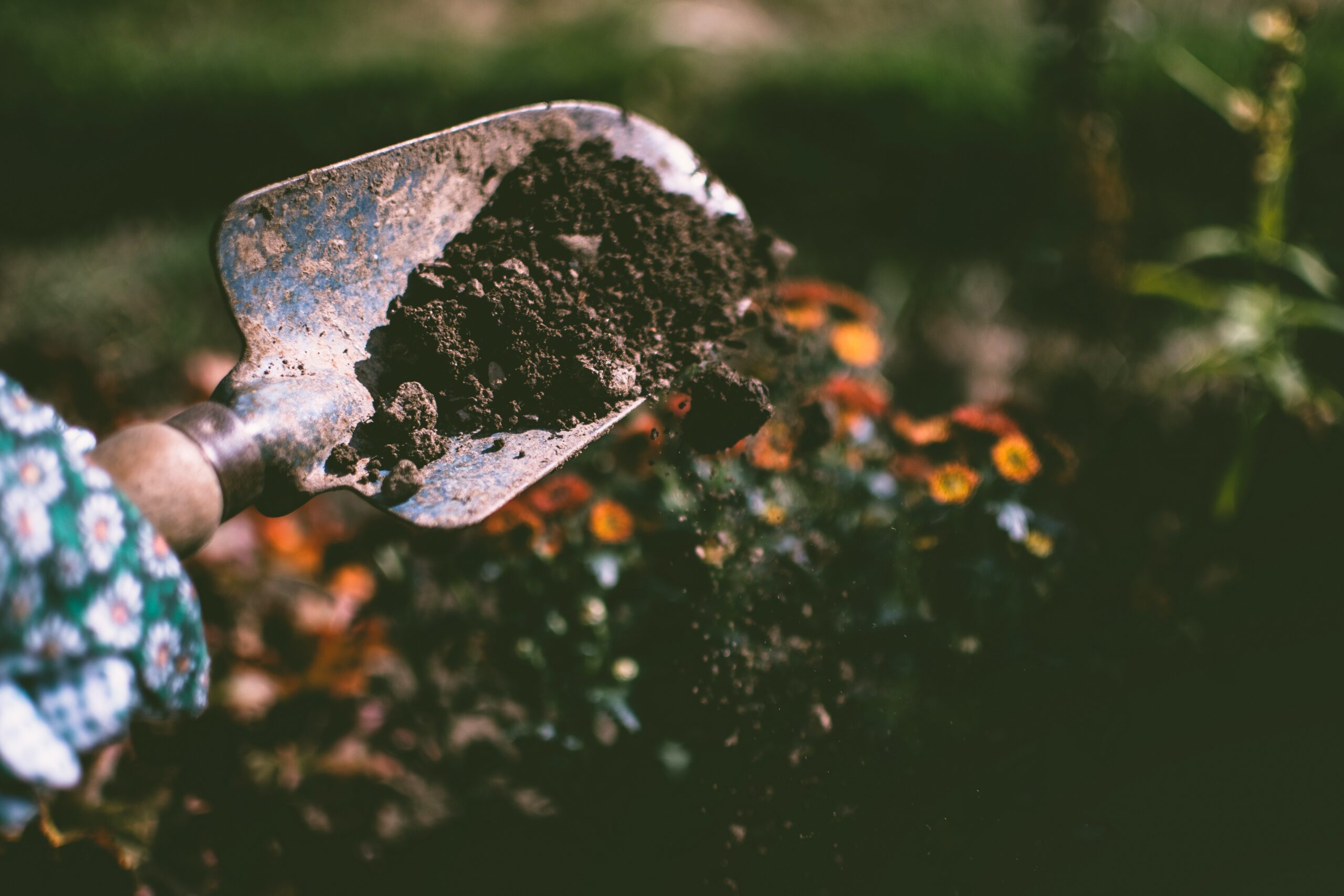
Healthy living soils protect water quality and support healthy plant establishment and growth. To learn more about the value of healthy soils check out:
Chapter 1 of WSU CAHNRS’, Landscape Maintenance: Healthy Plants while Minimizing Pesticides. Video. “Chapter 1 Sustainable Soil Care Practices” https://www.youtube.com/watch?v=f-jPeqLyS8E&feature=youtu.be
There are many things you can do to improve and protect the health and vitality of your soils.
Cover your Soil with Mulch
Maintain a cover of 3-4 inches of coarse woody mulch over most bare soil in landscaped areas. Woody mulch such as arborist chips, cedar chips, hardwood chips, and hog fuel (coarse chipped wood) provides a soil cover that protects the soil from erosion and reduces soil moisture evaporation. It improves soil condition, and it acts like a slooooow release fertilizer – slowly decomposing and adding nutrients to the soil. It also helps to retain soil moisture and reduces weed seed germination! While bark is very popular, it is waxy and can create an interface that sheds rainwater. If you strongly prefer bark mulch, coarse bark mulch will allow better water penetration than fine bark mulch.
Woody mulch does so many good things for your landscape that it’s covered in greater detail in the mulch section below.
To learn more about the value of woodchip mulch and how to apply it, look to chapter 4 of WSU CAHNRs Landscape Maintenance: Healthy Plants while Minimizing Pesticides video. “Chapter 4, The Power of Woodchip Mulch” https://youtu.be/f-jPeqLyS8E?si=4pqGqrdxF1m7GT5e&t=1418
Grow a Variety of Plants
Each plant species attracts and supports specific microbial allies in the soil. A more diverse plant palette helps to nourish a wider variety of life in your soil and healthy living soils support healthy plant growth.
Avoid Unnecessary Soil Disturbance
Excessive soil disturbance destroys the pores and channels that naturally form in healthy soil over time. In minimally disturbed soils, those pores and channels allow water to infiltrate and move through the soil, and they allow plant roots to access the air they need. Soil disturbance can also cause the organic matter in the soil to decompose quickly resulting in low carbon soils with low fertility.
Prevent Soil Compaction
Avoid driving on or moving heavy equipment on soil. Don’t walk on or work in wet soil. Establish walking paths that are separate from planting areas. Use some form of mulch on walking paths.
Repair Areas of Erosion
Erosion not only robs you of precious topsoil, but eroded soil can also bring excess nutrients to streams, lakes, and marine waters. This can feed algal blooms and cause other water quality problems. Look for signs of erosion and try to stop it. Sweep eroded soil off of sidewalks, driveways, or other hardened surfaces and put it back in your landscape.
Slopes are vulnerable to erosion. Keep them planted with layers of vegetation and/or keep them covered with mulch. Woody mulch will wash away on steeper slopes – a rocky mulch may be a better choice for these areas.
Avoid Synthetic Fertilizers and encourage Natural Nutrient Cycling Instead
In healthy living soils, plants provide carbon sugars to microbes and mycorrhizae who in turn provide nutrients and water to the plants. When plants are artificially fertilized, they don’t support these microbes and mycorrhizae and consequently can’t benefit from them.
Most landscape plants will thrive without additional fertilizers or organic amendments and excess levels of some nutrients can even be detrimental to plant health. For example, excess phosphorus in the soil can make it difficult for plants to access the other nutrients they need. A laboratory soil test will help you understand the nutrient levels in your soil, and Master Gardener volunteers are available to help you understand the results of your test. Learn more about soil testing on WSU Whatcom County Extension’s Soil Testing webpage https://extension.wsu.edu/whatcom/hg/soil-testing/, and how to get in touch with the Master Gardener volunteers on our Diagnostic Plant Clinic webpage https://extension.wsu.edu/whatcom/hg/hg-plant-clinic/
If your soil is very nutrient poor or has very low organic material, consider top-dressing with a layer of compost. Then cover the compost with a 4-inch layer of coarse woody mulch to help keep weeds from colonizing the compost. Mulch will also keep compost from washing away in the rain. Over time insects, worms, and fungi will help to move the nutrients from the compost deeper into the soil and will improve the soil’s structure in the process.
Note that if you live in the Lake Whatcom watershed, you’ll want to be extra careful to avoid adding nutrient pollution to the lake. For guidance on sustainable landscaping in the Lake Whatcom watershed and a great list of low-phosphorus mulch, compost, and soil products for your yard, look here: https://www.lakewhatcom.whatcomcounty.org/get-involved/at-home/gardening
Avoid using Pesticides and Herbicides
In addition to posing a health risk to people and pets, pesticides can kill beneficial soil organisms, and harm honeybees and native pollinators. Pesticides and herbicides also make their way into our streams, lakes, and marine waters, where they harm fish, aquatic plants, and aquatic insects. Many pest problems and weed problems can be managed without pesticides or herbicides. The WSU Hortsense webpages (https://hortsense.cahnrs.wsu.edu/) and the WSU Whatcom County Master Gardener volunteers are great resources to help you with your weed questions. To learn how to reach the Master Gardener volunteers check out our Diagnostic Plant Clinic webpage https://extension.wsu.edu/whatcom/hg/hg-plant-clinic/
Pick Great Plants
Understanding your site and your soils provides you with the knowledge you need to pick landscape plants that will naturally thrive there. This is the foundation of sustainable landscaping but it’s not the only factor to consider.
Plants can serve a wide variety of functions in your landscape such as:
- Attract wildlife
- Provide edible berries
- Provide beauty or interest throughout the year
- Offer shade in the summer
- Buffer winter winds
Native plants can also provide a sense of place. Drought tolerant plants can also help you to conserve water.
Consult the Great Plant Picks Website
The Great Plant Picks website is an excellent free online resource that can help you choose the perfect plant for your site and your landscaping goals. A program of the Elisabeth C. Miller Botanical Garden affiliated with the University of Washington, the website offers helpful lists and a searchable database of over 1,000 plants. All of the plants included on the website are reasonably disease and pest resistant, are vigorous and easy to grow for gardeners of average experience and aren’t invasive. You’ll find the Great Plant Picks website here: https://www.greatplantpicks.org/
The demonstration gardens managed by the WSU Master Gardeners at Hovander Park in Ferndale are another great resource. There you’ll find a pollinator garden, a native plant garden, a mixed border of “Great Plant Picks,” a cottage perennial garden, and a weed identification garden. To learn more, you can visit the Master Gardener Foundation of Whatcom County’s Hovander Gardens webpage https://whatcommgf.org/gardens/hovander-garden/
Vertical Layers
If one of your landscaping goals is to bring more birds to your yard, choose native or non-invasive plants that offer food, shelter or other habitat features and plant them in vertical layers. Vertical layers also help to create shade on the soil surface which inhibits weed seed germination.
The Great Plant Picks website’s Advanced Search feature https://www.greatplantpicks.org/search/advanced lets you search for plants that are attractive to birds in general and hummingbirds specifically.
You can learn more about making your yard bird-friendly from this article: National Audubon Society (2018, January 26). How to Make Your Yard Bird-Friendly. Retrieved November 17, 2020, from https://www.audubon.org/news/how-make-your-yard-bird-friendly-0
Avoid Growing Noxious Weeds
Noxious weeds are non-native plants that grow aggressively and don’t have natural enemies to keep them in check. They can destroy important habitats, clog waterways, and create fire hazards. Some are poisonous to people and livestock. Many noxious weeds such as common fennel, English ivy, butterfly bush, and myrtle spurge are escapees from home gardens. You can learn more about noxious weeds and how to control them on Whatcom County’s Noxious Weeds webpages: https://www.whatcomcounty.us/930/Noxious-Weed-Fact-Sheets. The site includes maps, how to identify those weeds in the field, photographs and more.
Conserve Water with Better Landscape Design
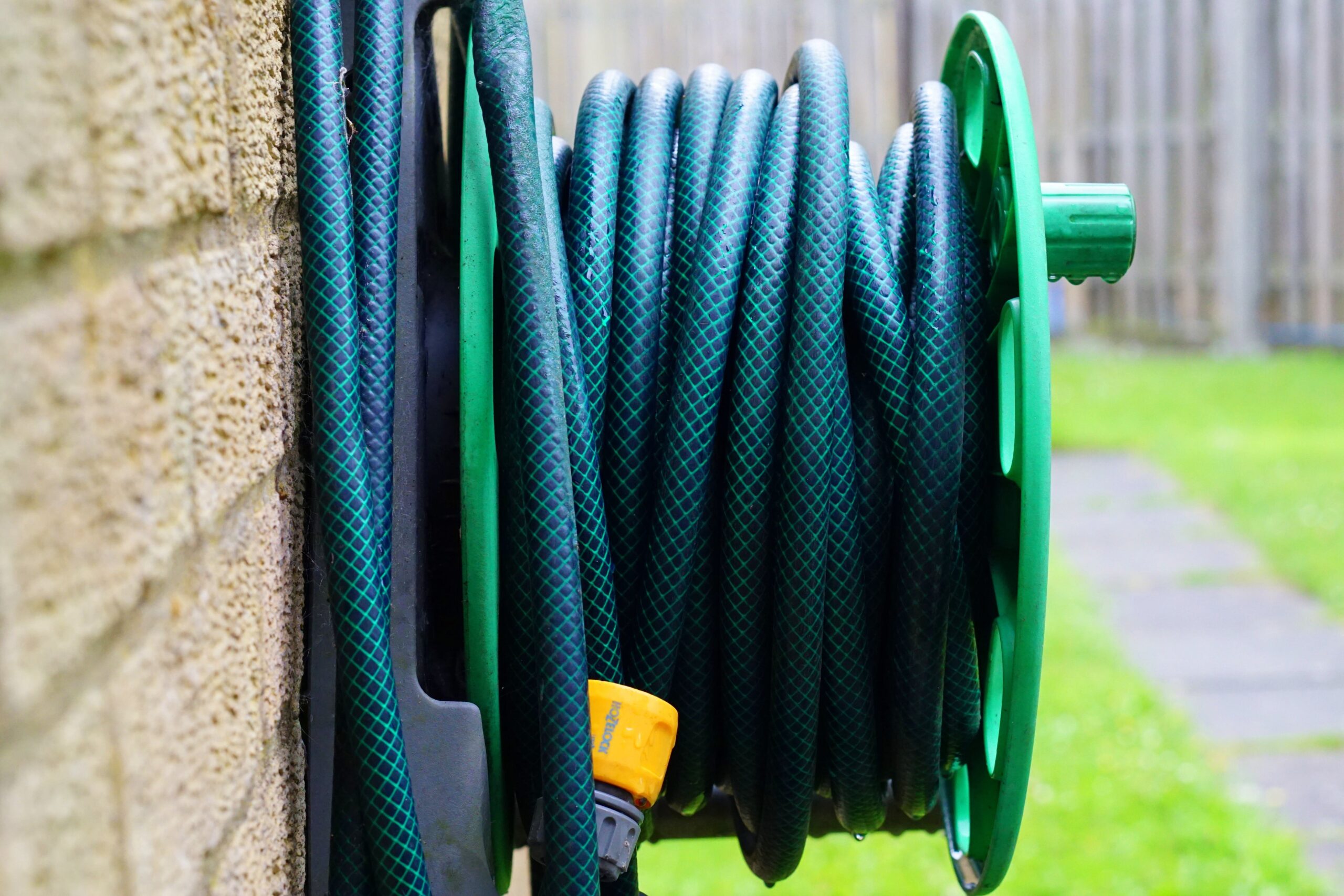
A LOT of summertime water is used on home landscapes. According to the Washington Department of Ecology, up to 70% of a household’s summertime water is used outdoors. There are great ways to design your landscape to minimize its need for summertime water.
Emphasize Drought Tolerant Plants in your Landscape
There are many great looking landscaping plants that need less summertime water. Our Pacific northwest natives and many non-native plants adapted to Mediterranean climates will thrive with little water once they are established. When you are looking to add or replace plants, choosing plants that inherently need less water is a great and simple way to conserve. You can find lists for drought tolerant plants suited for the Pacific Northwest in many garden guides and websites, and you can search for drought tolerant plants within the Great Plant Picks website https://www.greatplantpicks.org/ mentioned in the Picking Great Plants section.
But know that all plants need regular water for the first few years while they are getting established. And drought tolerant plants may still need some summertime water to look their best.
Just add Mulch!
Coarse woody mulch reduces soil evaporation. It also improves the health of your soil, reduces weed seed germination, and prevents soil erosion. Coarse woody mulch does so much good for your landscape that it’s covered in greater detail in the mulch section (webpage?) LINK Look there to learn more about the best kinds of mulch to use, what to avoid, and how to apply mulch.
To learn more about the value of woodchip mulch look to chapter 4 of WSU CAHNRs Landscape Maintenance: Healthy Plants while Minimizing Pesticides video. “Chapter 4, The Power of Woodchip Mulch” https://youtu.be/f-jPeqLyS8E?si=4pqGqrdxF1m7GT5e&t=1418
Group Plants according to their Water Needs – Hydrozone
Consider plants’ needs for summertime water and group plants that need more water together. This allows you to avoid wasting water on plants that don’t need as much. Having thirstier plants grouped together can also save you time as you’ll be able to water them in batches.
Don’t Overwater your Landscape
More is not better. Too much water can drown plant roots (plants that are adapted to wet soils are, of course, an exception) and it can encourage fungal diseases. Excess water can also contribute to water pollution. When water runs off yards and down storm drains, it carries fertilizers, pesticides, and other pollutants into our local rivers, lakes, and marine waters.
Consider Reducing the Size of your Lawn or Eliminating it Entirely
A lot of summertime water goes to keeping our lawns green. If the only time you spend on your lawn is when you mow, weed, or water it, you could consider reducing its size or eliminating it altogether. Replacing it with easy care, pest resistant, and drought tolerant plants and protecting the soil with a good layer of coarse woody mulch will require less water and less regular maintenance once your new landscape plants are well established. WSU Horticulturalist Dr. Linda Chalker-Scott provides some guidance on how to convert lawn areas to landscape plantings in her web article, “How to get rid of your lawn.” https://gardenprofessors.com/how-to-get-rid-of-your-lawn/
Conserve Water and Reduce Runoff with Better Watering Techniques and Tools
By some estimates nearly half of that water is wasted due to inefficient watering techniques or systems which means that learning better watering techniques and tools can help a lot.
Water Infrequently but Deeply
Deep infrequent watering encourages plants to grow deeper roots into soil that won’t dry out as quickly in the summertime. This principle applies to both landscape plants and lawns. How deeply you want to water will depend on how deeply the plant in question will grow its roots. Roots of lawn grasses grow about 6 inches deep, shrub roots grow around 12 to 18 inches deep, and the feeder roots of trees are generally found in the top 18 to 20 inches soil.
You can use a long screwdriver or a soil probing rod to check how deeply moisture has penetrated the soil. The probe will slide easily through moist soil but will be very difficult to push through dry soil.
When you water less frequently you’ll want to water more slowly. Water can run off dry soil at first. But once the surface becomes moistened, the water will soak in.
Water in the Morning
Morning is the best time to water – you lose less to evaporation from sun and wind. Also, if you’re using overhead watering such as a sprinkler or a hose, watering in the morning gives foliage a chance to dry out which can help prevent fungal diseases on plants that are more vulnerable to them.
Drip Irrigation and Hose Timers
Drip irrigation systems are great for many applications – you get less evaporation and less runoff, and you also get fewer weeds because you are applying water only to the plants that need it and not coincidentally watering weeds or weed seeds in a larger area. Once you get these systems set up, they can also save you time.
There are some drawbacks though. Drip irrigation systems are more expensive than just a hose or a sprinkler, and they do require setup and maintenance. This WSU publication on drip irrigation covers many of the details: Drip Irrigation for the Yard and Garden https://pubs.extension.wsu.edu/drip-irrigation-for-the-yard-and-garden
Soaker hoses are a pretty straightforward low-tech form of drip irrigation but there are still a few things to know in order to use them properly. You’ll want to use a backflow preventer and a pressure regulator, keep the soaker hose level, and use the appropriate spacing for your soil type. This fact sheet from the Saving Water Partnership goes over proper installation and maintenance: Soaker Hoses, Good for your Garden, Your Wallet, and Our Environment https://www.savingwater.org/wp-content/uploads/Soaker-Hoses.pdf
Check the Whatcom Water Alliance’s website for rebates on water saving devices for your yard and garden. https://www.whatcomwateralliance.org/rebates
Maintain your Irrigation System
A leak in your faucet, hose, or underground sprinkler system can waste a lot of water over the course of a year. Repair any visible leaks in your hoses and faucets and regularly check for leaks and for broken or clogged heads in your sprinkler system.
Use Better Lawn Watering Tools and Techniques
The lawn is the thirstiest feature of most yards so learning smart lawn watering techniques can make a big difference. There are many ways that you can conserve water and keep your lawn healthy.
- Water in the morning when you’ll lose less to evaporation and wind.
- Water deeply and less frequently. This encourages deeper, more drought resistant roots in grasses just as it does in landscape plants.
- Don’t overwater your lawn. Most lawns only need about an inch of water per week in the summer to stay green – that’s rain plus irrigation. You can figure out how much water your sprinkler delivers per hour by placing several straight sided containers such as tuna or cat food cans in the sprinkler zone for a period of time (for example ½ hour). Measure how much water is in each of the containers. Calculate the average, then divide by the amount of time you ran the sprinkler. Use this information to learn approximately how long you’ll need to run the sprinkler to deliver 1 inch of water.
- Consider letting your lawn go dormant for the summer. But make sure to give your grass 1 inch of water each rainless month. It’s important to know that a dormant lawn won’t hold up well to heavy foot traffic. If you use your lawn for sports, or you have active children, or dogs, you may be better served by regularly watering your lawn during the summer.
Use a Water Saving Technology
Consider investing in an irrigation controller that responds to soil moisture levels or weather conditions. You can learn more about these WaterSense labeled controllers on the EPA’s website here: https://www.epa.gov/watersense/watersense-labeled-controllers And you may be able to get a rebate for purchasing one from the Whatcom Water Alliance https://www.whatcomwateralliance.org/rebates or from the City of Bellingham https://cob.org/services/environment/conservation/indoor-water-conservation/rebate
Rain Barrels and Rain Gardens offer Additional Ways to Reduce Runoff
To learn more about Rain Barrels:
- Rain Barrel Setup: Skagit County: Washington State University. (n.d.). Retrieved November 17, 2020, from https://extension.wsu.edu/skagit/mg/rain-barrel/
- Construction Plans – Rain Barrel Setup: Skagit County: Washington State University. https://s3.wp.wsu.edu/uploads/sites/2073/2014/03/RainBarrelSetup.pdf
To learn more about Rain Gardens check out the many excellent resources here:
- WSU Extension Rain Gardens https://extension.wsu.edu/raingarden/
- And if you are interested in an online raingarden training you can find one here which is offered for free: Online Rain Garden training course for Non-Professionals (for Property Owners and LID Enthusiasts) https://www.wastormwatercenter.org/low-impact-development/lid-training-programs/
Use Mulch
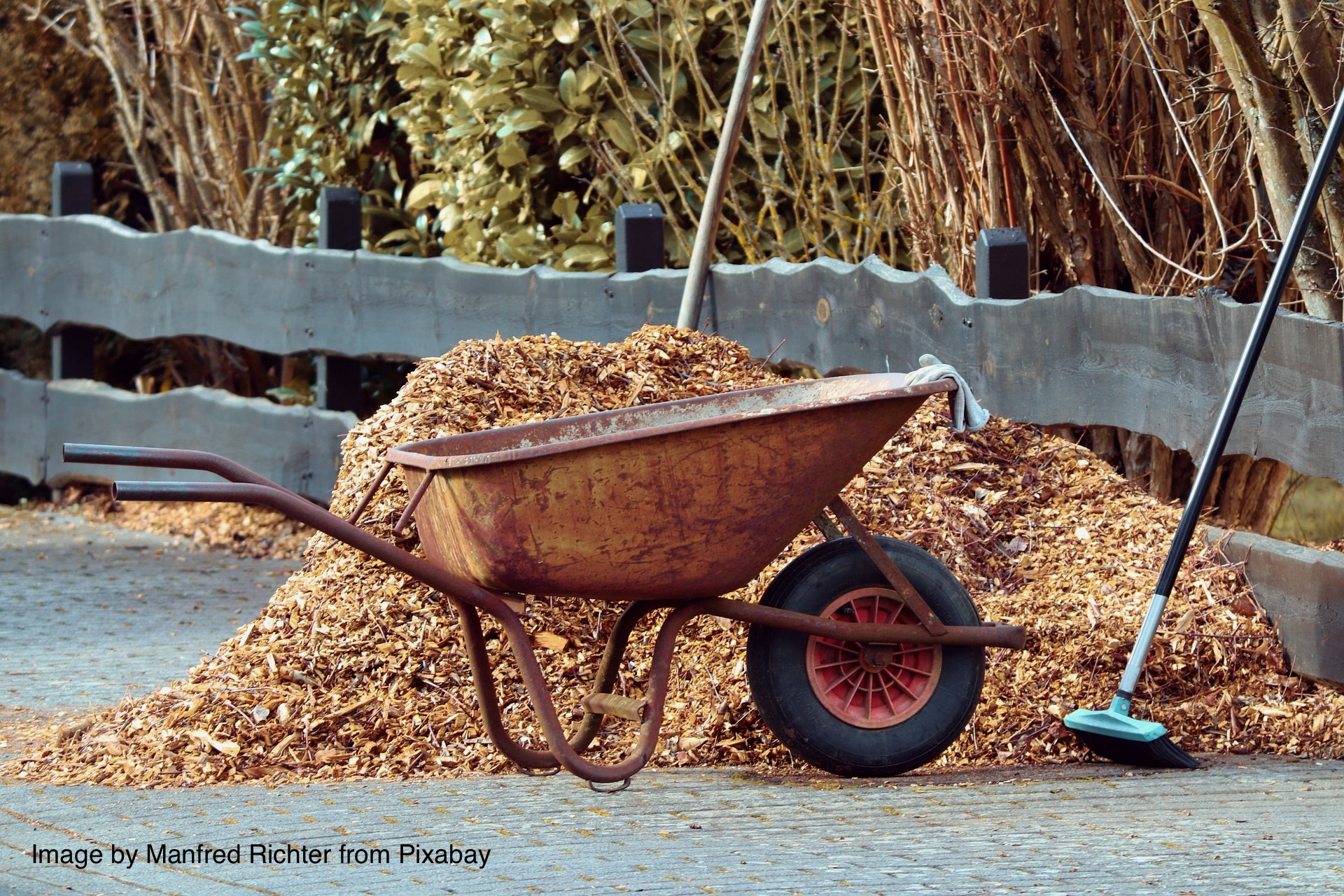
Coarse woody mulch is a home landscape workhorse. It does great things in the garden – it absorbs moisture in an irrigated landscape and slowly releases it to the soil, it reduces summertime soil temperatures, and it inhibits weed seed germination. It also acts as a slow-release fertilizer that slowly feeds the soil and improves soil health.
To learn more about the value of woodchip mulch look to chapter 4 of WSU CAHNRS Landscape Maintenance: Healthy Plants while Minimizing Pesticides video. “Chapter 4, The Power of Woodchip Mulch” https://youtu.be/f-jPeqLyS8E?si=4pqGqrdxF1m7GT5e&t=1418
There are many kinds of mulch to choose from.
Woody Mulch
Arborist chips – the chipped bark, branches, and leaves or needles from arborists’ tree trimming work – are an excellent choice. According to WSU Horticulturalist Dr. Linda Chalker-Scott, they are the best choice for building healthy soil and they can be very economical. Other coarse wood chips are also a great choice.
Some gardening publications and websites assert that cedar chips will leach allelopathic chemicals that will harm your plants but there’s no evidence to support that claim. Cedar chips will not harm your existing plants. You can learn more about arborist chips and other types of mulch in the WSU Publication Using Arborist Wood Chips as a Landscape Mulch https://pubs.extension.wsu.edu/using-arborist-wood-chips-as-a-landscape-mulch-home-garden-series.
If you live in an area that is prone to wildfire then you’ll want to choose a non-flammable mulch material for the zones immediately adjacent to your home and structures. LINK to wildfire risk info?
Bark and Landscape Cloth
Bark is a popular choice but it’s not the best choice. Finer bark mulch tends to become compacted creating a barrier that keeps water out of the soil. The waxy nature of bark enhances its water shedding properties and bark is also more flammable than woodchips (See the wildfire risk info below). If you do use bark, know that coarsely textured bark (larger chunks) will work better than finely shredded bark. Sawdust is another fine textured material that is prone to becoming compacted and burns more readily than woodchips.
Landscape cloth is also a popular product. People like to use this as a weed barrier. It does help to block the light and keep existing weed seeds from germinating. But unless the cloth is covered with several inches of coarse mulch, new weed seeds that blow into the area will readily germinate on top and will grow their roots down into the cloth, becoming even more difficult to pull out. Landscape cloth also interferes with gas exchange in the soil which is very important for root health. Landscape cloth is not recommended.
Look for Low-Phosphorus
If you are in the Lake Whatcom Watershed or any place where nutrient pollution is a concern for local lakes or streams, look for mulches that are known to be low in phosphorus. You can find a list of “Approved low-phosphorus mulch, compost, and soil products” https://drive.google.com/file/d/145eGRsPLq8TInvsu60f6BppyfQyZWByo/view on the Lake Whatcom Management Program’s website.
Rocky Mulch
Organic mulches are excellent for many reasons but they’re not going to work well in every situation. For example, on hillsides you might be better off with using a rocky mulch which will be heavier and less likely to wash downhill.
Wildfire Considerations
Rocky mulches are also the least flammable mulch option. If your property is at risk of wildfire, you will want to ensure that the 5-foot perimeter around your built structures is very ignition resistant. You can learn more about protecting your property from wildfire on the National Fire Protection Association’s Preparing Homes for Wildfire webpages https://www.nfpa.org/Education-and-Research/Wildfire/Preparing-homes-for-wildfire. You’ll also find many great resources to help you make your property wildfire resistant at the Whatcom Conservation District’s website https://www.whatcomcd.org/wildfire
How to Apply Mulch
Apply a 4–6 inch Layer of Coarse Woody Mulch
A shallow layer can actually encourage weeds because it will enhance soil moisture, but it won’t prevent weed seed germination. Starting with a 4–6-inch layer of arborist chips or coarse woody mulch provides the most benefits. It will quickly shrink down to a 3 to 4 inch layers, and then slowly break down over time. As it breaks down, woody mulch will slowly supply nutrients and condition the soil. Montor the depth of your mulch layer over time and plan to add more periodically so that you can maintain a 3 to 4 inch layer.
Fall and Winter are Great Seasons to Apply Mulch
You can apply mulch at any time, but November through February is often a great time to apply it because the garden tends to be more open and easier to work in at that time. Plus, it’s cooler weather for doing heavy work!
Other Mulch Tips
A pitchfork is a great tool for working with coarse woody mulch.
Organic mulches like soil, leaves, and grass clippings, contain nutrients which can be good for your landscape but bad for our lakes, streams and marine waters. If it gets onto sidewalks, driveways, or other hard surfaces, sweep it up and put it somewhere back into the garden where it can provide benefits and where it’s not going to be swept by the rain into our streams, lakes, and marine waters.
Keep Learning about Sustainable Landscaping
If you’d like more guidance and hands-on exercises that will help you create a custom landscaping plan for your site, WSU Whatcom County Extension offers facilitated Gardening Green courses. You can learn more about Gardening Green courses here: https://extension.wsu.edu/whatcom/nr/gardening-green/
Cheryl Lovato Niles
Water Resources Educator
clniles@wsu.edu
(360) 778-5812
Learn more:
creativecommons.org/licenses/by/3.0/
Gardening Green Courses
WSU Whatcom County Extension offers Gardening Green courses to help you learn how to make your yard lower maintenance, healthier, and beautiful.